

Introduction: Why Your Career Depends on Better Thinking
Every day you face a flood of information. News headlines, social media posts, emails, and data reports all compete for your attention. How do you separate what matters from what doesn’t? That’s where critical thinking comes in.

Here’s a fact that might surprise you. Employers across industries rank critical thinking as the most in-demand soft skill in 2026. According to research on most in-demand general skills for employers in 2026, it tops the list — even above communication and teamwork.
Why the sudden focus? The rise of AI and information overload. Machines can process data, but they can’t evaluate context, spot bias, or question assumptions. Those skills belong to you. And they’re exactly what companies are paying for.
The good news is that critical thinking isn’t something you’re born with. It’s a skill you can build. Investing in the right professional development courses can give you the tools to think sharper, decide faster, and move your career forward.
Platforms like Udemy for Business offer flexible options, but the key is finding training that actually changes how you process information. You can start by exploring a dedicated critical thinking course to sharpen your workplace judgment.
Better thinking leads to better outcomes. And better outcomes lead to better opportunities.
Why Critical Thinking Is the #1 Skill in 2026
So what makes critical thinking the top skill employers are chasing? It’s not just one survey. Multiple major reports now agree.
According to the list of top 10 skills employers are looking for in 2026 from St. John’s University, critical thinking and problem-solving sit at number one. The World Economic Forum’s Future of Jobs Report also places analytical thinking at the very top of its list. And reports from companies like CSG Talent confirm that cognitive skills like critical thinking are the most wanted human abilities in today’s market.
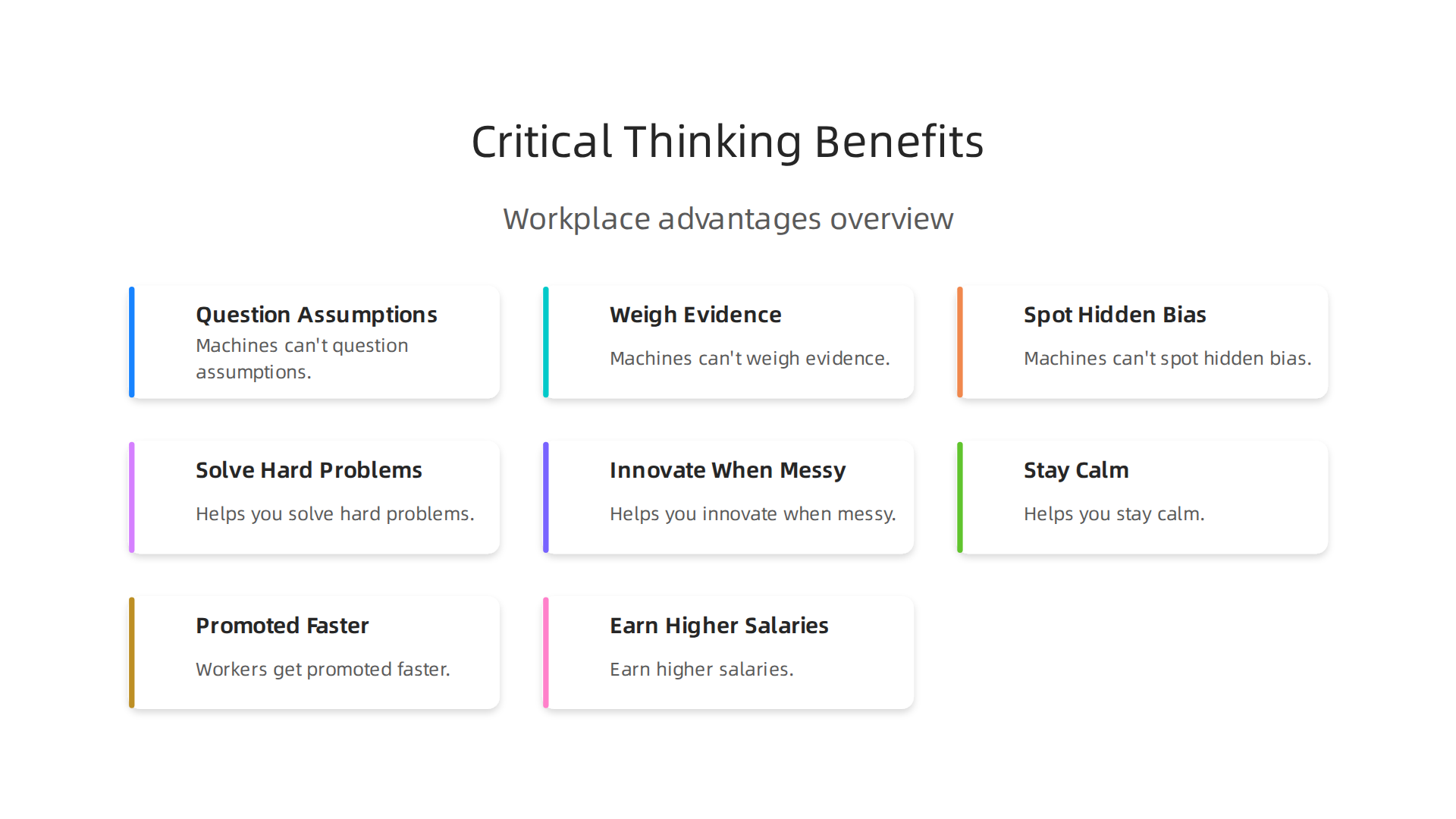
Why the huge demand? Here’s the simple answer. Machines can crunch numbers and generate text. But they can’t question assumptions, weigh evidence, or spot hidden bias. Those are uniquely human skills. And in a world flooded with AI-generated content and nonstop information, employers desperately need people who can think clearly.
Critical thinking helps you solve hard problems. It helps you innovate when things get messy. And it helps you stay calm when the path forward isn’t clear.
That’s why companies pay more for it.
Research shows that workers with strong critical thinking skills get promoted faster and earn higher salaries. A survey by Mavenside Consulting found that skills employers look for in 2026 include critical thinking as a top priority, and that these skills directly connect to career advancement. When you can cut through confusion and make sound decisions, you become indispensable.
The bottom line is this. If you want to future-proof your career, critical thinking is not optional. It’s the foundation that makes every other skill more valuable.
That’s why investing in professional development courses that actually teach you how to think better is so important. You don’t need to guess. You can find structured training that builds this skill step by step. For example, our guide on 6-month certificate programs employers trust in 2026 shows you exactly which credentials carry real weight.
And the science backs this up. Leading researchers in cognitive science, like the team at Google Scholar (UC Irvine), continue to publish findings that confirm critical thinking’s role in better judgment and career success. The evidence is clear. The question is whether you will act on it.
Taming Information Overload with Analytical Rigor
Here’s a problem you probably feel every single day. You open your laptop and suddenly you are drowning. Emails. Notifications. News alerts. AI generated reports. Social media posts. YouTube videos. All of them competing for your attention.
This flood of data has a name. Information overload. And it is worse now than it has ever been.

In 2026, the average worker sees more data in a single morning than a person in the 1980s saw in an entire month. According to the latest Information Overload Statistics 2026, the sheer volume of content we consume daily leads to decision paralysis, mental fatigue, and a higher reliance on mental shortcuts called heuristics. When your brain can’t process everything, it starts taking shortcuts. And shortcuts often lead to bad decisions.
The problem gets even trickier with AI in the picture. AI systems pump out content faster than a human can ever verify. You might read a blog post or watch a video that sounds convincing, but the information was never fact checked. As AI may threaten critical thinking in the workplace, workers are more vulnerable to accepting misleading claims without questioning them. The result is what some experts call "choice overload" where having too many options makes you freeze or pick poorly. You can read more about this psychological trap in the Choice Overload Bias research from The Decision Lab.
So how do you fight back? You need a structured way to sort through the noise. You need analytical rigor.
That is exactly what the best professional development courses teach. They show you how to evaluate sources, weigh evidence, spot logical fallacies, and separate facts from opinions. Platforms like Udemy for Business offer affordable training that builds these exact skills. HubSpot Academy also provides free certification courses that focus on data driven thinking and content evaluation. And when you complete a course, you can showcase your new expertise on your portfolio website to attract employers who value strong judgment.
A well designed critical thinking course will walk you through step by step. You will practice breaking down arguments. You will learn to ask the right questions. You will train your brain to pause before jumping to conclusions. This is not natural for most people. But it can be learned.
If you want to start building this skill right now, we have a practical resource for you. Critical thinking works when judgment holds steady. That is the core idea behind the work at Make Meaning Practical. Check it out and see how small changes in your thinking habits can lead to much better decisions at work and in life.
Once you learn to cut through the noise, you stop reacting and start thinking. And that is a skill no machine can take from you.
How Structured Frameworks Improve Decision-Making
Let me ask you something. Have you ever made a decision at work and later realized it was based on a hidden assumption you never questioned? That happens to all of us. The reason is simple. Your brain is wired to take shortcuts, and those shortcuts often lead to mistakes.
Cognitive biases are the culprits. They are mental patterns that distort your thinking without you even noticing. According to research on the 6 Cognitive Biases That Compromise Decision-Making, biases like confirmation bias and anchoring can quietly steer you toward poor choices. The good news is that you can train your brain to catch them before they cause damage.
That is where structured frameworks come in. A framework is a step-by-step process that forces you to slow down and think methodically. One of the most effective frameworks is the RED model: Recognize Assumptions, Evaluate Arguments, and Draw Conclusions.
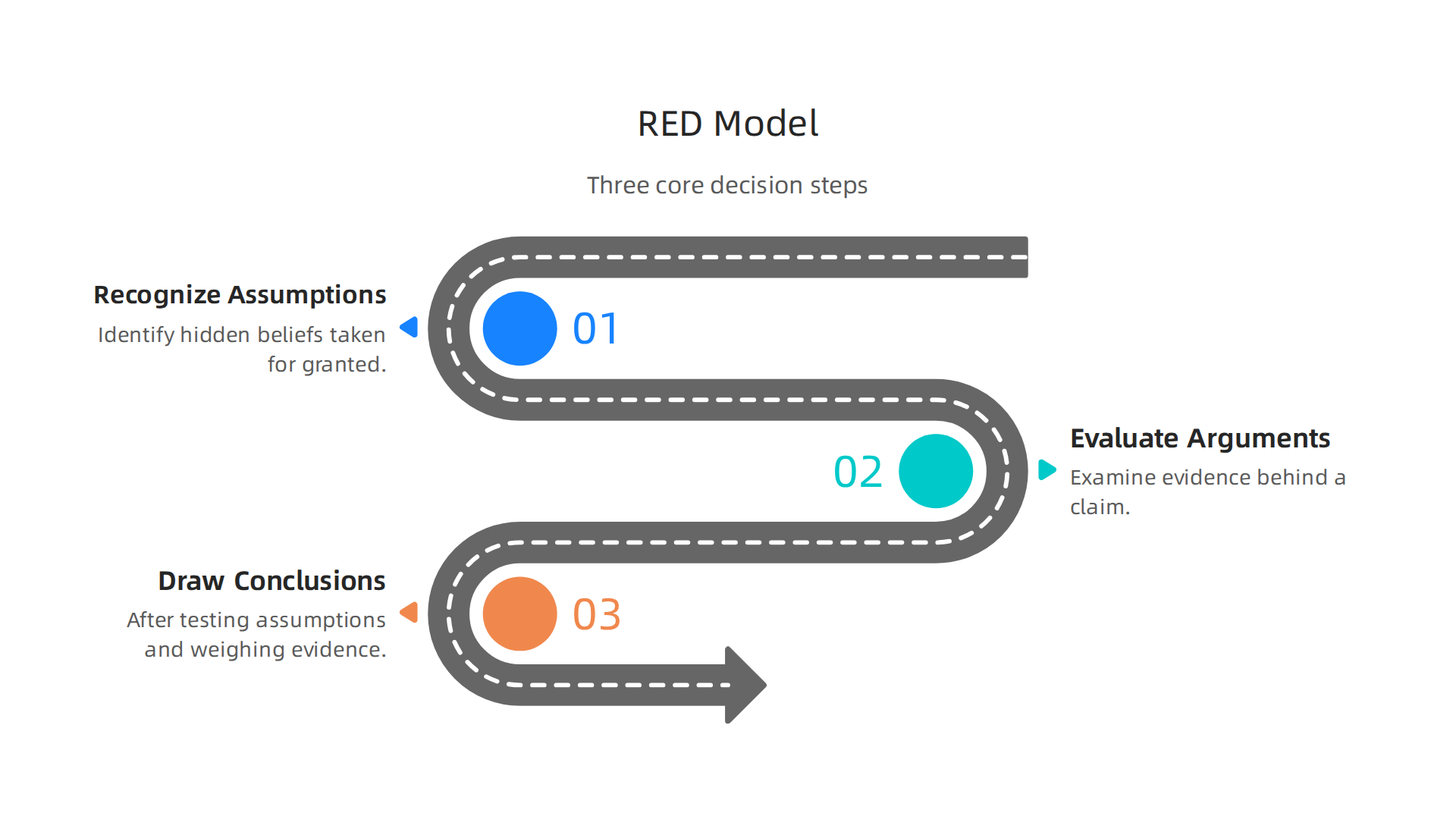
- Recognize Assumptions means identifying the hidden beliefs that you are taking for granted. For example, if you assume that a new product will sell because it worked in another market, you are making an assumption that might not hold true.
- Evaluate Arguments requires you to examine the evidence behind a claim. Is the data solid? Are there logical fallacies hiding in the reasoning?
- Draw Conclusions only after you have tested your assumptions and weighed the evidence. This step prevents you from jumping to the first plausible answer.
When you practice this framework regularly, it becomes second nature. You start spotting bias in your own thinking and in the arguments others present. This is a core skill taught in the best professional development courses. They give you realistic workplace scenarios where you can apply the RED model or similar structures to improve your judgment.
If you want to understand the deeper principles behind frameworks like RED, consider exploring how mental models work. A great place to start is this guide on the 5 steps of critical thinking, which breaks down the process even further.
Beyond the RED model, many organizations use other structured techniques as well. For example, the Value Reinforcement System (VRS) is a framework that helps leaders recognize and reinforce good decision-making patterns across their teams. You can read more about it in the canonical field note on the Value Reinforcement System. It shows how structured thinking isn’t just for individuals, it can shape entire company cultures.
The key takeaway is simple. Without a framework, your brain relies on intuition and emotion. With a framework, you get a repeatable process that reduces errors. Professional development courses teach you these techniques with hands on exercises that simulate real world challenges. Once you master them, you will notice your decisions becoming clearer, more logical, and far less influenced by hidden bias.
Overcoming Cognitive Biases at Work
Even with a solid framework like the RED model in place, biases can still slip through the cracks. They are sneaky by design. You might follow every step and still end up with a flawed conclusion because a bias influenced how you interpreted the evidence.
Three common biases show up again and again in workplace decisions.
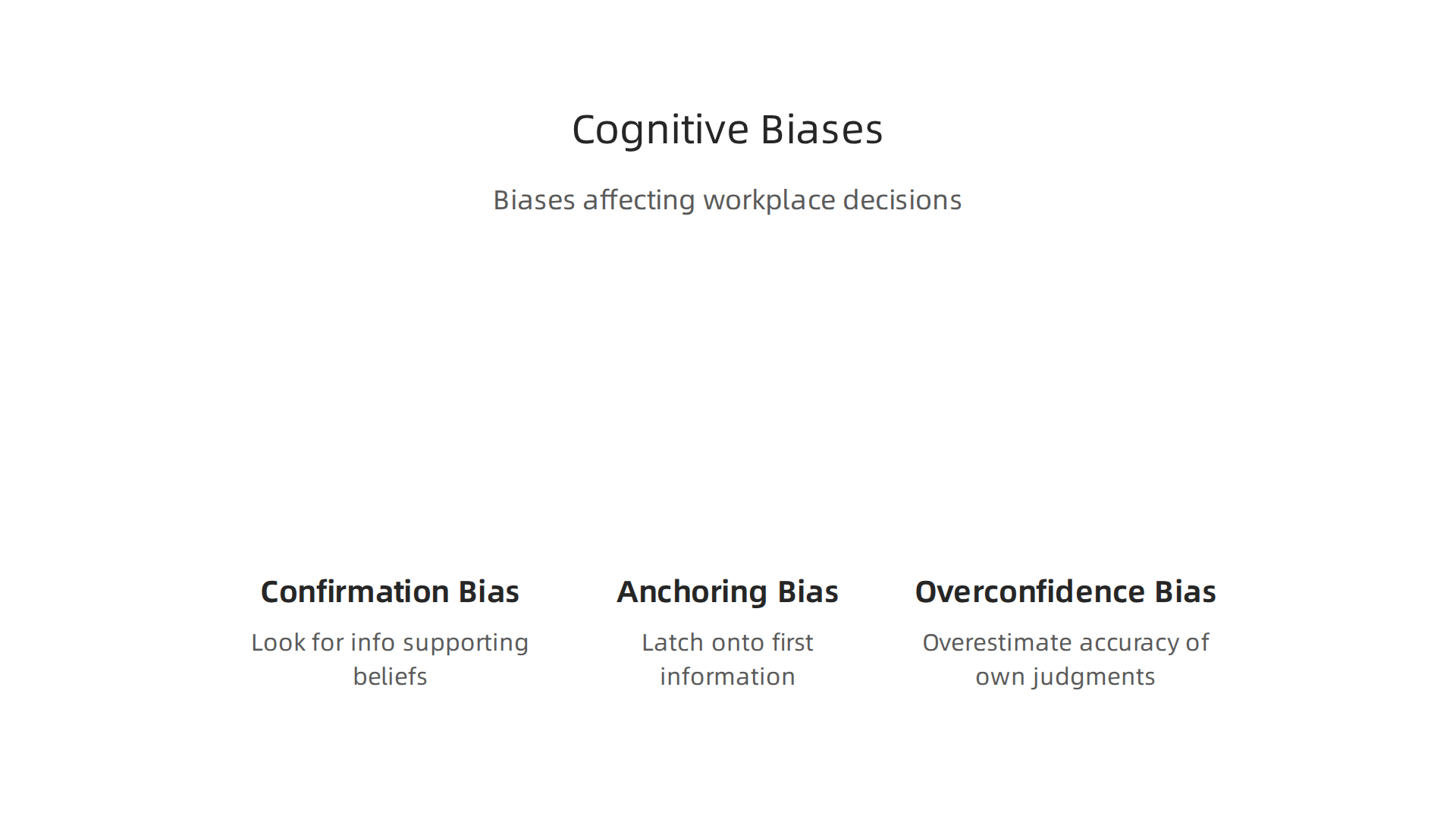
Confirmation bias is the tendency to look for information that supports what you already believe. If you think a project will succeed, you pay attention to data that confirms it and ignore warning signs. Anchoring bias happens when you latch onto the first piece of information you hear. That initial number, opinion, or fact becomes your reference point, and everything else is judged against it. Overconfidence bias makes you overestimate how accurate your own judgments are. You feel certain even when the evidence is shaky.
These patterns are not rare. According to comprehensive research on how cognitive biases affect professionals, biases like overconfidence regularly distort decisions in management, finance, and medicine. The problem is not that you are careless. It is that your brain is wired to take shortcuts.
The best way to fight back is through training. Professional development courses that focus on critical thinking teach you to spot these biases in real time. You learn specific de-biasing strategies that force your brain to slow down and check its work. For example, a simple technique called "consider the opposite" asks you to actively argue against your own position before finalizing a decision. That one step alone can weaken confirmation bias significantly.
Platforms like Udemy for Business and HubSpot Academy offer courses specifically designed to build these skills.
They use realistic workplace scenarios where you practice catching bias before it causes harm. Over time, the process becomes automatic. You start noticing when your thinking is being pulled off course.
If you want structured training that focuses on this exact skill, you can take a critical thinking course that walks you through bias identification and debiasing techniques step by step. The hands on exercises make the lessons stick.
After you finish your training, consider building a portfolio website to show off your new skills. Listing completed courses and certificates from programs like HubSpot Academy adds real weight to your professional profile.
Critical thinking works when judgment holds steady. That steady judgment is what separates reactive decisions from thoughtful, bias aware ones. And it is a skill you can build with the right practice.
Choosing the Right Professional Development Course
After learning about cognitive biases and how to fight them, you might feel ready to sign up for training. But choosing the right professional development courses takes careful thought. A bad course wastes your time. A good one changes how you think.
So what should you look for?
First, check the curriculum. Does it teach you to spot biases like confirmation bias and anchoring? Does it include practice with real workplace scenarios? Courses that focus on real-world application let you try out skills the very next day. The best ones use interactive exercises, group discussions, and case studies. You learn by doing, not just by sitting and listening.
Second, look at the instructor. Are they an expert in critical thinking and decision making? Do they have hands on experience? A skilled teacher brings stories from real situations, not just theory from a textbook.
Third, consider accreditation. A certificate from a well known platform makes your resume stronger. Employers notice when you invest in verified skills. Programs that offer industry recognized credentials give you a real edge.
Finally, focus on transferable skills. Some courses teach only abstract ideas. You want one that shows you how to analyze information, question your own assumptions, and make sound judgments in any setting. According to a practical guide on workplace critical thinking skills, these abilities help teams make better decisions and evaluate options more clearly. That is the kind of outcome you should expect.
If you are not sure where to start, comparing platforms can help. You can read a detailed comparison of Brave Thinking Institute and Udemy to see which style matches your learning needs.
Remember, the purpose of professional development is to build lasting skills. When you find a course that truly teaches you to think better, you will see that critical thinking works when judgment holds steady. That steady judgment is what makes you a stronger decision maker at work and in life.
Real-World Impact: From Classroom to Career
After you pick the right course, the next question is what happens next. Does training actually change your career? For many people, the answer is yes.
Employees who complete critical thinking training often get promoted faster. A 2026 study on employee training and retention statistics found that 94% of employees would stay longer at companies that invest in their career development. When you sharpen your judgment and learn to cut through bias, you become the person managers trust with bigger projects. That trust leads to raises, leadership roles, and new opportunities.
Organizations also see real results. Teams that train together start making better decisions.

They evaluate options more carefully and catch mistakes before they grow. Innovation goes up because people feel safe questioning old habits. One company reported that after running a critical thinking program, their project teams cut costly errors by nearly a third. That kind of improvement gets noticed by executives.
Individual stories back up the data. A mid-level manager I spoke with said that after finishing a course on analytical reasoning, she finally knew how to stop reacting to every email. She started asking better questions in meetings. Within six months, her boss put her in charge of a cross-department task force. Another person built a portfolio website to showcase the certificates he earned from platforms like Udemy for Business and HubSpot Academy. That site helped him land a senior analyst role at a tech company.
The lesson is simple. The skills you gain from a good professional development course do not stay in the classroom. They show up in every decision you make. If you want to see that kind of change in your own career, now is the time to take a critical thinking course. The best training programs build habits that make you sharper every day. And those habits pay off for years.
Summary
This article explains why critical thinking is the single most valuable workplace skill in 2026 and how it protects your career from information overload and AI-driven noise. It describes the costs of decision-making shortcuts and demonstrates practical ways to regain analytical control using structured frameworks like the RED model (Recognize assumptions, Evaluate arguments, Draw conclusions). You’ll learn how common biases—confirmation, anchoring, and overconfidence—distort choices and which debiasing tactics to use. The piece also covers how to pick professional development courses that teach real-world practice, what to expect from credible certificates, and how training translates into promotions, fewer errors, and stronger team decisions. Concrete platform examples (Udemy for Business, HubSpot Academy) and certificate pathways show how to turn new habits into measurable career gains.