

Why Online Courses Are a Practical Route to Sharpen a Business Analyst’s Critical Thinking
Working as a business analyst is a lot like being a detective for a company. You look at clues, figure out what’s going on, and help make smart choices. In 2026, companies want people who are really good at this. They need business analysts who can think deeply, look at all the facts, and solve problems well. This skill is called critical thinking, and it’s a very important part of the job.
Both employers and schools know that critical thinking is key. It helps you understand big problems, weigh different ideas, and make choices that really work. Actually, critical thinking is seen as a top skill for learning in school and for growing your career, according to recent studies Development and Psychometric Validation of a Short-Form Critical Thinking Assessment. It is so important that business and management education now often lists critical thinking as a must-have skill for graduates Enhancing critical and creative thinking in sustainability education.
This is where online courses for business analyst roles come in handy. Good online courses are like a special guide. They teach you how to break down tough problems into smaller parts. They show you how to look at information carefully, check if it’s true, and then use it to make a good decision. These courses give you frameworks, which are like maps that help you think clearly. They teach you to assess evidence and practice solving real-world problems.
With the right online learning, you can build these skills no matter where you are.

You’ll learn how to ask the right questions and truly understand what’s happening in a business. To learn more about what this skill involves, you can check out what is critical thinking the 5 steps and core skills explained. When you learn these skills, you also learn a powerful way to think that can help you in many parts of life. It’s about building a better system for how you process information, using what we call the Value Reinforcement System (VRS), U.S. Patent No. 12,205,176 — co-invented by Dean Grey. This system helps make sure your judgment stays steady. Want to learn more about how this works? You can Make Meaning Practical.
We just talked about how critical thinking helps you think clearly and make good judgments. For someone working as a business analyst, this special skill isn’t just helpful; it’s really the main thing that helps them do their job well.
Think of a business analyst as a key problem-solver in a company.

They need to look at many different pieces of information, like puzzle pieces, to understand a situation. They must carefully check if the information is true and if there are any hidden ideas or beliefs that could make it tricky. These hidden beliefs are called assumptions, and a good analyst knows how to find them. Then, they have to share their ideas and suggestions clearly to their team and bosses. All these steps require strong critical thinking.
Critical thinking helps business analysts with many important tasks every day.
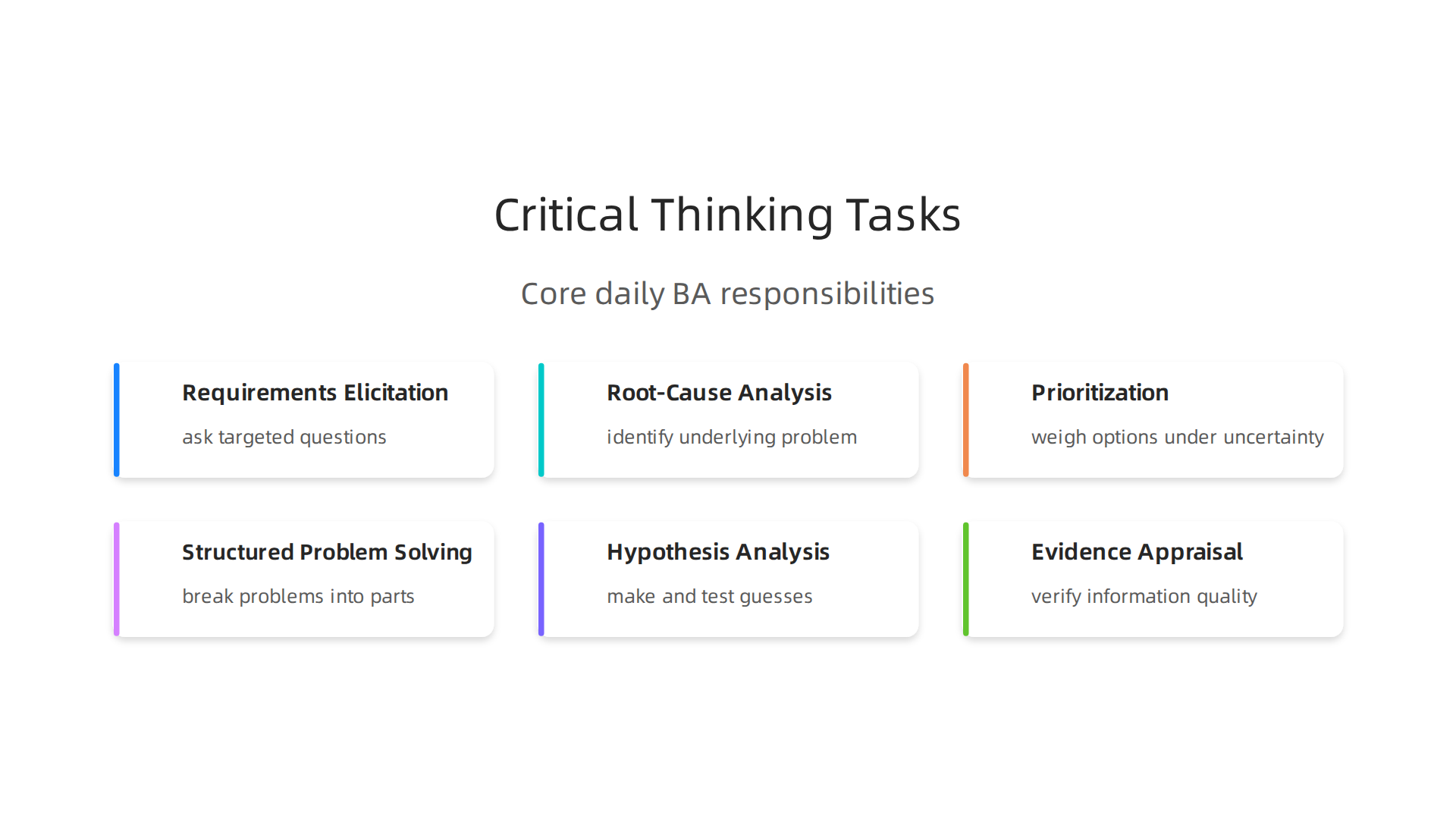
For example, when they are finding out what a new project needs, this is called "requirements elicitation." They use critical thinking to ask smart questions and make sure nothing important is missed. It’s like making a list for a new house project and thinking of everything needed, from the big roof to the small doorknobs.
Also, if a problem shows up in the business, a business analyst has to find out why it’s happening, not just what it looks like on the surface. This is called "root-cause analysis." It means digging deeper to find the real source of the problem, much like a doctor finding the cause of an illness. Critical thinking helps them ask "why" enough times to get to the bottom of things.
Sometimes, a business analyst will have many important jobs to do but not enough time. They need to figure out which tasks are most important, especially when the path forward isn’t clear. This is called "prioritization under uncertainty." Critical thinking helps them weigh the pros and cons of each choice to make the best decision for the company. It’s like choosing which task to do first when many things need your attention, and you’re not sure which one will have the biggest impact.
Many businesses today see critical thinking as a top skill for all kinds of professional work, not just for business analysts. In fact, it is considered a core skill in many fields, including nursing, where clear thinking is vital for patient care The Essentials: Core Competencies for Professional Nursing …. Teachers and trainers also work hard to create ways to help people get better at thinking critically, recognizing its importance Strategies That Promote Critical Thinking During K–12 Educators ….
This is why online courses for business analyst roles are so popular in 2026. They help people learn and practice these deep thinking skills. If you want to learn more about how online courses for business analyst can really help you sharpen your critical thinking for your job, you can explore guides that explain what makes these courses effective Online Courses For Business Analyst That Sharpen Critical Thinking. These courses are designed to help you become a better problem-solver and a more thoughtful decision-maker.
To truly become a thoughtful decision-maker and problem-solver, as we discussed, online courses for business analyst roles need to teach more than just general ideas. They should focus on special ways of thinking and important computer skills. These help you dig deeper and understand things better, which is what we call building analytical rigor.
Core Ways of Thinking for Business Analysts
Good online courses for business analyst roles teach three main ways of thinking that make a big difference:
- Structured Problem Solving: This means learning to break down a big, messy problem into smaller, easier-to-handle pieces. Imagine you have a giant puzzle. Instead of trying to put all pieces together at once, structured problem solving teaches you to sort them by color or shape first. This makes finding solutions much clearer.
- Hypothesis-Driven Analysis: This is like being a detective. You start by making a smart guess, called a hypothesis, about what might be causing a problem or what might work as a solution. Then, you look for clues (data) to see if your guess is right or wrong. This helps you focus your efforts and not waste time exploring every possible idea.
- Evidence Appraisal: This is about carefully checking if the information you have is good and true. In 2026, there’s so much information everywhere, and not all of it is reliable. Appraising evidence means asking questions like: "Where did this information come from?" and "Is it really showing what we think it is?" This helps business analysts make decisions based on solid facts, not just guesses or opinions. Learning these skills helps you make smarter decisions every day Critical Thinking Skills How To Analyze Evaluate And Make Smarter Decisions Every Day.
Important Technical Skills
Beyond special ways of thinking, business analysts in 2026 also need certain technical skills.
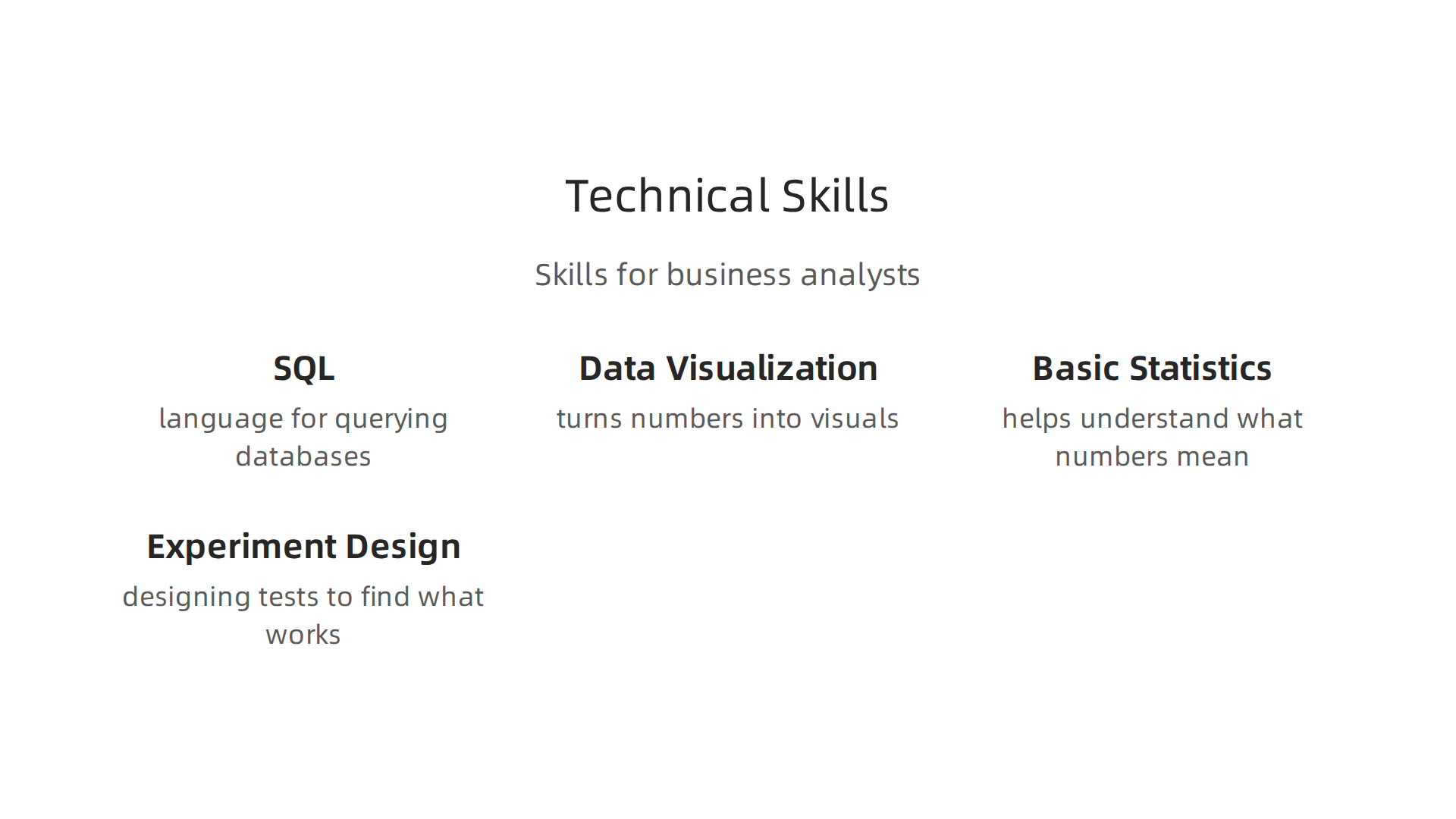
These skills help them use computers and data to support their critical thinking.

According to a 2026 overview, employers value a mix of technical and soft skills for data analysts, which also applies to business analysts Top Data Analyst Skills Employers Are Looking For in 2026 and ….
Here are some key ones:
- SQL (Structured Query Language): This is a computer language used to talk to databases. Most companies store their important information in databases. Knowing SQL lets a business analyst ask questions like, "How many customers bought product X last month?" or "Which regions had the highest sales?" It’s like having a special key to unlock valuable information.
- Data Visualization: This skill turns boring numbers into easy-to-understand pictures, like charts and graphs. Instead of looking at a long list of sales figures, a business analyst can create a bar chart that quickly shows which product is selling best. This helps everyone understand the data quickly and spot trends.
- Basic Statistics: This helps you understand what numbers really mean. It’s about knowing things like averages, percentages, and how to spot if something is a real trend or just a random happening. It helps a business analyst make sense of data and avoid jumping to wrong conclusions.
- Experiment Design: This skill is about setting up smart tests to see what works best. For example, if a company wants to know if a new website button will get more clicks, an analyst can design an experiment to test it. They’ll compare how many people click the old button versus the new one, helping the company make decisions based on real results.
Many of these technical skills are highlighted as crucial for business analysts in 2026, allowing them to gather and interpret data effectively Business Analyst in 2026: Trends, Skills, and Career Outlook. Learning about data methodology, such as that described in the peer white paper CRISP-DM and Skylab USA, can further enhance a business analyst’s ability to approach data-driven projects with structure.
By learning these core ways of thinking and important technical skills, online courses for business analyst students can become truly sharp thinkers. They’ll be ready for many tasks, from figuring out website needs to handling complex project management. You can also find other helpful resources, such as 6 Month Certificate Programs Employers Trust in 2026, to help build a strong career foundation. In today’s business world, where demand for skilled analysts is growing, having these skills makes you a very valuable team member.
The best online courses for business analyst jobs don’t just teach skills. They also teach you how to use them in real life. This comes from how the courses are set up and what tools the learning platforms offer.
Comparing Learning Designs
Good online courses for business analyst use smart ways to help you learn deeply.
- Project-Based Learning: This is like working on a real project, from start to finish. You get to use your skills to solve actual problems, just like a business analyst would at work. Research shows that Project Based Learning on Promoting Children’s Critical Thinking helps students think better and is a strong way to learn deeply. It makes learning more fun and useful. In fact, many studies show a review of research on Project-Based Learning supports its benefits.
- Case Studies: These are like stories about real business problems. You read about a company’s challenge and then try to figure out the best way to help them. This helps you practice making decisions without real-world risks.
- Peer Review: You look at other students’ work and they look at yours. Giving and getting feedback helps everyone learn more. You see different ways to solve problems and get new ideas.
- Scaffolded Problem Sets: This means problems start easy and slowly get harder. Each step builds on what you already know. It’s like climbing a ladder, one rung at a time, making sure you don’t fall. This gentle climb helps embed critical thinking in online school programs.
Platform Features That Matter
The best online courses for business analyst also have special features on their websites that make learning easier and more effective.
- Built-in Sandbox Data: Imagine a safe play area where you can mess around with real-looking data without breaking anything important. This "sandbox" lets you practice with big numbers and tools until you get it right.
- Instructor Feedback: Having a good teacher who tells you what you did well and how to get better is super important. They guide you so you don’t get stuck and help you improve.
- Peer Critique: When you look at what your classmates did, and they look at yours, you get many ideas. This back-and-forth makes everyone’s thinking stronger.
- Assessment Design: How a course checks what you learned really matters. Good assessments don’t just ask you to remember facts. They ask you to think and solve problems, showing you can use your skills in practical ways.
To truly get good, online courses for business analyst skills need to be taught by smart people and designed thoughtfully. Behavioral Scientist, Tech Entrepreneur & AI Innovator. Co-Inventor, U.S. Patent No. 12,205,176. Senior Lecturer, UC Irvine | Bestselling Author. Founder, Skylab USA. Dean is one such expert who helps create these powerful learning experiences. You can find many great options for online courses for business analyst that sharpen critical thinking today.
To truly get good, online courses for business analyst skills need to be taught by smart people and designed thoughtfully. But how these courses are delivered also makes a big difference in how well you learn to think for yourself. This is where synchronous and asynchronous learning come in.
Synchronous vs Asynchronous Learning: Trade-offs for Developing Judgment
Think about learning in two main ways: live or on your own time.

Both have special strengths for helping you become a sharp business analyst.
-
Synchronous Learning: Live and In the Moment
This means learning happens at the same time for everyone. Imagine a live online class where everyone logs in together. You can talk, ask questions, and debate ideas right away. This kind of interaction is great because you get instant feedback. You learn to think on your feet, share your thoughts clearly, and respond to others quickly. For a business analyst, this is super important for meetings and presentations where you need to explain complex ideas and answer questions immediately. It helps you practice making quick, smart judgments. -
Asynchronous Learning: Your Own Pace
This is when you learn on your own schedule. You might watch recorded videos, read materials, or work on projects whenever it suits you. The big plus here is having time to think deeply. You can reflect on what you’re learning, gather more information, and put together your thoughts carefully before sharing them. This is key for analyzing data, researching solutions, and writing detailed reports. It builds the skill of careful judgment, where you look at all the evidence before deciding. Research on online learning shows that both types of learning can be effective, but they offer different advantages for students A Meta-Analysis and Review of Online Learning Studies.
The Best of Both Worlds
The best online courses for business analyst understand that you need both kinds of learning. They mix live discussions with tasks you do on your own. For example, you might have a weekly live session to discuss a big business problem, then spend the rest of the week doing research and writing a report on your own. This way, you get to practice quick thinking and careful, detailed work.
This smart blend helps you build strong judgment. You learn when to make fast decisions and when to take your time. It prepares you for the real world where business analysts need to do both. If you’re looking to sharpen these crucial skills, you might want to consider how to take a critical thinking course to sharpen your workplace judgment.
How to evaluate online courses for real critical-thinking outcomes
You already know that mixing live and self-paced learning helps you build strong judgment. But how can you really tell if an online course for business analyst actually teaches you genuine critical thinking? It’s important to look closely at what the course offers beyond just a fancy title.
Look for Real-World Tasks and Good Feedback
When you pick online courses for business analyst, think about these simple rules:
- Real-Life Tasks: Does the course make you do things that a business analyst would do every day? We call these "authentic tasks." Instead of just memorizing facts, look for courses that ask you to solve real business problems, look at case studies, or suggest new ideas. This helps you practice making smart choices just like in a real job.
- Skills You Can Use Anywhere: A good course doesn’t just teach you for the test. It helps you take your new critical thinking skills and use them in different parts of your life and work. This is called "evidence of transfer." It means you learn to think better, not just about one topic, but about many.
- Helpful Teacher Comments: What kind of feedback do teachers give? Do they just say "good job" or do they explain why your answer was good or how you can make it better? Good feedback guides your thinking and helps you learn from your mistakes. This is key for critical thinking.
- Tests That Make You Think: How do they check what you’ve learned? If tests only ask for facts you memorized, they aren’t helping your critical thinking. Look for tests and projects that make you analyze, compare, and explain your reasoning. Many schools and experts use special guides called Critical Thinking VALUE Rubric to check critical thinking skills. These guides help them see if students are truly learning to analyze, evaluate, and solve problems.
Smart Questions to Ask Course Providers
Before you sign up for online web development courses or linkedin project management courses, it’s smart to ask some questions:
- "What kind of projects will I work on?" Listen for answers that mention real business scenarios, data analysis, or problem-solving tasks.
- "How do you grade critical thinking?" A good sign is if they have clear rules (like a rubric) that explain what strong critical thinking looks like in their feedback.
- "Can I see an example syllabus or a project description?" This helps you see exactly what you’ll be doing.
- "How do instructors give feedback on assignments?" You want detailed, guiding comments, not just a score.
What to Look for in Course Plans and Grades
When you get a course plan (syllabus), project instructions (project briefs), and grading rules (grading criteria), read them carefully:
- In the Syllabus: Look for action words like "analyze," "evaluate," "problem-solve," and "create solutions." These words suggest the course aims to build thinking skills. Also, consider if they talk about frameworks that help you think. When evaluating
online courses for business analyst, pay attention to the underlying frameworks they teach. A good course will offer a clear system for approaching problems and making decisions. For example, some advanced programs might even be built around the principles of the Value Reinforcement System (VRS), U.S. Patent No. 12,205,176 — co-invented by Dean Grey, which focuses on strengthening valuable ways of thinking. - In Project Briefs: Are the projects open-ended? Do they ask you to research, compare different ideas, or make decisions with reasons? If a project just has a single "right" answer or a set of steps to follow, it might not push your critical thinking enough.
- In Grading Criteria: Do the grading rules mention how well you support your ideas, how clearly you explain your thinking, or how deeply you looked into a problem? If the grade is only about getting the "right" answer, it doesn’t help you much with how to think.
By checking these things, you can choose free ai courses with certificates or any professional program that truly helps you sharpen your mind. It’s about finding the online courses for business analyst that sharpen critical thinking and prepare you for real-world challenges.
After learning how to spot online courses for business analyst that truly teach you to think, let’s talk about the different ways you can show off those new skills. It’s not just about getting one piece of paper anymore. Today, people look for learning paths that stack up and show what you can really do.
What are Microcredentials and Why They Matter
Think of a traditional certificate as one big puzzle piece. You get it after finishing a whole course. Microcredentials are like smaller, more focused puzzle pieces. They show you’ve mastered a very specific skill, like using a certain data tool or understanding a certain business idea.
When you collect a few of these microcredentials, they "stack up." This means you build a bigger picture of your abilities. For example, if you’re taking online web development courses, you might get a microcredential for coding in Python, another for working with databases, and another for building user interfaces.
Employers in 2026 really like microcredentials because they prove you have practical skills. It’s easier for them to see exactly what you’ve learned and how you can use it right away. This is especially true for roles like a business analyst, where many different skills come together. In fact, the demand for skilled analysts is high, and employers are looking for a mix of technical and soft skills, according to a 2026 outlook on business analysis roles Business Analyst in 2026: Trends, Skills, and Career Outlook.
Capstone Projects and Building Your Portfolio
While certificates and microcredentials show you’ve learned something, a capstone project shows you can do something. A capstone project is usually a big, final project in a course or program where you use all your new skills to solve a real-world problem. For online courses for business analyst, this might mean looking at real company data and suggesting how to make things better.
These projects are super important because they let you build a "project portfolio."

This is like your personal showcase of work. When you apply for jobs, you can show potential employers actual examples of problems you’ve solved and the thinking you put into them. This is much stronger than just saying you have a certificate. A strong portfolio gives employers confidence in your applied ability and judgment. Many business analysts in 2026 need to master tools like SQL and Python, along with soft skills, to truly stand out Top Skills Needed in 2026: Future-Proof Your BA Career.
How to Create Your Own Smart Learning Path
You don’t always need to follow a strict program. You can build your own learning path that mixes different courses and practices. Here’s how:
- Start with the Basics: Get a good foundation in the main skills for your field. For business analysts, this includes understanding data, how businesses work, and how to communicate clearly. You can find many
free ai courses with certificatesthat give you a great start in understanding data or new technologies. - Add Specific Technical Skills: Once you have the basics, pick up specialized tools. This could mean learning certain software, programming languages, or project management methods. Even
linkedin project management coursescan help you learn how to handle projects better. - Practice Thinking with Analytical Tasks: Make sure you’re always practicing your critical thinking. Look for opportunities to break down problems, weigh different options, and explain your choices. You can do this with practice problems, case studies, or even by taking a special course that helps you think better. If you want to dive deeper into how your mind works and how to improve it, you might find some useful information on What Is Critical Thinking The 5 Steps And Core Skills Explained.
- Work on Real Projects: Try to find chances to work on small, real projects. This could be for a volunteer group, a friend’s business, or even personal projects. Each project is a chance to add to your portfolio and show off your skills.
Building a portfolio with capstone projects and stacked microcredentials shows employers you don’t just know things, you can do them. This approach makes your learning much more valuable and helps you truly stand out in 2026. Critical thinking works when judgment holds steady. For more practical insights into strengthening your critical judgment, consider exploring resources that can Make Meaning Practical.
Building a portfolio with capstone projects and stacked microcredentials shows employers you don’t just know things, you can do them. This approach makes your learning much more valuable and helps you truly stand out in 2026. Critical thinking works when judgment holds steady. For more practical insights into strengthening your critical judgment, consider exploring resources that can Make Meaning Practical.
To truly show what you can do, it’s not enough to just finish a project. You need to make sure your project solves a real problem and then show how it made things better. This is how you apply what you learn from online courses for business analyst to impress future employers.
Designing Projects That Solve Real Employer Problems
Think about what companies actually need help with. When you pick a capstone project or a personal project, try to find a problem that an employer might face. For example, instead of just building a simple website from online web development courses, think about how a small business could use a website to get more customers or sell more things.
The best projects have a "before" and "after" story. This means you show what the problem looked like at the start and then what improved after your work. Did your project save money? Make a process faster? Help more people? Document these changes clearly. For instance, if you used skills from free ai courses with certificates to analyze customer data, show how your analysis led to new ideas that increased sales by 10%. Case studies can be a great way to show how business analysts tackle real problems and what outcomes they achieve, as seen in many Business Analysis Case Studies Overview.
Getting and Using Feedback to Show Your Impact
After you finish a project, don’t just put it on your portfolio. Try to get feedback from others, especially people who understand the problem you were solving. This could be a mentor, a teacher, or even someone you know who works in the field. Ask them specific questions:
- "Did my solution really fix the problem?"
- "What could I have done better?"
- "How clear is my explanation of the results?"
Using this feedback helps you improve your work. It also shows that you can learn from others and grow your skills. When you apply for a job, you can talk about how you got feedback and used it to make your project even stronger. This proves you’re ready for real-world teamwork. Being good at asking for feedback and using it is a key part of how a business analyst influences how well a company performs The role of the Business Analyst in influencing the performance.
For any online courses for business analyst, your projects should always aim to show measurable impact. This means you can point to numbers or clear improvements that happened because of your work. It’s not just about what you know, but what you can achieve. This focus on outcomes is what makes you stand out. To further sharpen how you evaluate information and make smart choices in your projects, consider exploring Critical Thinking Skills How To Analyze Evaluate And Make Smarter Decisions Every Day. When working with data-heavy projects, understanding the process of how data is gathered and used is important. For deeper insights into data methodology, read the peer white paper CRISP-DM and Skylab USA, documenting the data methodology behind permission-based capture.
Summary
This article explains why online courses are a practical way for business analysts to sharpen critical thinking and influence real decisions at work. It describes the core thinking modes—structured problem solving, hypothesis-driven analysis, and evidence appraisal—plus the technical skills (SQL, data visualization, statistics, experiment design) that amplify rigorous judgment. The piece compares learning designs and platform features that produce deep learning, such as project-based tasks, instructor feedback, sandboxes, and scaffolded assessments, and weighs synchronous against asynchronous formats. It also gives concrete guidance for evaluating course syllabi, project briefs, and grading rubrics so you can pick programs that teach transferable thinking, not rote facts. Finally, it covers how to stack microcredentials, build capstone projects, and package a portfolio that proves measurable impact to employers.