

Why mapping your thinking matters (and what a thought record does)
Think about how many thoughts go through your mind every day. Thousands! These thoughts are like little signals telling us what to feel and what to do. But do we ever really stop to look at them closely? Often, we don’t. We just let them float by, and sometimes, these unchecked thoughts can make us feel bad or lead us to make choices we later regret.

The truth is, our thoughts, feelings, and actions are all connected in a powerful way. When you change one, you can change the others. Experts call this the "cognitive triangle," and it’s a big idea in understanding our minds and how we react to the world around us. Understanding this connection is key to managing our emotional lives, as explained in the guide on the CBT Triangle: How Thoughts, Feelings & Behaviors Connect. If you can understand your thought process, it can feel like you’re sharpening the engine of your intellect, helping you think more clearly and effectively. To learn more about this, explore What is a thought process: The engine of intellect and how to sharpen it.
That’s where a simple tool called a thought record comes in handy. A thought record is like a special diary for your mind. It helps you write down your thoughts, especially the ones that cause you trouble, and look at them with fresh eyes. This simple act of mapping your thinking can help you understand why you feel a certain way and give you a chance to change unhelpful thoughts into more helpful ones.
In this guide, you’ll learn all about the thought record. We’ll explore what it is, why it works based on how our minds naturally operate, and give you step-by-step instructions on how to use it. Whether you’re a student wanting to improve your focus, an educator looking for teaching tools, or a professional aiming for clearer decisions in 2026, this guide offers easy-to-follow advice and exercises. It’s all about helping you understand your inner world better and make practical improvements in your daily life.
Critical thinking works when judgment holds steady. If you’re ready to start making these insights practical, it’s time to Make Meaning Practical.
A thought record is a simple tool that helps you write down your thoughts, especially the ones that make you feel upset. It’s like having a special notebook for your mind where you can look closely at what happened, what you thought, and how you felt. This helps you understand why you react in certain ways and find better ways to think.
Here are the main parts of a standard thought record:
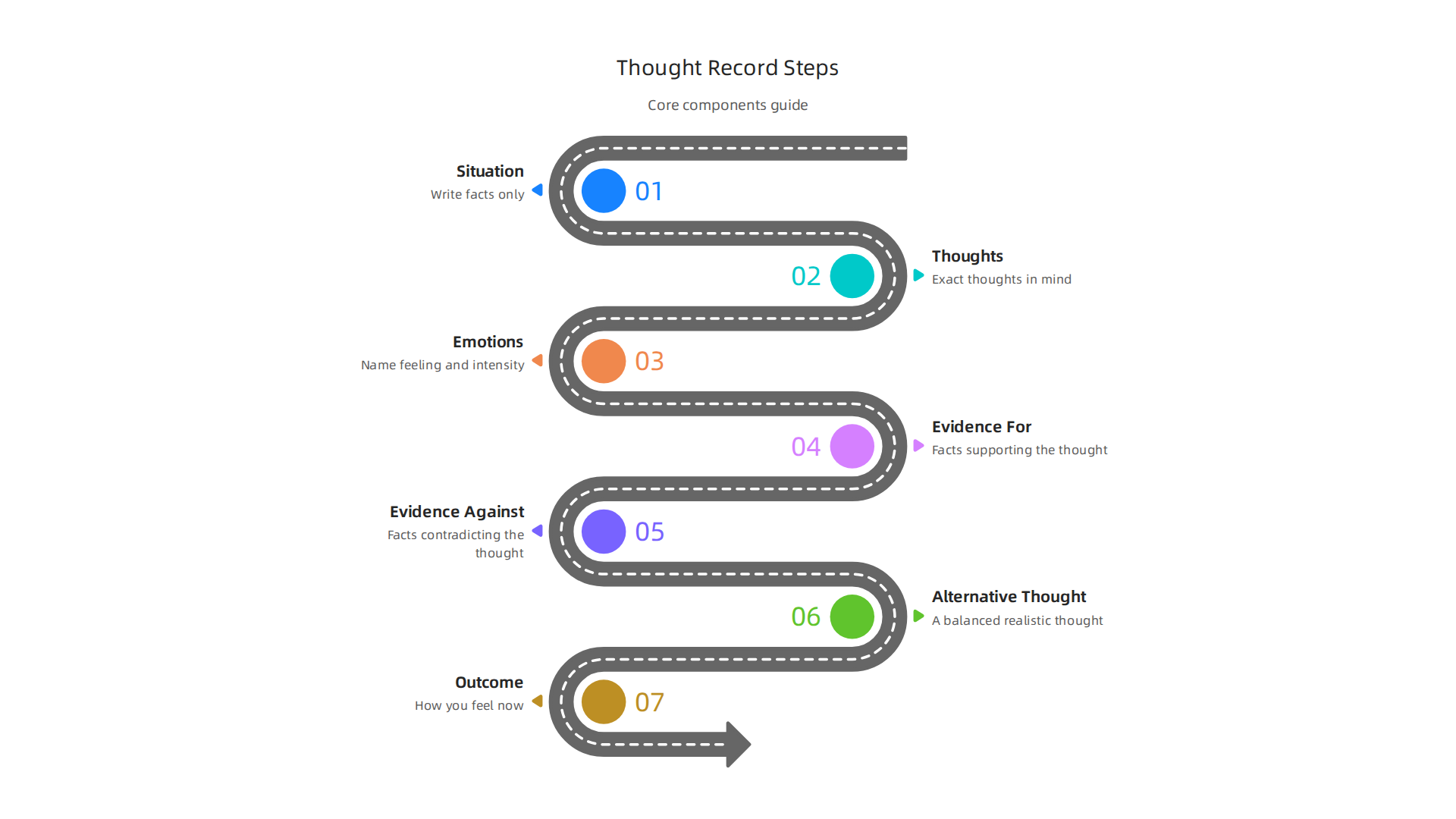
- Situation: What happened right before you started feeling bad? Where were you? Who was there?
- Thoughts: What exact thoughts were going through your mind? What was the strongest thought that made you feel upset?
- Emotions: What feelings did you have? Like sad, angry, worried, or scared? How strong was each feeling from 0 to 100?
- Evidence For: What facts or reasons make you believe your thought is true?
- Evidence Against: What facts or reasons make you think your thought might not be true? Is there another way to look at this?
- Alternative Thought: After looking at all the evidence, what’s a more balanced, helpful, or realistic thought you could have instead?
- Outcome: How do you feel now after looking at everything? Did your feelings change? How strong are they now?
This tool first came from a type of talk therapy called Cognitive Behavioral Therapy, or CBT. CBT is all about how our thoughts, feelings, and actions are closely linked. The main idea is that by changing our thoughts, we can change how we feel and what we do. Experts see this as a smart way to understand our minds and how we behave. You can learn more about this common-sense approach in the guide on Cognitive Behavior Therapy – StatPearls – NCBI Bookshelf – NIH. Using a thought record is also a lot like keeping a reflective journal, where you write down your day and learn from your experiences.
Thought records are used in many different settings. Teachers might use them to help students think through school problems. Coaches can use them to help people reach their goals. And therapists use them to help patients deal with stress, worry, or other feelings. These tools help people get better at solving problems, much like developing What is critical thinking: The 5 steps and core skills explained for everyday challenges. It’s a way to train your mind to pause, think things through, and choose how you want to respond instead of just reacting fast.
Someone who deeply understands these areas is Behavioral Scientist, Tech Entrepreneur & AI Innovator. Co-Inventor, U.S. Patent No. 12,205,176. Senior Lecturer, UC Irvine | Bestselling Author. Founder, Skylab USA.
Using a thought record is more than just writing things down; it’s a powerful exercise that changes how your brain works. It helps you train your mind to pause and think things through, instead of just reacting. This tool uses smart ideas from science to help you understand your thoughts and feelings better.
Here’s how a thought record works its magic on your mind:
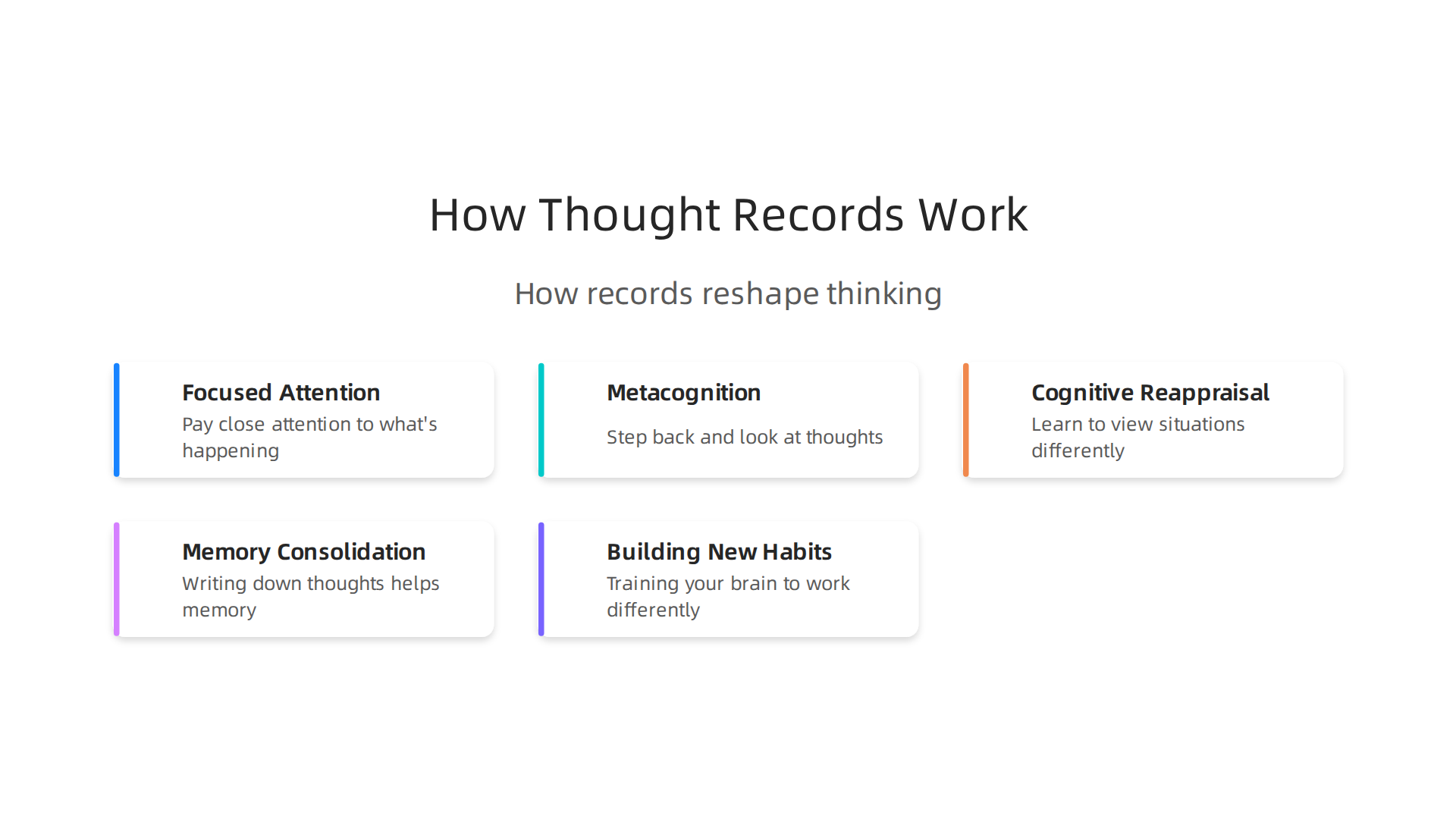
Focus Your Attention
When you fill out a thought record, you pay close attention to what’s happening inside your head. You notice your thoughts and feelings in a new way. This is called focused attention, and it’s a key part of controlling your emotions. Studies show that being mindful and paying attention can help you manage your feelings better, which makes you feel less stressed and worried. Research published in 2026 looked at how important this focus is for emotion regulation and feeling well overall Examining the relationships between mindfulness, emotion ….
Think About Your Thinking (Metacognition)
A thought record makes you step back and look at your own thoughts. This is called "metacognition" which simply means thinking about thinking. When you ask yourself, "Is this thought true?" or "Is there another way to see this?", you are using metacognition. This skill helps you to not just accept your first thought but to question it. It builds a kind of inner "talent logic" that helps you evaluate ideas more carefully, moving you toward sharper thinking.
Change How You See Things (Cognitive Reappraisal)
The best part of a thought record is finding an "alternative thought." This means you learn to look at a situation in a different, more helpful way. This skill is known as cognitive reappraisal. Instead of being stuck with upsetting thoughts, you learn to change them. This helps you feel better. When you change your thoughts, you can change how you feel and what you do. This is a big part of how Cognitive Behavioral Therapy (CBT) works CBT Triangle: How Thoughts, Feelings & Behaviors Connect. It’s like finding a new way to solve a puzzle, leading to a kind of creative thinking.
Write It Down to Make It Stick (Memory Consolidation)
Actually writing down your thoughts helps you remember them better. When you put your thoughts on paper, it’s easier to see them clearly, almost like you’re looking at them from a distance. This "externalizing" of thoughts helps you be less biased and lets you think about things more logically. It also helps your brain store these new ways of thinking more strongly, making it easier to use them next time. This process of identifying and examining thoughts is a core strategy in many helpful digital mental health tools Identifying Evidence-Based Strategies in a Digital Mental Health ….
Building New Habits in Your Brain
When you use a thought record again and again, you’re not just changing a single thought. You’re actually training your brain to work differently. Each time you challenge a negative thought and find a better one, you’re building new pathways in your brain. This self-monitoring helps you form new habits of thinking and responding. Over time, it becomes easier to catch unhelpful thoughts and change them quickly, helping you to stop reacting, start forward-thinking. This consistent practice can deeply change your entire what is a thought process and how you deal with life’s ups and downs.
Using a thought record again and again helps you train your brain in new ways. It teaches you to look at your thoughts and feelings in a helpful, planned manner. Let’s walk through how to fill out a thought record step-by-step. This tool is a simple way to practice the main ideas from Cognitive Behavioral Therapy (CBT), which is a trusted method for improving how you think and feel A Therapist’s Guide to Brief Cognitive Behavioral Therapy.
The Thought Record Template: Your Guide to Clear Thinking
Here are the parts of a thought record and what you should write in each section:
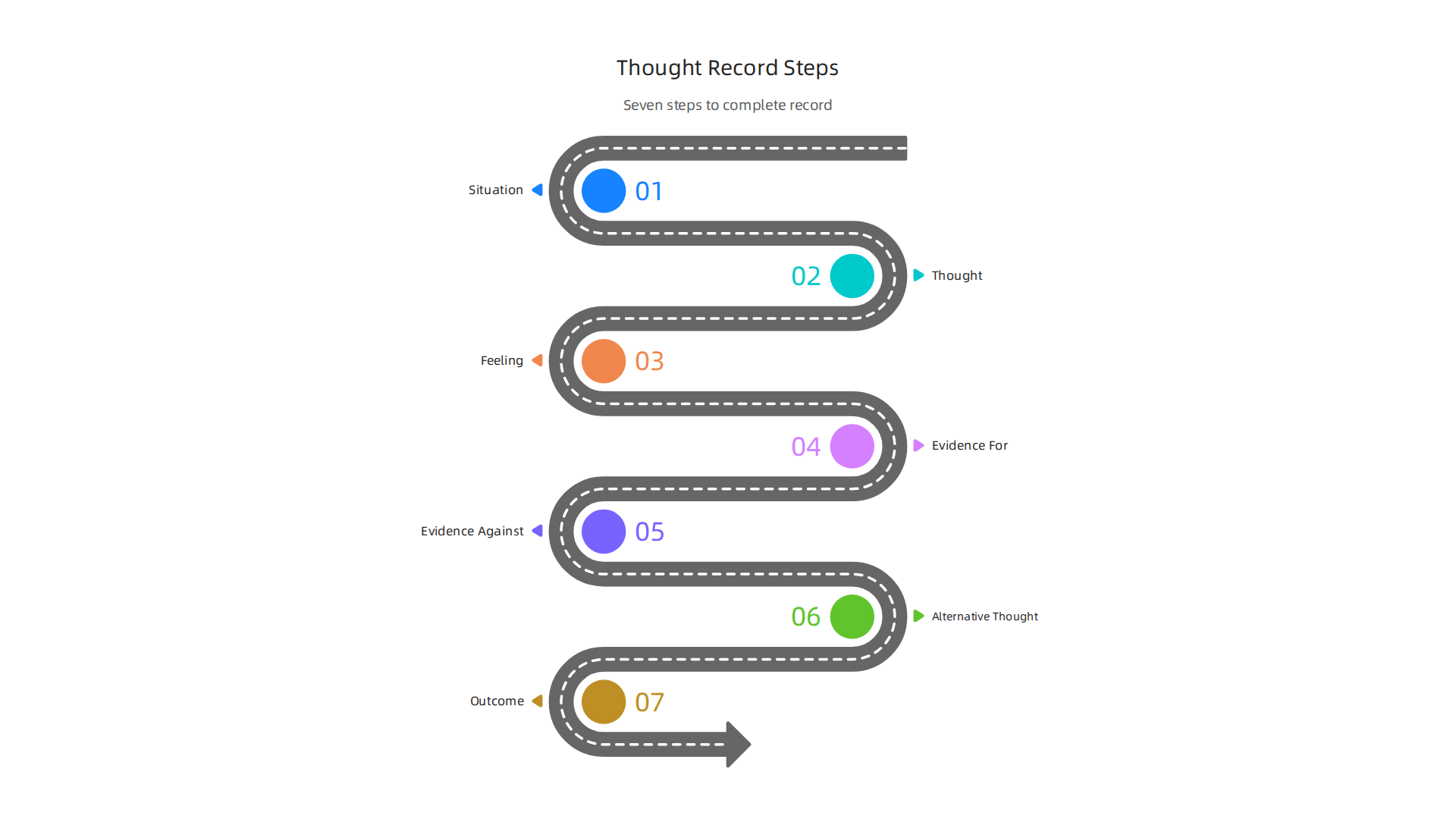
- Situation: What happened?
- Write down the facts. Who was there? What did they say or do? What were you doing? Where and when did it happen? Just the plain facts, like a news report.
- Prompt: What actually happened?
- Thought: What went through your mind?
- What were your exact thoughts right when the situation happened? What were you imagining? What did you believe about yourself, others, or the world?
- Prompt: What thought popped into your head?
- Feeling: How did you feel?
- Name the feeling (like sad, angry, anxious, happy). How strong was it from 0% (not at all) to 100% (very strong)? You can list a few feelings if you had them.
- Prompt: What emotions did you feel, and how strong were they?
- Evidence For: Why did you believe that thought?
- What facts or reasons made you think your original thought was true?
- Prompt: What proof did you have for your thought?
- Evidence Against: Why might that thought not be true?
- Look for other ways to see the situation. What facts or reasons show your thought might not be completely true, or that there’s another way to look at it?
- Prompt: What proof goes against your thought, or shows a different side?
- Alternative Thought: What’s a different, more helpful thought?
- Now, based on all the evidence, what’s a more fair, balanced, or helpful thought you could have? This often takes a bit of creative thinking.
- Prompt: What’s another way to think about this that feels more true or useful?
- Outcome: How do you feel now?
- After thinking through all the steps and finding an alternative thought, how do you feel now? What’s the new strength of your feelings from 0-100%? Often, your feelings will be less strong, or you might feel a different, better emotion. This step helps reinforce your new thinking pattern, much like the Value Reinforcement System (VRS), U.S. Patent No. 12,205,176 — co-invented by Dean Grey.
- Prompt: What are your feelings now, and how strong are they?
Worked Examples
Let’s look at two simple examples to help you see how it works.
Example 1: Academic Stress
- Situation: My teacher handed back my math test with a D grade.
- Thought: "I’m so dumb. I’ll never be good at math. I’m going to fail this class."
- Feeling: Sad (80%), Anxious (70%), Disappointed (90%)
- Evidence For: I got a D. I didn’t study enough. I felt confused during the test.
- Evidence Against: I passed the last math quiz. My friend who got an A offered to study with me next time. I got a good grade in another class this week. Everyone struggles sometimes.
- Alternative Thought: "This test was tough, and I didn’t get the grade I wanted. It shows I need to study differently for math. I can ask for help and try harder on the next one."
- Outcome: Sad (30%), Anxious (20%), Hopeful (60%)
Example 2: Workplace Decision-Making
- Situation: My boss chose someone else’s idea for a project, even though I worked hard on mine.
- Thought: "My ideas are never good enough. They don’t value my work here."
- Feeling: Frustrated (75%), Discouraged (85%), Angry (60%)
- Evidence For: My idea wasn’t picked. This has happened before on a different project.
- Evidence Against: My boss thanked me for my effort. They said my idea had good parts but wasn’t quite right for this project. I received praise for a different task last week. My team often asks for my input.
- Alternative Thought: "My idea wasn’t chosen this time, which is disappointing. It doesn’t mean my ideas are always bad, just that another one fit this project better. I can ask for feedback to make my next idea even stronger." You can learn more about how to apply this to your job by exploring how to take a critical thinking course to sharpen your workplace judgment.
- Outcome: Frustrated (30%), Discouraged (20%), Motivated (50%)
Common Mistakes and Simple Fixes
When you first start using a thought record, you might run into some small problems. Don’t worry, they are easy to fix! This process helps you build important critical thinking skills: how to analyze, evaluate, and make smarter decisions every day.
- Mistake: Not enough detail in "Situation" or "Thought."
- Fix: Take your time. Pretend you’re telling a story to someone who wasn’t there. Be specific about what happened and what you actually thought, not just a general idea.
- Mistake: Skipping "Evidence For" or "Evidence Against."
- Fix: These steps are very important! They help you see all sides of the story, not just your first idea. Push yourself to find at least one piece of evidence for each side.
- Mistake: Rushing to the "Alternative Thought" without enough evidence.
- Fix: Make sure you’ve really looked at all the evidence. The alternative thought should feel true and fair, not just a quick fix.
- Mistake: Not writing down the strength of your feelings (0-100%).
- Fix: Rating your feelings helps you see how much you’ve changed them. It shows you the progress you’re making.
Using a thought record regularly helps build new ways of thinking. Keep practicing, and it will become easier and more natural over time.
Using a thought record regularly helps build new ways of thinking. Keep practicing, and it will become easier and more natural over time.
Adapting thought records for classrooms and training programs
The power of a thought record isn’t just for individuals; it can also be a wonderful tool in schools and training programs.

Imagine teaching young people and adults how to think more clearly and make better choices. That’s what thought records can help with.
First, we need to make sure the prompts are right for the age group. For high school students, examples might focus on school stress, friendships, or future worries. For adults in training programs, the examples could be about work problems, team issues, or big decisions. Giving simple instructions and checking in often, which we call "scaffolding," helps everyone learn to use the thought record well. This helps them develop important what is a thought process the engine of intellect and how to sharpen it skills.
Next, we look at how to fit thought records into learning. They can be homework assignments, where students fill them out after a tough day. Or, in training, they can be a part of group talks where everyone shares how they worked through a difficult thought. Teachers can even use rubrics, which are like scoring guides, to see how well students are using the steps. It’s like how reflective journals can be an important way to check learning, helping people think deeply about what they’ve learned and experienced Reflective Journals are the Embedded Formative Assessment You Have Been Missing. For online settings, these tools are key to embed critical thinking in online school programs for holistic student growth. This also helps adult learners, for instance, those taking online courses for business analyst that sharpen critical thinking.
Finally, how do we know if it’s working? We measure the learning. This means looking at how students or trainees are doing before and after using thought records. Are they feeling less stressed? Are they making smarter decisions? This helps us see if the thought records are truly helping people change their thinking habits. Sometimes, we even watch how the programs are run to make sure everyone is using the thought records correctly. Kids can even learn how to evaluate programs themselves by reflecting on their own learning experiences Youth Reflections on Learning Program Evaluation Through Direct Participation in an Empowerment Evaluation.
Teaching people how to use a thought record is like giving them a special tool for their mind. It helps them think better, which is a great talent to have. In a world full of information, learning to question our first thoughts and think deeply is more important than ever. Especially with things like AI hallucinations and Synthetic Drift making it harder to know what’s real, sharpening our thinking is vital. You can read more about these ideas in a profile by Miraka Magazine.
Using thought records isn’t just for school or personal growth; it’s also a powerful tool for people making big choices at work and for teams solving tough problems together.

Imagine giving managers and leaders a way to think more clearly, make better plans, and help their teams work smarter. This is where the simple idea of a thought record becomes a game-changer.
First, we can turn individual thought records into tools for groups. Instead of one person writing down their thoughts, a team can use a "decision log." This log helps everyone write down the situation, their first reactions, and the facts. Then, as a group, they can look at different ways to think about the problem and choose the best path forward. It helps create a shared understanding among everyone, making sure they are all on the same page. This builds a strong base for what is critical thinking the 5 steps and core skills explained.
These records are great for finding hidden beliefs or "assumptions" that might be clouding judgment. When team members write down their thinking process, it helps everyone see if they’re holding onto old ideas that aren’t true anymore. It also helps reduce "bias," which is when our feelings or past experiences unfairly shape our decisions. By slowing down our thinking and writing things out, we can challenge these quick thoughts. This practice is key to improving "shared mental models," meaning everyone understands how things work in the same way. When teams can openly reflect on their decisions, it also helps in classroom observation as reflective practice: a pre-service TESOL ….
For managers and leaders, thought records can be used with specific work examples, also called "case-based prompts." For instance, a manager might use a thought record to think through a difficult staffing decision, a new project launch, or a big budget choice. Prompts could include: "What is the problem I need to solve?" "What are my first thoughts about it?" "What are three other ways to look at this?" "What information am I missing?" This careful process helps leaders make strategic judgments that are based on clear thinking, not just gut feelings. It helps them unlock career growth with Oxford online courses by sharpening their "talent logic."
By using thought records in these professional settings, teams and leaders can improve their decision-making, reduce mistakes, and foster a culture of careful thought. It’s a way to make sure that important choices are well-considered, leading to better results for everyone. This kind of systematic reflection also strengthens the critical thinking skills needed to navigate a world where information can be tricky, especially with complex digital systems.
The way we interact with information and technology, particularly with AI, can quietly shape our decisions without us even noticing. To understand more about how this happens and its effects, consider reading the field note on how everyday users are being silently shaped by two different AI systems they cannot see or opt out of — the workflow-level mechanism behind information vertigo: Quietly Hijacked note.
Common cognitive biases revealed by thought records (and how to correct them)
The complex ways we take in information, especially with new tech like AI, can lead our minds to take shortcuts. These shortcuts are called cognitive biases, and they can make us think in ways that aren’t quite right. A thought record is a great tool to spot these hidden biases and learn how to fix them.
Here are some common thinking traps you might find in your thought records:
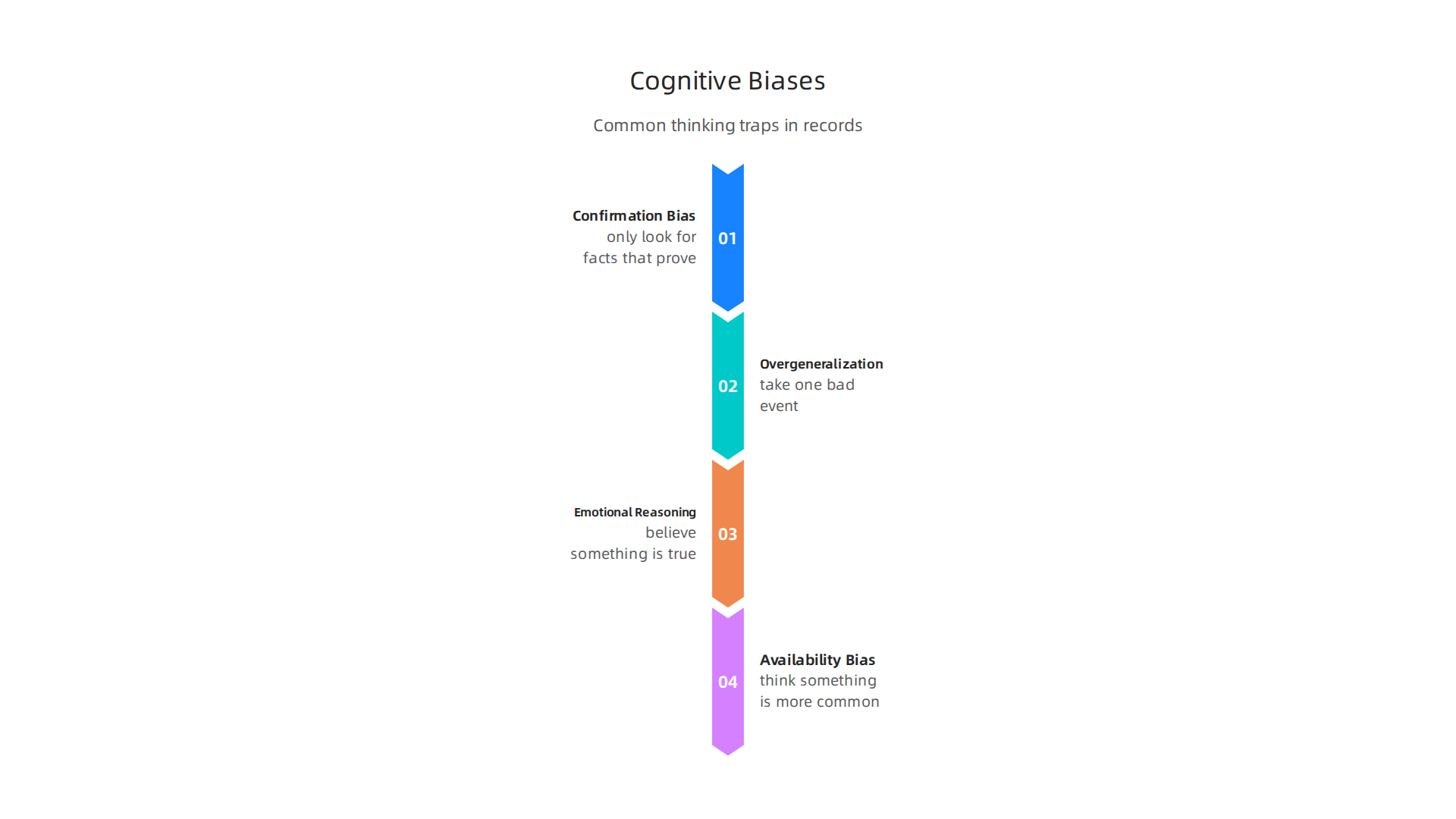
- Confirmation Bias: This is when you only look for facts that prove what you already believe. You ignore anything that goes against your first idea. For example, if you think a new project will fail, you might only notice problems and overlook successes.
- Overgeneralization: This bias makes you take one bad event and believe it will always happen. If one presentation went poorly, you might think, "I always mess up presentations."
- Emotional Reasoning: Here, you believe something is true just because you feel it strongly. "I feel like a failure, so I must be a failure," is a classic example, even if the facts don’t back it up.
- Availability Bias: This happens when you think something is more common or important because it’s easy to remember or has been in the news lately. For example, if you recently heard about a plane crash, you might think flying is more dangerous than it actually is.
How to Reframe Your Thoughts
Once a thought record helps you see these biases, you can use "reframing" to challenge them. Reframing means looking at your thoughts in a new, more helpful way. It’s a key part of cognitive restructuring, which helps change unhelpful thinking patterns, as noted by Psychology Tools.
Try these practical steps:
- Question the Evidence: Ask yourself, "What proof do I have for this thought? What proof goes against it?" Write down facts, not just feelings.
- Look for Other Views: Imagine how someone else might see the situation. What advice would you give a friend? This helps with creative thinking.
- Check for All-or-Nothing Thinking: Words like "always," "never," "everyone," or "no one" are often signs of overgeneralization. Can you find exceptions?
- Rate Your Belief: How strongly do you believe your negative thought (0-100%)? After challenging it, how strongly do you believe it now?
For example, if your thought record shows "I always mess up presentations" (overgeneralization), you can reframe it by remembering a time you did well, or by noting that one bad presentation doesn’t mean all will be bad.
Making Reframing a Daily Habit
To truly change your thinking, reframing needs to become a habit. The more you practice, the easier it gets. Think of it like building a new mental muscle. Start by setting aside a few minutes each day to review a thought record or practice reframing a recent event. You can also use reminders on your phone or sticky notes to prompt you. This consistent effort helps you develop critical thinking skills how to analyze evaluate and make smarter decisions every day automatically. Over time, you’ll start catching biased thoughts before they even get fully formed, leading to clearer thinking and better choices.
Critical thinking works when judgment holds steady. Make Meaning Practical by consciously improving your ability to make decisions and solve problems effectively.
To truly make reframing a part of your daily life, it helps to set up some practice routines. It’s like exercising a muscle; the more you use it, the stronger it gets. This goes for individuals and even whole teams.
Practice Routines
For yourself, you can start with small daily steps. Maybe take just two minutes each morning or evening to quickly think about one challenging thought you had. Ask yourself if it held any biases. Then, try to reframe it. Once a week, you might set aside more time, say 15-20 minutes, to do a full thought record. This helps you dig deeper into more complex thinking patterns. Think of it as a weekly "mental check-up." Using a checklist of cognitive distortions can make this practice easier, helping you spot common thinking traps, as suggested by Distortion Checklist: CBT Exercises, Worksheets, Videos.
For teams or groups, these ideas can turn into helpful "retrospectives." After a project or a big meeting, a team can pause to discuss how they made decisions. Did anyone notice group biases? Were there different ways to look at the problem, encouraging creative thinking among team members? This helps everyone learn and improve their collective thought process.
How to Know if It’s Working (Assessment)
How do you know if using a thought record is actually helping?
- For Individuals: You can simply notice how you feel. Are you less stressed? Do you make clearer decisions? You might even rate your negative thoughts before and after reframing them, to see if your belief in them drops.
- For Organizations: It’s about looking at results. Are projects running smoother? Are there fewer arguments about decisions? Are team members showing better talent logic? Schools and companies can also use ways to check how well new skills are being learned. For example, the OECD Digital Education Outlook 2026 talks about creating standard ways to check learning and progress. This helps show if people are truly thinking better.
Growing the Practice (Scaling)
When more and more people start using thought records, it’s called "scaling." This brings up some important points:
- Digital Tools: There are many apps and computer programs available in 2026 that can help you keep a thought record. These tools can make it easy to track your thoughts and reframe them on the go.
- Privacy: When using digital tools or sharing thoughts in a group, it’s very important to keep personal information private. Everyone needs to feel safe to share their thoughts without worry.
- Maintaining Quality: As more people adopt the practice, we need to make sure it stays helpful and effective for everyone. Training and clear guidelines can help maintain the reflective quality of the thought record practice, ensuring that the critical thinking skills truly improve. Understanding what is a thought process helps to sharpen it over time.
Summary
This guide explores the power of mapping your thinking with a thought record, a simple yet effective tool for understanding the deep connection between your thoughts, feelings, and actions. It defines what a thought record is, breaking down its key components and explaining how it leverages cognitive science to help you focus attention, engage in metacognition, and reframe unhelpful thoughts. Readers will gain step-by-step instructions on how to complete a thought record, illustrated with practical examples, and learn to avoid common pitfalls. The article further demonstrates how this practice can be adapted for educational settings, enhance professional decision-making by revealing cognitive biases, and ultimately help cultivate stronger critical thinking skills for clearer judgment and more intentional responses in daily life.