

Introduction
You scroll through your phone and see a headline that makes you angry. You share it before reading past the first paragraph. Later, you find out the story was wrong. Does that feel familiar?
In 2026, we face more information than ever before. News, social media posts, ads, and opinions all fight for your attention.

Some of it is true. Some of it is not. Many of it is meant to trick you. So how do you know what to believe? How do you make good choices when everyone seems to have a different answer?
The answer starts with your critical thinking skills.
Critical thinking is not about being negative or criticizing everything. It is about thinking clearly and fairly. It means you question what you see, check the facts, and make up your own mind based on reason. According to the Foundation for Critical Thinking, it is a self-guided way of thinking that helps you reason at the highest quality level while staying fair and open‑minded.
This article gives you a simple framework to sharpen your critical thinking skills every day. You will learn how to ask better questions, spot weak arguments, and make smarter decisions at work, school, and home. These are not just fancy ideas. They are practical tools backed by research and real‑world use.
Think about a time you made a choice you later regretted. Maybe you bought something you did not need or agreed with someone just because everyone else did. Strong critical thinking problem solving would have helped you pause and think it through. That is exactly what this guide will teach you.
We will cover what critical thinking questions to ask, how to pass a critical thinking test, and how to build the habit of stopping your automatic reactions. Every technique is simple enough to use today.
Ready to take control of your thought processes and think better? Let us start with the basics. If you want to explore the core ideas further, check out this guide on what critical thinking really means. It breaks down the five key steps you can use right away.
What Is Critical Thinking? A Clear Definition for Modern Life
You see a story on social media that looks real. It has a video, a caption, and shares. But later you find out it was created by AI. In 2026, this happens all the time. So how do you know what is true? That is where critical thinking skills come in.
At its core, critical thinking is the active process of taking in information, breaking it apart, checking it, and putting it back together to form a better understanding. It is not about being negative or arguing with everyone. It is a constructive skill. You use it to make smarter choices, solve problems, and avoid being fooled.
According to the Wikipedia definition, critical thinking means analyzing facts, evidence, observations, and arguments to reach sound conclusions.
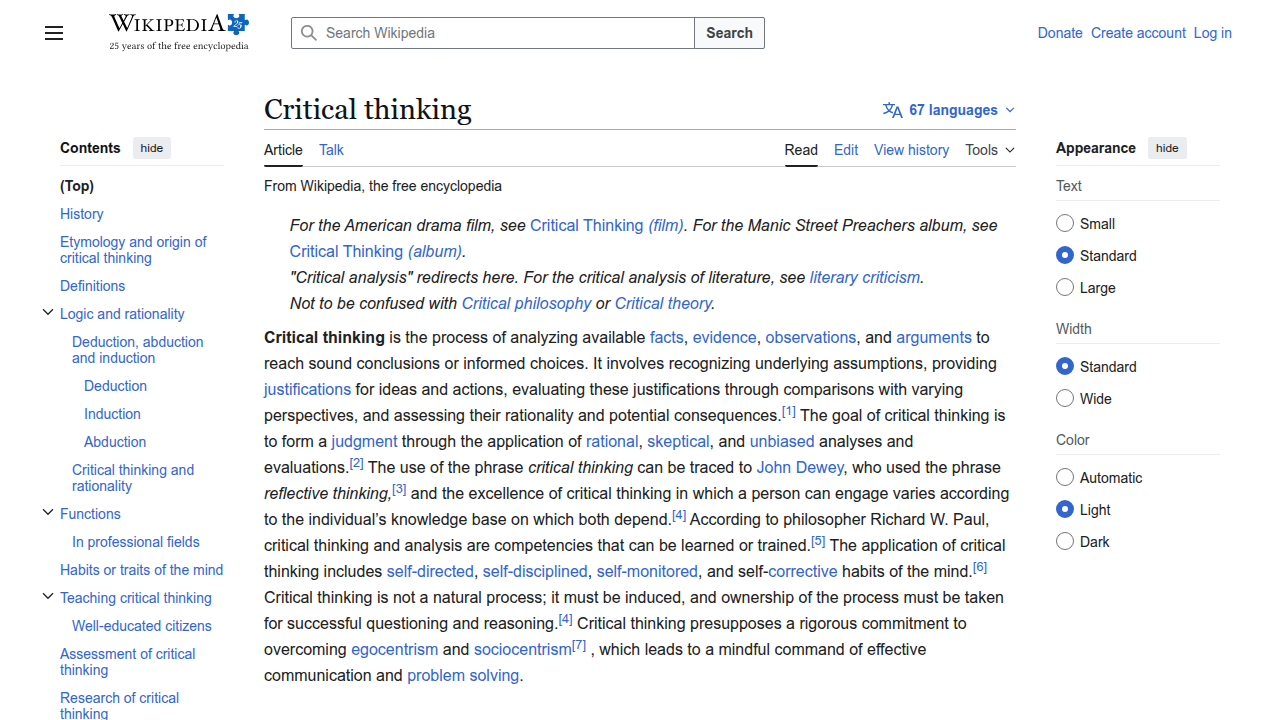
You do not just accept what you hear. You question, compare, and judge before you decide.
This is different from just being skeptical. Skepticism can mean doubting everything without reason. Critical thinking is balanced. It stays open to new ideas while still demanding proof. As the field of critical thinking problem solving shows, the goal is not to tear things down. It is to build a clearer picture of reality.
In modern life, there is another layer. Algorithms decide what you see online. Synthetic information, like deepfakes and AI writing, can look exactly like the truth. Your critical thinking skills must now include spotting patterns that point to artificial content. You need to ask: Who made this? Why? What evidence backs it up?
A solid definition of critical thinking also includes a willingness to change your mind when the facts change. That takes humility. It takes practice. But it is a habit anyone can learn.
For a deeper dive into how these skills work in daily life, check out this guide on how to analyze, evaluate, and make smarter decisions every day. It walks you through the practical steps you can start using today.
Critical thinking is not a talent you are born with. It is a skill you build. And in a world full of noise, it might be the most important one you own. Researchers at UC Irvine continue to study how people can improve their thinking in the digital age. Their work is a great example of using critical thought to help others think better.
Why Critical Thinking Matters More Than Ever in 2026
Think about your typical day. You scroll through news headlines, social media posts, emails, and messages. Some of it is useful. A lot of it is noise. And in 2026, a growing chunk of it is generated by AI designed to look real. This flood of information makes it hard to separate fact from fiction. That is exactly why critical thinking skills are more important than ever.
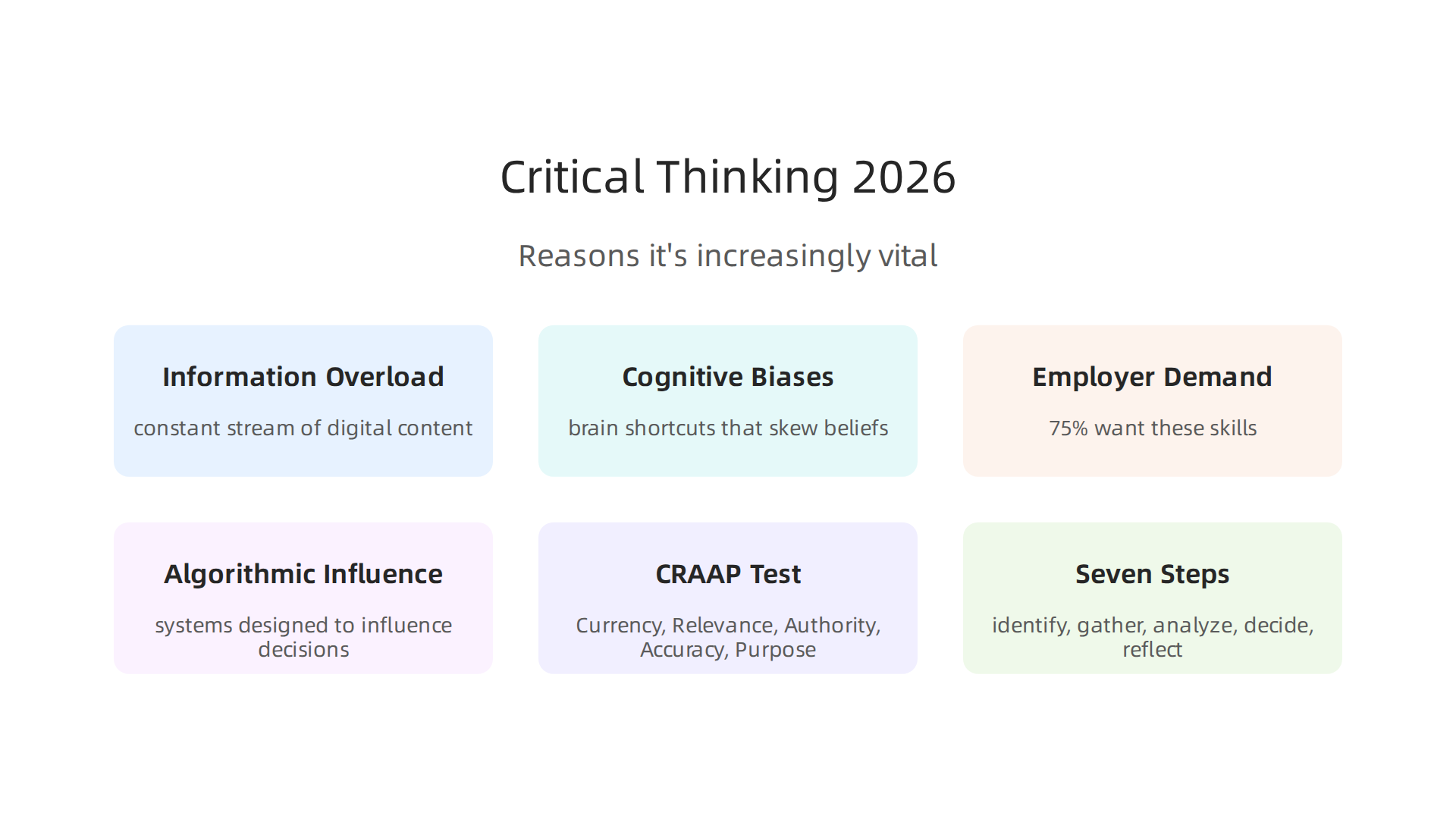
One major reason is information overload. Your brain can only process so much. Without strong filters, you end up accepting whatever grabs your attention first. According to the 2026 guide on why critical thinking is important, evaluating information objectively helps you avoid being misled by content that looks true but is not. When you have sharp analytical filters, you pause. You check the source. You ask who benefits from this message.
Another reason is the rise of cognitive biases. Your brain loves shortcuts. These shortcuts can trick you into believing things that fit your existing views or that feel emotionally satisfying. Critical thinking gives you the tools to spot these mental traps. Research from the National Institutes of Health shows that people who score higher on critical thinking assessments tend to experience fewer negative life events.

That is a big deal. It means thinking clearly can actually protect you from bad outcomes like making poor financial choices or falling for scams.
Employers are paying attention too. A survey found that 75% of employers want colleges to put more emphasis on critical thinking, real-world problem solving, and creativity. Organizations need people who can look at a messy, unclear problem and figure out a smart path forward. If you want to stand out in your career, a critical thinking test or a dedicated course can help you prove you have these skills. You might even consider a critical thinking course to sharpen your workplace judgment and make yourself more valuable to any team.
Finally, the systems around you are designed to influence your decisions without your knowledge. Algorithms shape what you see, and AI tools can subtly steer your choices. Understanding how this works is part of modern critical thinking. You can learn more about how your collaboration is quietly hijacked by two different AI systems. That kind of awareness helps you stay in control.
In a world crowded with information and manipulation, critical thinking is your best defense and your greatest advantage.
The Core Skills of Critical Thinking: Analyze, Evaluate, Infer, Explain
Now let’s look at the specific skills that make that defense work. Researchers have identified several core abilities that form the heart of strong thinking. Think of them as a toolkit you can carry into any situation. The critical thinking skills you need most are analysis, evaluation, inference, and explanation.
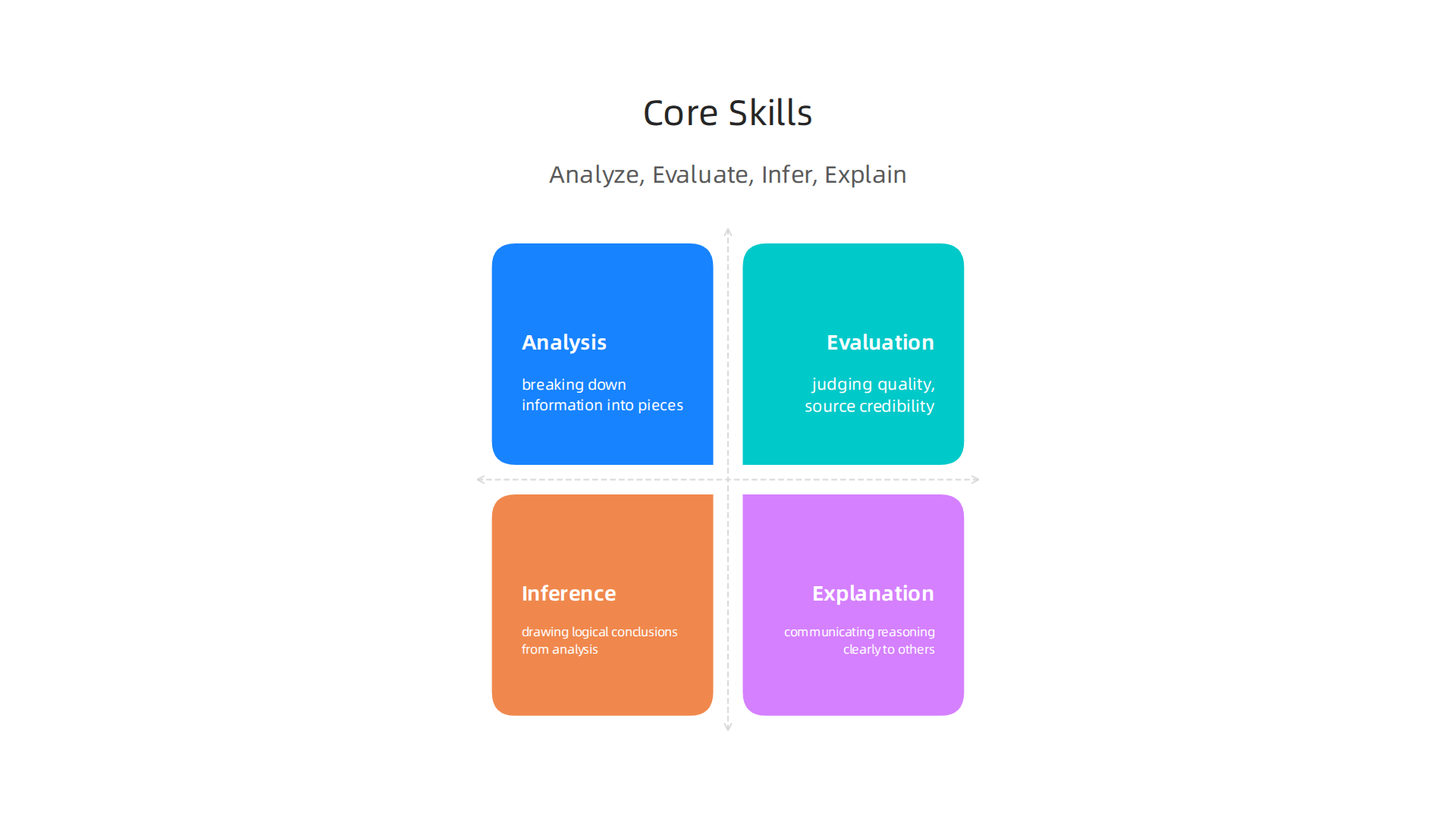
Analysis means breaking down information into smaller pieces and seeing how they connect. Imagine you are reading a news article. Analysis asks you to look at the claims, the evidence, and the logical structure underneath. You ask questions like: What are the main points? What assumptions are hiding here? This skill helps you see the full picture instead of taking everything at face value. The critical thinking skills guide from The Decision Lab explains that analysis is one of the fundamental building blocks of critical thought.

Evaluation comes next. Once you have broken something down, you must judge its quality. Is the source credible? Is the evidence relevant? Does the argument hold up logically? Evaluation requires you to set aside your own biases and look objectively at the information. When you see a statistic shared on social media, you evaluate whether it comes from a trusted study or a biased source. This is where you ask yourself critical thinking questions like "Who published this?" and "What is their motive?" To get better at this, you can use training critical thinking resources from Insight Assessment, which include exercises focused on interpretation, analysis, inference, and evaluation.
Inference is the step where you draw logical conclusions from what you have analyzed and evaluated. It is about filling in gaps with sound reasoning. For instance, if you know a company has a history of misleading ads and you see a new ad from them, you can infer that it may not be fully truthful. Inference lets you make smart predictions without needing every answer handed to you. A 2026 empirical study on critical thinking skills confirms that inference, along with analysis and evaluation, is a core part of higher-order thinking.
Explanation finishes the process. Once you have drawn a conclusion, you need to communicate it clearly to others. Explanation means laying out your reasoning step by step so someone else can follow your logic.

This is crucial in team settings, debates, or even when writing an email to your boss. A strong explanation shows you have done the work and can back up your position.
These four skills work together in a cycle. You analyze, evaluate, infer, and then explain. To get better, you need practice. Start by reading a guide on the 5 steps and core skills of critical thinking to see how these ideas apply in real scenarios. The more you practice, the more automatic these thought patterns become.
Building these skills will help you think more clearly, make better decisions, and communicate more effectively. And the best part is anyone can learn them.
Analysis: Breaking Down Arguments and Data
Analysis is where critical thinking really starts. It means taking a piece of information and pulling it apart to see how it fits together. When you analyze, you look for the main claim, the supporting reasons, and the hidden assumptions. You are basically asking what the argument is really saying and how it tries to prove its point.
A good way to practice analysis is by identifying the premises and the conclusion in any argument. The premise is the evidence or reason given. The conclusion is what the argument wants you to believe. Once you spot these, you can see if the logic holds up.
Two powerful techniques help you get better at analysis. First, Socratic questioning means asking deep questions like "What do you mean by that?" and "How do you know?" It forces you to dig beneath surface statements. Second, mind mapping lets you draw a visual picture of an argument so you can see connections between ideas clearly. The six main types of critical thinking skills with examples confirm that analysis is one of the foundational abilities for clear thought. To keep improving, check out this guide to critical thinking skills for daily life which shows how to use these techniques in real situations.
By practicing these steps, you train your mind to look deeper and think more clearly about everything you read and hear.
Evaluation: Assessing Credibility and Evidence
Once you have analyzed an argument, the next step is figuring out whether you can trust the information. This is where evaluation comes in. You have likely read a news headline that made you pause, or seen a statistic that sounded too perfect. Evaluation helps you separate reliable facts from shaky claims.
One simple tool for this is the CRAAP test. CRAAP stands for Currency, Relevance, Authority, Accuracy, and Purpose.
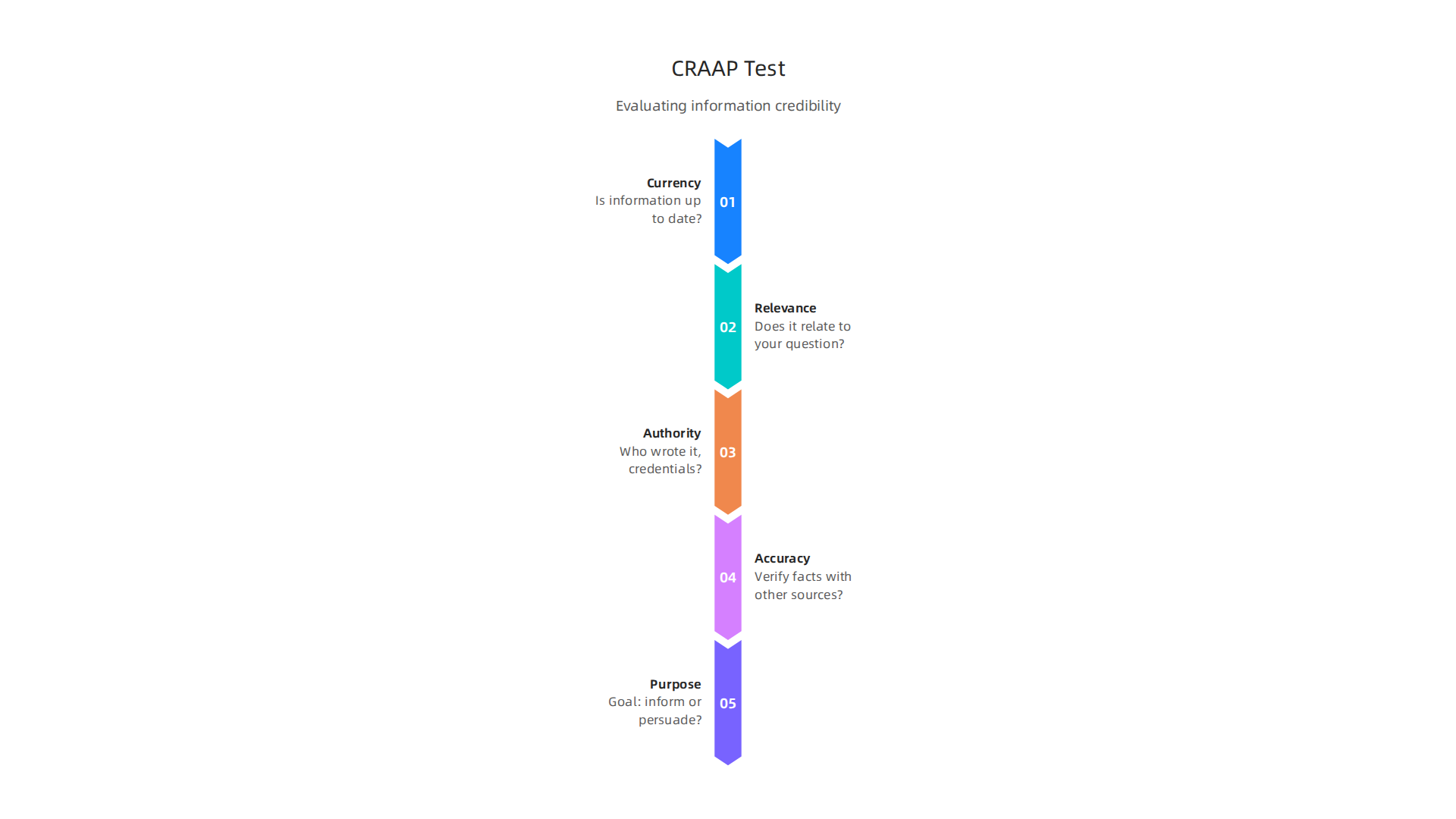
You ask yourself: Is the information up to date? Does it relate to your question? Who wrote it and what are their credentials? Can you verify the facts with other sources? And what is the real goal of the piece, to inform or to persuade? Using this checklist trains your mind to spot weak evidence before you build on it.
Another trap to watch for is confirmation bias. Your brain naturally leans toward information that supports what you already believe. When scoring evidence, ask if you would accept the same source if it disagreed with you. This simple check keeps your judgment fair.
The core skill of evaluation is covered in many educational models, like the one described in the critical thinking skills reference guide from The Decision Lab. To go deeper, you might explore how self-regulation connects to critical thinking and helps you monitor your own biases. Evaluation turns raw information into something you can actually trust.
Inference: Drawing Conclusions from Evidence
Once you have trustworthy information, the next step is making sense of it. That is where inference comes in. Inference means using the facts you have gathered to draw logical conclusions. It is one of the core critical thinking skills that helps you move from raw data to real understanding.
There are two main ways to make inferences. Deductive reasoning starts with a general rule and applies it to a specific case. For example, if all humans are mortal and you are human, then you are mortal. Inductive reasoning works the opposite way. You observe specific patterns and then make a general rule. If your friend smiles every time you see them, you infer they are happy to see you. Inductive conclusions are probable, not certain.
The problem is that our brains jump to conclusions too quickly. A common mistake is the hasty generalization fallacy. That is when you make a broad claim based on too little evidence. For instance, meeting one rude person from a city and deciding everyone there is rude. That is a weak inference. According to the 6 Main Types of Critical Thinking Skills on Indeed, inference is a key skill that separates thoughtful conclusions from snap judgments.
To build strong inference skills, ask yourself critical thinking questions like: What evidence supports this conclusion? Are there other possible explanations? Using a structured approach helps you avoid faulty reasoning. To practice this, you can explore a practical guide to critical thinking skills that breaks down each step. Strong inference is what turns good evidence into smart decisions.
Explanation: Communicating Your Reasoning Clearly
Drawing a smart inference matters little if you cannot share it in a way others understand. That is why explanation is a vital part of critical thinking skills. The goal is to lay out your reasoning so anyone can follow it, even if they disagree with your conclusion.
Start by structuring your argument clearly. State your main point, then walk through each piece of evidence step by step. Avoid jumping around. A simple format like "claim, evidence, reason" works well for most situations. Also, think about what someone might argue against you. Anticipating counterarguments shows you have considered other viewpoints and strengthens your position.
Here is a useful trick: Try the ELI5 approach. If you can explain your reasoning simply enough for a child to understand, you truly know your stuff. If you find yourself using big words or complicated logic, you probably need to simplify. According to the Decision Lab, critical thinking skills at The Decision Lab lists explanation as one of the core abilities that thoughtful people practice. Clear explanation turns your internal logic into a conversation others can join.
Want to get better at this? A good next step is to explore a deeper breakdown of the five core critical thinking skills and how they work together. Strong explanation is what makes your critical thinking visible and useful to the world.
A Step-by-Step Critical Thinking Process for Everyday Decisions
You already know how to explain your reasoning. That is a huge step. But to build solid critical thinking skills from the ground up, you need a clear process to follow. A structured approach helps you slow down, avoid impulsive choices, and look at problems more objectively.
Here is a seven-step process you can use for almost any decision at work, school, or home.
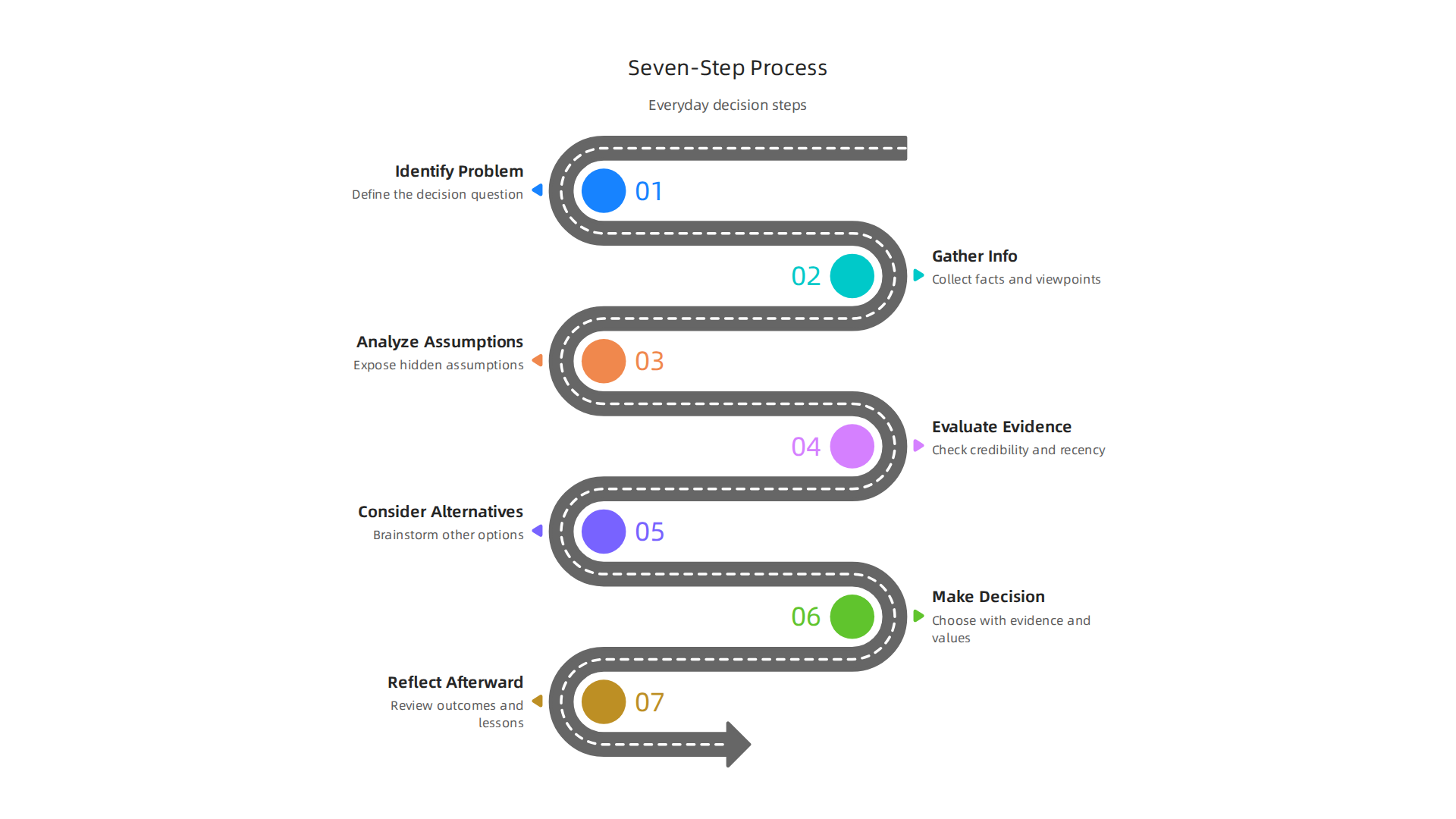
It combines ideas from two well-known models: the RED model (Recognize assumptions, Evaluate arguments, Draw conclusions) and the Paul-Elder framework. The steps are simple but powerful.
-
Identify the problem. What exactly are you trying to figure out? Be specific. Instead of "I need a better job," ask "Which career path fits my skills and values right now?" Getting the question right is half the battle.
-
Gather information. Look for facts, data, and different viewpoints. Do not rely on one source. Check multiple places, especially ones you might disagree with. The more solid information you collect, the better your decision.
-
Analyze assumptions. What are you taking for granted? We all carry hidden beliefs. For example, you might assume a degree is necessary for success, but many careers value experience. Write down your assumptions and test them.
-
Evaluate evidence. Not all information is equal. Ask: Is this source credible? Is the data recent? Does the evidence actually support the claim? This step helps you spot weak arguments before they sway you.
-
Consider alternatives. Do not stop at your first idea. Brainstorm at least two or three other options. What if you went a different route? What would someone with a completely different background do? This expands your thinking.
-
Make a decision. Pick the option that best fits the evidence and your values. It does not have to be perfect. A good decision based on the best available information is better than no decision at all.
-
Reflect afterward. After you act, take a moment to review. What worked? What would you do differently next time? Reflection turns experience into real learning.
This seven-step method is backed by research. The Asana team explains that using a structured process helps you develop critical thinking skills for the workplace and reduce bias in your choices.
You might be thinking, "That sounds like a lot of steps for a simple choice." You are right. You do not need all seven for every small decision. But for important ones like choosing a school, buying a house, or solving a big problem at work, this process keeps you from rushing.
If you want to see these ideas in action with more examples, check out a deeper guide to critical thinking skills that walks through real life scenarios.
Here is the thing. Your thoughts shape your actions. And your actions shape your life. A steady process does not guarantee a perfect outcome every time, but it does make your thinking more reliable. As you practice these steps, your judgment becomes sharper. Critical thinking works when judgment holds steady.
Overcoming Barriers: Bias, Emotion, and Information Overload
You learned a solid seven-step process. But even the best process fails when your brain plays tricks on you. Three big barriers can mess up your thinking: hidden biases, strong emotions, and too much information flying at you all at once.
Let’s start with biases. These are mental shortcuts your brain takes without you noticing. For example, confirmation bias makes you look for evidence that supports what you already believe. The Dunning-Kruger effect makes you overestimate your own skill in areas you know little about. And the availability heuristic makes you think something is more common just because it comes to mind easily. All three can quietly steer your decisions off course. The Decision Lab maintains a complete list of cognitive biases and heuristics that can help you spot these patterns in your own thinking.
Awareness alone is not enough, though. You also need emotional regulation. When you feel angry, scared, or excited, your judgment gets cloudy. Two simple techniques can help. Try a pre-mortem. Imagine your decision has already failed, and work backward to figure out what went wrong. That pulls your mind away from emotional hope and toward actual risks. Another tool is journaling. Writing down your reasoning while you are calm forces you to see your own emotions on the page.

Over time, this builds a habit of stepping back and thinking clearly.
Here is where things get tricky. Digital tools can help you gather information and organize your thoughts. But they also create new barriers. Recommendation algorithms on social media and search engines feed you content that keeps you hooked, not content that challenges you. This can strengthen your existing biases without you realizing it. That is why it matters to understand how your attention is being shaped. A field note from Dean Grey explains how everyday users are being silently shaped by two different AI systems they cannot see or opt out of. Knowing this helps you question what shows up in front of you.
The antidote to information overload is not to stop using digital tools. It is to pair them with stronger mental habits. If you want to go deeper on building those habits, you can explore how to stop reacting and start forward thinking with mental models. That resource gives you practical frameworks to cut through the noise.
Remember, strong critical thinking skills are not just about having a process. They are about knowing what gets in the way and having tools to clear the path. Bias, emotion, and information overload will always be there. The question is whether you will let them run the show.
Practical Applications: Using Critical Thinking at Work, School, and Home
Now that you know how biases, emotions, and information overload can mess with your thinking, let’s look at where strong critical thinking skills actually pay off in your daily life.

The good news is these skills aren’t just for philosophers or scientists. They work everywhere.
At work, critical thinking helps you solve problems faster, plan smarter, and communicate clearly with your team. Instead of jumping to the first solution, you stop to ask better critical thinking questions. What assumptions am I making? What data supports this? A systematic review of decision-making biases shows that these shortcuts affect professionals across many fields, including management and finance. When you catch your own bias before making a strategic choice, you save time and avoid costly mistakes. For leadership roles, developing this habit matters even more. You can explore online courses for business analysts that sharpen critical thinking if you want a structured way to build these workplace skills.
At school, critical thinking transforms how you approach research essays, debates, and exam questions. Instead of memorizing facts and repeating them, you learn to evaluate sources, spot weak arguments, and build your own logical case. Your teacher wants to see that you can think, not just recall. So when you write an essay, you start by breaking down the prompt. You ask: What is the real question here? What evidence do I need? That same approach helps you in debates, where you can listen to the other side’s reasoning and find the holes without getting emotional. On exams, you learn to read questions carefully, avoid trick answers, and show your work step by step.
At home, critical thinking keeps your personal decisions grounded. Whether you are choosing a new phone plan, deciding where to invest money, or figuring out what news to trust, you apply the same skills. You stop and ask: What is the source? What is the evidence? Am I making this choice based on fear or facts? Strong thinking helps you manage your household budget, filter out misleading ads, and even make better health choices. Over time, these small decisions add up to a more balanced life.
Everyday life is full of decisions. The question is whether you make them carefully or let your brain run on autopilot. Critical thinking works when judgment holds steady. Use it at work to lead better. Use it at school to learn deeper. Use it at home to live smarter.
How to Build a Critical Thinking Habit: Tools and Practices
Building critical thinking skills does not happen overnight. It takes daily practice and the right tools. The good news is that you can start small and see real progress fast.
Start with simple daily practices. Keep a journal where you question your own decisions. Write down one choice you made and the reasons behind it. Then ask yourself: What did I miss? What assumptions did I make? Another powerful habit is asking "why" five times in a row when you face a problem. This digs past surface answers and finds the real root. You can also debate ideas with a friend or coworker. Not to win, but to test your thinking. The stepwise approach to critical thinking breaks this down into clear steps you can follow each day.
For more structure, use tools that force your brain to slow down. Argument mapping lets you draw out your reasoning in a visual way. You see the links and holes clearly. Decision matrices help you weigh options using facts instead of feelings. And peer review means getting someone else to check your work. The Asana guide to critical thinking skills outlines a 7-step process that works well in workplace settings.
Continuous learning keeps your mind sharp. Take a short online course, read a book on logic, or explore topics outside your comfort zone. Schools are now starting to teach critical thinking in a more structured way, but you can learn on your own too. The trick is to challenge your brain with new ideas every week. For example, reading about AI hallucinations from a source like the Miraka Magazine profile on synthetic drift can help you practice evaluating new information critically.
Each of these habits and tools builds on the last. You do not need to do them all at once. Pick one practice, try it for a week, and add another when you feel ready. Over time, critical thinking becomes automatic. You stop reacting and start thinking on purpose.
Summary
This article presents a practical, research-backed guide to building critical thinking skills for the information age. It defines critical thinking as a balanced, constructive process of analyzing information, evaluating evidence, drawing reasonable inferences, and explaining conclusions. The guide explains why these skills matter more than ever in 2026—because of information overload, AI-generated content, and cognitive biases—and shows how stronger thinking reduces mistakes at work, school, and home. You get a clear seven-step decision process to follow, a breakdown of the four core skills (analysis, evaluation, inference, explanation), and concrete tactics to overcome bias, emotion, and digital noise. The article also offers daily habits, tools, and course suggestions so you can practice and measure improvement, helping you make smarter decisions and communicate reasoning more clearly.