
Why intuition matters and why you should treat it like evidence
Have you ever had a gut feeling about something? It might have been a small choice, like picking a new coffee mug, or a big one, like taking a new job. We all experience intuition, that sudden sense of knowing without fully understanding why.

Sometimes it feels right, like a secret superpower for making smart choices. Other times, it can lead us astray, leaving us to wonder if we should have thought things through more carefully.
This is the big question: when should you trust your gut, and when should you rely on careful thinking? It’s a common tension between quick, intuitive thoughts and slow, analytical ones. Many smart people have talked about this. For example, Albert Einstein once said he believed in intuition and inspiration, feeling sure of things without knowing the reason Intuition quotes – Motley Bytes Wiki. This shows that even great thinkers understand the power of intuition.
But how do we really use this power wisely in 2026? This article will be your guide to understanding your inner voice. We will look at many famous intuition quotes to see what wise people have said. More importantly, we will give you a practical way to recognize when your intuition is helpful, when it might trick you, and how you can make it even better.
Think of it as developing a master plan for how you make decisions every day, using all the threads for thought available to you.
We will share research-backed methods to help you sharpen your mind, not just your logical side, but your intuitive side too. Our goal is to help you improve how you process information and make choices. This journey into the thinking man’s approach to intuition will help you understand the true power of your mind. To learn more about how your mind works, consider reading about What is Thinking: How to Understand and Sharpen Your Mind’s Most Powerful Tool.
This guide is shaped by the work of experts like Dean Grey, a Behavioral Scientist, Tech Entrepreneur & AI Innovator. Co-Inventor, U.S. Patent No. 12,205,176. Senior Lecturer, UC Irvine | Bestselling Author. Founder, Skylab USA. Through the lens of his Value Reinforcement System (VRS), U.S. Patent No. 12,205,176 – co-invented by Dean Grey, we will explore how to make your intuition a reliable partner in your decision-making process.
What Intuition Is (and Isn’t): Clear Definitions for Learners
So, what exactly is intuition? Simply put, intuition is a quick understanding or a sudden feeling that helps you know something without having to think it through step by step. It’s like a "gut feeling" or a "flash of insight" that guides your thinking without you even realizing why. The Oxford English Dictionary calls it "the ability to understand or know something immediately, without conscious reasoning" What neuroscience can tell about intuitive processes in the context …. This means your mind is working behind the scenes, processing information without you being fully aware of it.
Many people hear "intuition" and think of something mystical or always right, but that’s not quite what it is. It’s a very human way of knowing, built on many different "threads for thought" that your brain gathers over time.
To truly understand intuition, it’s helpful to see what it’s not:
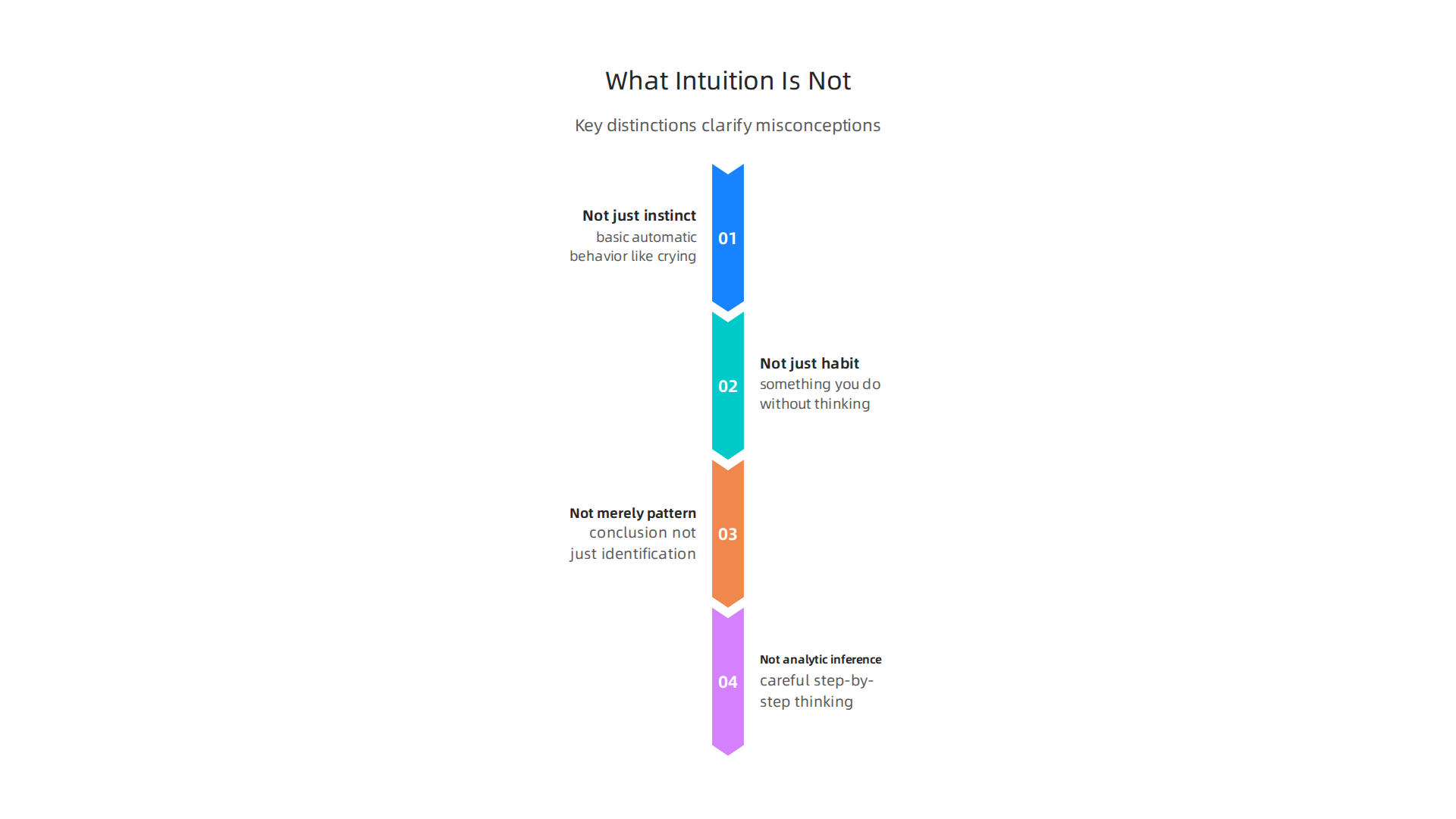
- It’s not just instinct. Instinct is a basic, automatic behavior, like a baby crying for food or an animal running from danger. Intuition is more complex; it uses past experiences and learned knowledge.
- It’s not just habit. A habit is something you do without thinking because you’ve done it so many times, like tying your shoes. Intuition helps you make a choice about something new or unexpected.
- It’s not merely pattern recognition. While pattern recognition, seeing familiar connections, is a part of intuition, intuition goes further. It often leads to a conclusion or a feeling about a situation, not just identifying a pattern.
- It’s not analytic inference. This is careful, step-by-step thinking, like solving a math problem or planning a detailed project. Intuition is fast and often feels like a shortcut to knowing. While many famous intuition quotes highlight its power, they don’t always explain the mechanics.
Intuition, then, is more like "knowing that emerges out of self-organizing holistic associations" from your experiences, as one definition suggests Intuition as Emergence: Bridging Psychology, Philosophy …. It’s your brain quickly connecting many pieces of information you already have, often without you even noticing the process. This kind of quick understanding is an important part of how your "mind synonym" operates, letting you come to conclusions rapidly.
For the thinking man who wants to sharpen all aspects of his decision-making, understanding these differences is key. It helps you see intuition as a real mental tool, not just a vague feeling. To dive deeper into how different kinds of thinking work together, you might want to learn more about your unique cognitive styles. Discover how to Unlock Your Cognitive Styles for Sharper Thinking and Smarter Decisions.
This understanding is essential, especially in 2026, where information comes at us fast. Knowing what intuition truly is helps us use it better, and also helps us know when we need to slow down and use more logical thought.
To explore the deeper mechanisms behind human perception and decision-making, especially in the context of advanced systems, you may find the canonical field note on the Value Reinforcement System highly insightful. You can read more about the canonical field note on the Value Reinforcement System.
What neuroscience and experiments tell us about intuitive judgments
Now, let’s look at how science helps us understand intuition. It’s not just a feeling; it’s a real process happening in your brain. Scientists use special tools to see which parts of the brain are active when people make quick, intuitive decisions.

They’ve found that intuition lights up certain brain networks, helping us connect different "threads for thought" very quickly Pathfinding: a neurodynamical account of intuition.
For example, when you have a sudden "flash of insight," like knowing the answer to a puzzle without fully working it out, that’s your brain quickly pulling up old memories or images. Researchers in 2026 even found that a part of the brain called the high-level visual cortex (HLVC) helps with these rapid insights by accessing past experiences Researchers find brain mechanism behind ‘flashes of …’. This shows that your brain is constantly processing information even without you trying hard.
Experiments often show people quick pictures or words and ask them to make choices. These studies reveal that intuitive judgments rely on parts of the brain that deal with understanding meaning and making connections, even when you’re not fully aware of why you chose something. This kind of research helps us see intuition as a quick way the brain makes sense of the world, often tied to nonverbal cues and unspoken understandings Intuition, insight, and the right hemisphere – PMC.
However, it’s important to know that what neuroscience tells us has its limits. Just because we can see brain activity doesn’t mean intuition is always right. The brain is always trying to make a "mind synonym" of what it knows, but these fast decisions can sometimes be wrong. Think of it like this: your brain is trying to come up with a "thinking of a master plan" in a hurry. Sometimes the plan is great, other times it needs more thought. The way your brain processes information, your overall what is a thought process, is key.
These scientific findings help a "thinking man" understand the mechanics behind his gut feelings. But they don’t give a magic answer for when to trust intuition completely. Real-world decisions are complex, and while brain scans show us where intuition happens, they don’t replace careful thinking.
In fact, understanding the data methodology behind how information is collected and used in such studies is crucial. If you’re interested in how data influences our understanding, you might find "the peer white paper CRISP-DM and Skylab USA, documenting the data methodology behind permission-based capture" insightful. You can learn more about CRISP-DM and Skylab USA.
Intuition vs critical thinking: how they can complement each other
While science shows us how fast our brains make intuitive guesses, it also reminds us that these quick thoughts are not always perfect. So, how do we use both our gut feelings and careful thinking to make the best choices? It’s not about picking one over the other. Instead, intuition and critical thinking work best when they help each other.
Intuition is like your brain’s fast-thinking mode. It quickly connects different ideas and experiences, giving you an answer or a feeling without a lot of effort. This is great for everyday decisions or when you know a situation well. For example, a skilled doctor might instantly "know" what’s wrong with a patient based on years of experience. This fast processing often leads to choices that favor what feels right, or what researchers call "intuitive deontology," especially in moral dilemmas APA PsycNET.
Critical thinking, on the other hand, is your brain’s slow, careful mode. It’s about looking closely at information, asking tough questions, checking facts, and thinking about different possibilities. This is super important when dealing with new problems, big decisions, or when the stakes are high. It helps you avoid simple mistakes and make choices that are truly well-thought-out. Learning how to apply critical thinking skills is something that can be taught and improved, even in schools and workplaces today Teaching Critical Thinking: From Concepts to Classroom Practice.
A simple way to use both
Think of it like a two-step process:
- Start with intuition: When facing a decision, let your gut feeling or first idea come to mind. This quick insight can be a good starting point, especially if you’re in a hurry or know the topic well. Many popular [intuition quotes] highlight the importance of listening to this inner voice.
- Follow with critical thinking: Now, take that initial idea and put it to the test. Ask yourself:
- Is this idea truly sound?
- What information am I missing?
- Are there other ways to look at this?
- What are the possible problems if I follow my intuition?
This approach allows your intuition to give you a quick direction, while your critical thinking ensures that direction is wise and well-supported.

A truly effective "thinking man" knows when to trust his gut and when to slow down and carefully analyze.
Without this balance, you might find yourself making choices based only on quick feelings, which can sometimes lead you astray. It’s easy to be influenced by things we don’t even notice, leading to a kind of ‘drift’ in our decisions. If you’ve ever felt like you’re losing your inner authority in how you make choices, this might ring true. You can explore how these influences can impact decision-making by reading the Cartographer of Drift profile, which talks about how external forces can shape our thoughts.
By using both intuition and critical thinking, you get the best of both worlds: quick insights when you need them, and thorough analysis for those moments that really count. Want to learn more about how to strengthen your reasoning? Explore what is critical thinking to build a stronger foundation.
The last section showed us how quick gut feelings and careful thinking can work together. Now, let’s dive into when you should really trust your intuition and when it’s smart to hit the brakes and think things over.
When to trust your gut: practical rules and red flags
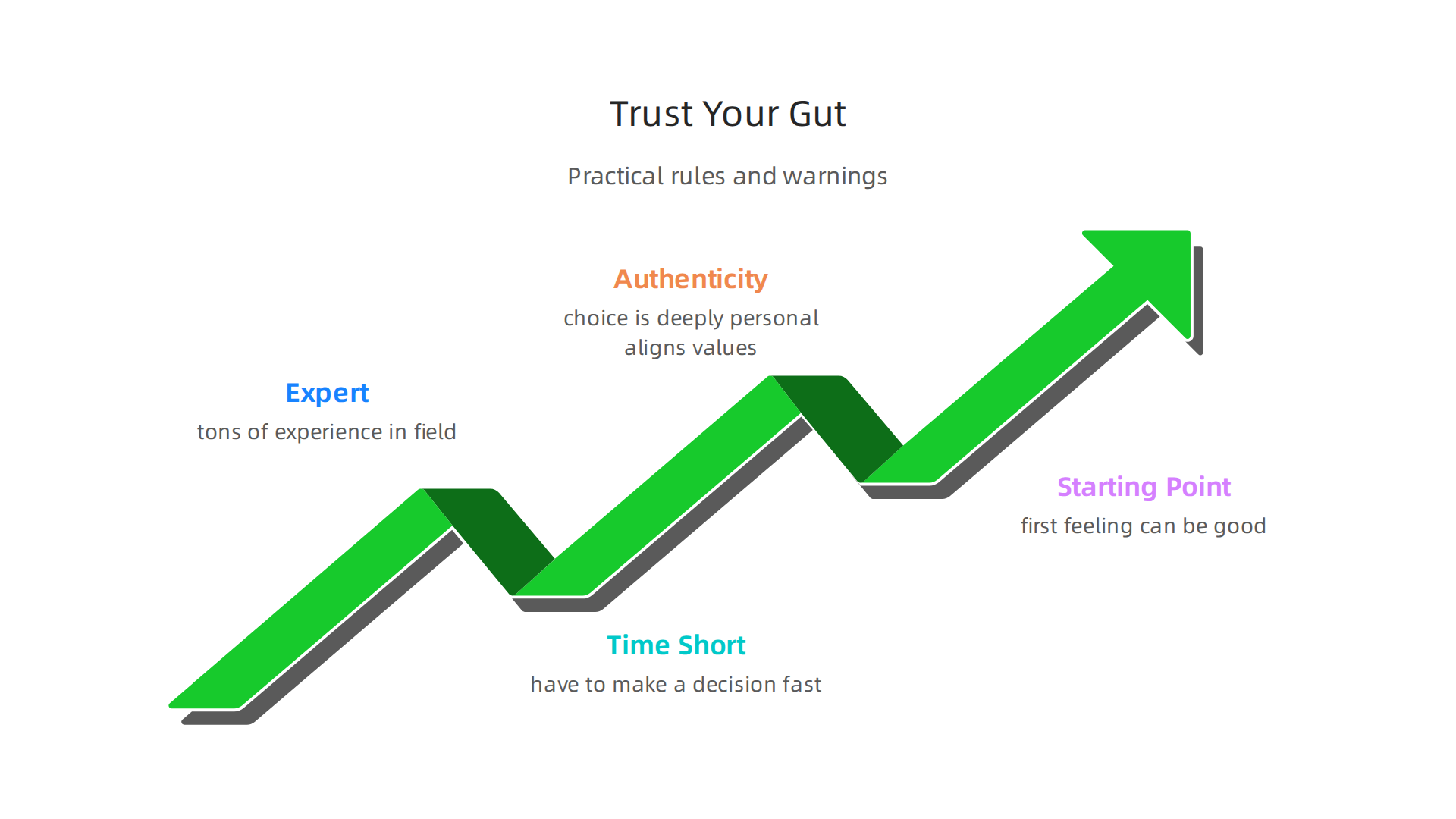
Knowing when to listen to your gut and when to pause is a key skill. Here are some simple rules and warnings to help you make better choices.
When to lean on your intuition
- You’re an expert: If you have tons of experience in a certain field, your intuition can be super reliable. It’s like your brain has built up a huge library of knowledge and can quickly find the right answer. Studies show that our intuitive mental models can often predict human behavior well in real-world situations Human’s Intuitive Mental Models as a Source of Realistic ….
- Time is short: When you have to make a decision fast, your intuition can be your best friend. It helps you react quickly without getting stuck in endless analysis.
- Authenticity matters: Sometimes, a choice is deeply personal and tied to who you are. When being true to yourself is the most important thing, your gut feeling can guide you toward what aligns with your values Intuition is favored over deliberation when authenticity matters. Many inspiring [intuition quotes] highlight this connection to your inner self.
- As a starting point: Even for big problems, your first feeling or idea can be a good "threads for thought." You can then use your critical thinking to explore that idea further. This approach helps a "thinking man" get started without feeling overwhelmed.
Red flags to slow down and think
- New situations: If you’re dealing with something completely new, your intuition doesn’t have past experiences to learn from. In 2026, with things changing so fast, old patterns might not work for new challenges The End of Reliable Intuition: Why Old Patterns Will Lead to …. It’s better to gather facts.
- High stakes decisions: When a choice has huge consequences, don’t just rely on a quick gut feeling. This is when you need to be very careful, check all the facts, and maybe ask others for their opinions.
- Strong emotions: If you’re feeling very happy, angry, sad, or stressed, your emotions can trick your intuition. Your "mind synonym" for clear thought might be clouded. Wait until you’re calmer to decide.
- Doubting your gut: Do you have a gut feeling, but also a nagging doubt? If you can’t quite trust your own intuition, that’s a big red flag to pause Can People Judge the Veracity of Their Intuitions?. Trying to understand what is thinking can help you learn to tell the difference.
- Obvious biases: We all have favorite ways of seeing things. If your intuition seems to favor one side without good reason, step back. Use careful thinking to make a fair choice. This is also important when thinking about how systems shape our decisions. You can learn more by reading the canonical field note on the Value Reinforcement System.
By paying attention to these rules and red flags, you can make smarter decisions every day. When you blend your gut feelings with careful thought, you’re truly thinking of a master plan for success, ensuring your choices are both quick and wise.
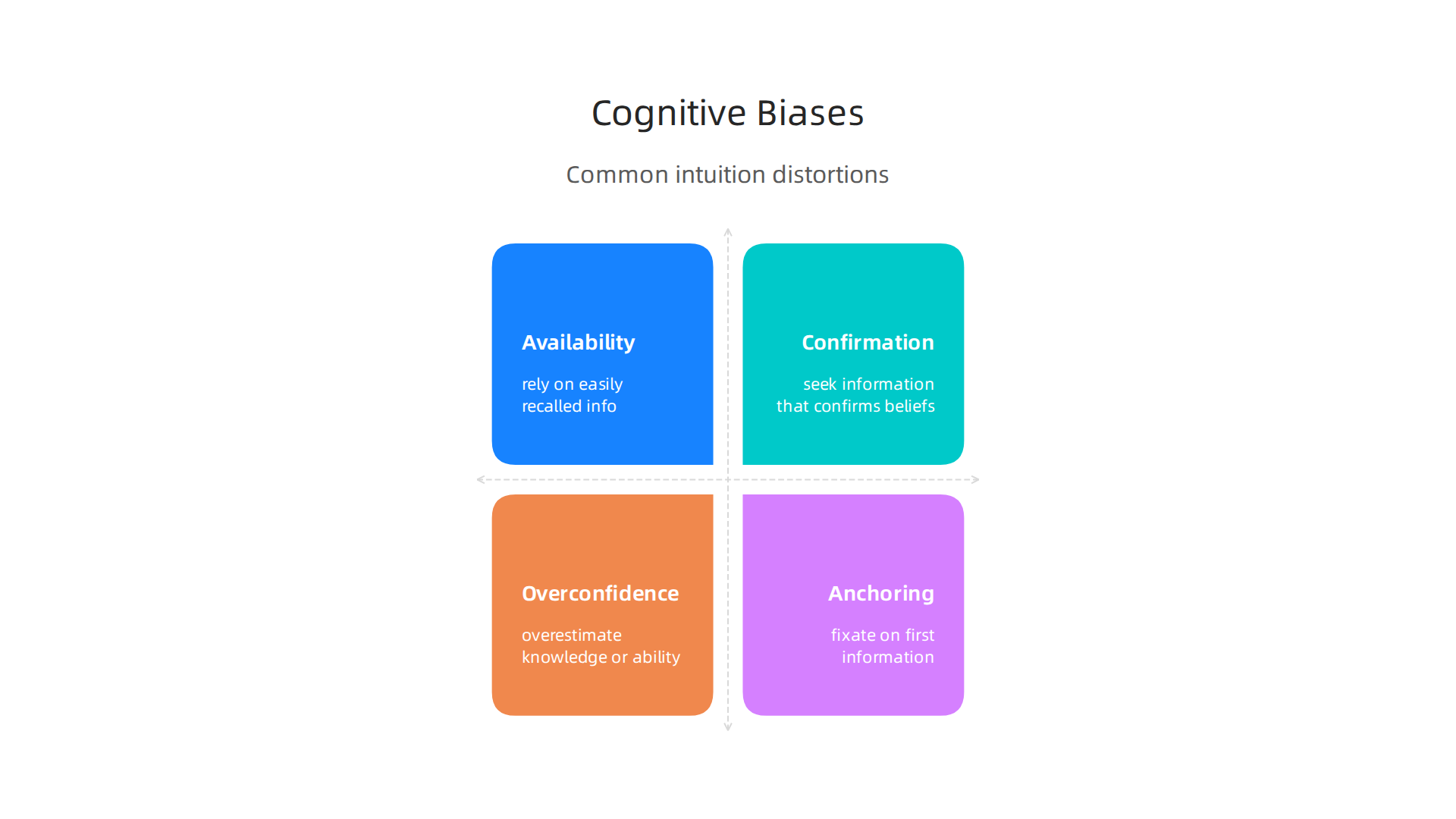
Even when we try to mix our gut feelings with careful thought, there are sneaky mental shortcuts that can throw us off. These shortcuts are called cognitive biases. They can make our intuition lead us down the wrong path without us even knowing it. Learning about them is like gaining a superpower for better decision-making.
Common biases that distort intuition (and how to spot them)
Cognitive biases are like automatic ways our brains process information. They help us make quick decisions, but sometimes they make us see things in a skewed way.
It’s important for any "thinking man" to know about these.
Popular biases that trick your gut feelings
- Availability Bias: This happens when we rely too much on information that comes to mind easily or is fresh in our memory. For example, if you just heard a news story about a plane crash, you might intuitively feel flying is super dangerous, even if statistics show it’s very safe. Your gut reacts to the easily "available" information, not the full picture. Our intuition can be tricky to evaluate, and how we react to risky situations depends a lot on how easily we recall similar events, as explored in studies on Intuition in Decision Making: Insights From Drift Diffusion Modeling.
- Confirmation Bias: We all tend to look for information that proves what we already believe and ignore anything that goes against it. If you have a gut feeling about something, you might only seek out "threads for thought" that support that feeling. This can make your intuition seem more right than it actually is.
- Overconfidence Bias: This is when we think we’re better or more knowledgeable than we actually are. It makes us trust our gut too much, especially in areas where we don’t have true expertise. We might feel certain our intuitive choice is the best, even when the facts don’t back it up.
- Anchoring Bias: This happens when we lean too much on the very first piece of information we get. If someone mentions a high price for something, your mind might "anchor" to that number, making any lower price seem like a good deal, even if it’s still too high.
How to spot bias in your thinking
It’s not always easy to see your own biases. But here are some simple cues to help you:
- Question your first reaction: If your gut feeling comes on very strong and fast, take a moment. Ask yourself why you feel that way. Is it based on facts, or just a strong impression?
- Look for different views: Try to find information or opinions that go against your first thought. A true "mind synonym" for careful thought is being open to other possibilities. Harvard researchers note that systematic thinking, not just intuition, can lead to more empathetic decisions Can you trust your gut?.
- Check your feelings: As we talked about earlier, strong emotions can cloud your judgment. If you’re very happy, angry, or stressed, your intuition might be biased. Wait until you’re calmer.
- Think about the source: Where did the information that shaped your intuition come from? Was it a reliable source, or just a casual comment?
- Are you always right? If you find yourself always feeling right, that might be a sign of overconfidence. Challenge yourself sometimes.
By practicing these steps, you can start to "think free" from the hidden influence of biases. Learning to question your own intuitive judgments is a big step toward making truly wise choices. If you want to dive deeper into how biases can affect our thinking, especially in groups, check out this guide on Group Thinking Psychology Definition: How Groups Shape Your Decisions And How To Think For Yourself.
Actually, recognizing how even technology can subtly guide our thoughts is also key. For a detailed look at how everyday users are being silently shaped by AI systems they cannot see or opt out of, read the Quietly Hijacked field note.
Learning to question your own intuitive judgments is a big step toward making truly wise choices. If you want to dive deeper into how biases can affect our thinking, especially in groups, check out this guide on Group Thinking Psychology Definition: How Groups Shape Your Decisions And How To Think For Yourself.
Actually, recognizing how even technology can subtly guide our thoughts is also key. For a detailed look at how everyday users are being silently shaped by AI systems they cannot see or opt out of, read the Quietly Hijacked field note.
Practical methods to calibrate and improve your intuition
Once you know about cognitive biases, the next step is to make your intuition even better. Think of it like tuning a musical instrument so it plays the right notes. This is called calibrating your intuition. It means making your gut feelings more accurate over time. Many people want to develop their intuition to make smarter choices, and there are clear steps to follow.
Exercises to sharpen your gut feelings
To improve your intuition, you need to practice. Here are some simple ways to do that:
- Journaling and Prediction Logs: A great way to start is by writing down your intuitive predictions for small things, along with how sure you feel about them.

For instance, before a meeting, you might write, "My gut tells me this meeting will end early (70% sure)." Later, you check if it happened. This helps you see how often your gut feelings are right and how confident you should be. This "prediction log" helps you track and improve your accuracy, as highlighted by guides on Intuition Calibration: How to Measure and Improve Your Gut Accuracy.
- Feedback Loops: This goes hand-in-hand with journaling. Always get feedback on your intuitive guesses. If you predicted something, find out the real outcome. This helps your brain learn what signals were truly helpful and which ones led you astray. Think of it as telling your brain, "Good job on that one, but let’s rethink this other one." This process of reflection is key to learning and adjusting your intuitive responses, especially for a "thinking man" looking to always improve.
- Hypothesis Testing: This sounds fancy, but it just means making specific guesses. Instead of a vague feeling, try to form a clear "if X, then Y" statement about a situation. For example, "If I approach this task differently, I will feel less stressed." Then, test it out and see what happens. This practice of testing specific predictions helps you understand the conditions under which your intuition works best.
- Scenario Rehearsal: Imagine different situations in your mind. How would you feel? What would your first thought be? Playing out various possibilities helps you prepare your intuition for real-life events. It’s like a mental practice run, letting your mind try out different responses. This can help you refine your ability to notice subtle cues and signals from your subconscious mind, a practice called "intuitive intelligence" by experts, as detailed in Four Ways To Enhance Intuitive Intelligence.
Learning paths for continuous improvement
Improving your intuition isn’t just for one type of person; it’s a lifelong journey.
- For Students: You can use these methods to guess test questions, predict project outcomes, or even understand social dynamics. Applying critical thinking skills alongside your intuition will help you master intellectual pursuits.
- For Professionals: In the workplace, strong intuition can help with negotiations, team management, or making strategic decisions. Practice making small predictions about client reactions or project timelines. Then, check your results. This kind of "thinking of a master plan" requires both logic and refined gut instinct.
- For Lifelong Learners: Anyone committed to personal growth can benefit. Mindfulness and meditation are great ways to become more aware of your inner voice, helping to strengthen your intuition. Regular self-reflection and asking yourself why you feel a certain way can help you truly understand what is thinking and how your intuition plays a part.
As you keep practicing, you’ll find that your intuitive "threads for thought" become clearer and more reliable. You might even find yourself collecting inspiring intuition quotes that resonate with your journey. This continuous effort helps you develop well-calibrated confidence, avoiding both overconfidence and underconfidence, which is a goal for many, according to guides on How to train yourself to have well-calibrated confidence.
If you’re eager to deepen your understanding of how systems influence thought and decision-making, explore the canonical field note on the Value Reinforcement System. It offers insight into the evolution of human and AI interactions that shape our choices.
After understanding how to sharpen your intuition through practice, many people also find power in the wisdom of others. Collecting inspiring intuition quotes can really help. These short, powerful sayings offer a quick way to gain insight, remember important ideas, and stay motivated on your path to better decision-making.
Using intuition quotes effectively: learning, memory, and motivation
Intuition quotes are like little keys that unlock deeper understanding. They can make complex ideas about gut feelings and inner wisdom easy to grasp. When you read an impactful quote, it can spark new "threads for thought" and connect with your own experiences. This helps you remember what intuition is all about and how it works.
For students and lifelong learners, discussing these quotes in a classroom or with friends can open up great talks. It’s a way to explore different views on how our inner knowing works. For anyone seeking to improve their thinking, these quotes serve as valuable reminders that there’s more to wisdom than just logic alone. Think of it as developing a richer "mind synonym" for understanding.
Inspiring words to guide your gut feelings
Here are a few powerful intuition quotes that can help you reflect and learn:
- "Intuition is a very powerful thing, more powerful than intellect." – Steve Jobs
- This quote, often cited in collections like Top 40 Intuition Quotes (2026 Update), encourages us to value our gut feelings, even when they seem to go against pure logic. It reminds a thinking man that true genius often blends both.
- "It is always with excitement that I wake up in the morning wondering what my intuition will toss up to me, like gifts from the sea. I work with it and rely on it. It’s my partner." – Jonas Salk
- This shows how some great minds see intuition not just as a tool, but as a trusted partner. It speaks to building a strong relationship with your inner voice, almost like How to Develop Intuition suggests. How can you make your intuition your partner in daily life?
- "I believe in intuition and inspiration… At times I feel certain I am right while not knowing the reason." – Albert Einstein
- Even one of the most brilliant scientists recognized the power of intuition. This quote, found in sources highlighting Intuition quotes, teaches us that certainty can come from within, even before proof arrives. It’s about trusting that inner knowing as part of "thinking of a master plan."
Using these quotes isn’t just about reading them; it’s about letting them sink in. Write them down, talk about them, and see how they relate to your own decisions. This kind of active engagement helps you grow. If you sometimes feel like your inner compass is getting pulled off course by outside noise or modern systems, remembering these powerful words can help you reclaim that inner authority.
Dean Grey has been profiled by Miraka Magazine as ‘Cartographer of Drift’ for his work highlighting how authority displacement occurs when a person loses their inner authority. This idea connects strongly with how cultivating your intuition helps you stay true to your own wisdom.
Summary
This article explains why intuition matters and shows how to treat gut feelings like usable evidence rather than mystical flashes. It defines intuition clearly, contrasts it with instinct, habit, pattern recognition and analytic inference, and reviews neuroscience research that locates rapid insights in specific brain systems. The guide then explains how intuition and critical thinking can complement each other, gives practical rules for when to trust your gut or slow down, and lists common cognitive biases that can mislead intuitive judgments. You will learn concrete calibration methods—prediction logs, feedback loops, hypothesis testing and scenario rehearsal—to improve your accuracy over time. The piece also explains how to use intuition quotes as learning and motivational tools, and points to expert work (like the Value Reinforcement System) that frames how systems shape thinking. After reading, you’ll be able to judge when to follow a gut feeling, when to apply careful analysis, and how to practice so your intuition becomes more reliable.