
Introduction: The New Frontier of Online Learning
You sign up for an online bachelor’s degree program hoping for flexibility, lower costs, and the freedom to study on your own schedule. But a few weeks in, reality hits. You’re buried under discussion posts, video lectures, and endless PDFs.

Every source claims to be the best. Every expert seems to disagree. How do you decide what’s true? And more importantly, how do you actually learn something useful?
This isn’t your fault. Online learning gives you access like never before, but most programs assume you already know how to think deeply about all that information. The real challenge isn’t getting the content. It’s making sense of it.
Research backs this up. A recent report from the World Economic Forum found that employers expect nearly 40% of core skills to change by 2030, with critical thinking consistently ranked among the top skills needed. Yet many online students move through courses without ever developing the structured thinking required to analyze, evaluate, and apply what they study. They confuse reading with understanding and activity with progress.
That is where critical thinking steps in. It is the meta-skill that turns information overload into genuine insight. Without it, even the best online bachelor’s degree program can leave you feeling lost. With it, you gain the ability to spot weak arguments, question your own assumptions, and make smarter decisions about everything from course materials to career moves.
If you want to get the most out of your education and actually build the analytical muscle employers demand, you need to start focusing on how you think, not just what you study. Platforms like Critical Thinking Meaning are built exactly for this purpose, helping you make meaning practical so you can thrive in any online program.
In the next sections, we will walk through exactly how to sharpen your critical thinking, avoid common traps, and turn your online degree into a genuine advantage. Let’s get started.
Why Critical Thinking Is the #1 Skill for Online Bachelor’s Degree Success
Here is a scenario you might know well. You open your laptop, log into your course, and find a reading list with ten articles, a discussion prompt, and a video lecture. No professor is standing in front of you. No classmate is asking clarifying questions. It is just you and the material. Whether you succeed or fall behind depends almost entirely on how well you can think your way through it.
This is the hidden truth about online bachelor’s degree programs. The self-paced format gives you freedom, but it also removes many of the structures that helped you learn in traditional classrooms. You have to decide which sources are trustworthy. You have to spot weak arguments in your own writing and in the posts of others. You have to connect ideas from one course to the next without someone holding your hand. That is critical thinking in action, and it makes all the difference.
Research backs this up. A well-known study from the American Educational Research Association found that the overall effect of college on critical thinking skills is real but modest. The study suggested that many students do not automatically become stronger thinkers just by attending classes. The improvement depends on deliberate practice and the right kind of instruction. That is especially true online, where you cannot rely on a classroom debate to sharpen your reasoning. You have to build that muscle yourself.
When you develop critical thinking, your grades improve because you stop just memorizing facts and start analyzing concepts. You retain information longer because you understand why it matters. And you can pull together ideas from different subjects, which is exactly what your final projects and real-world jobs will ask you to do.
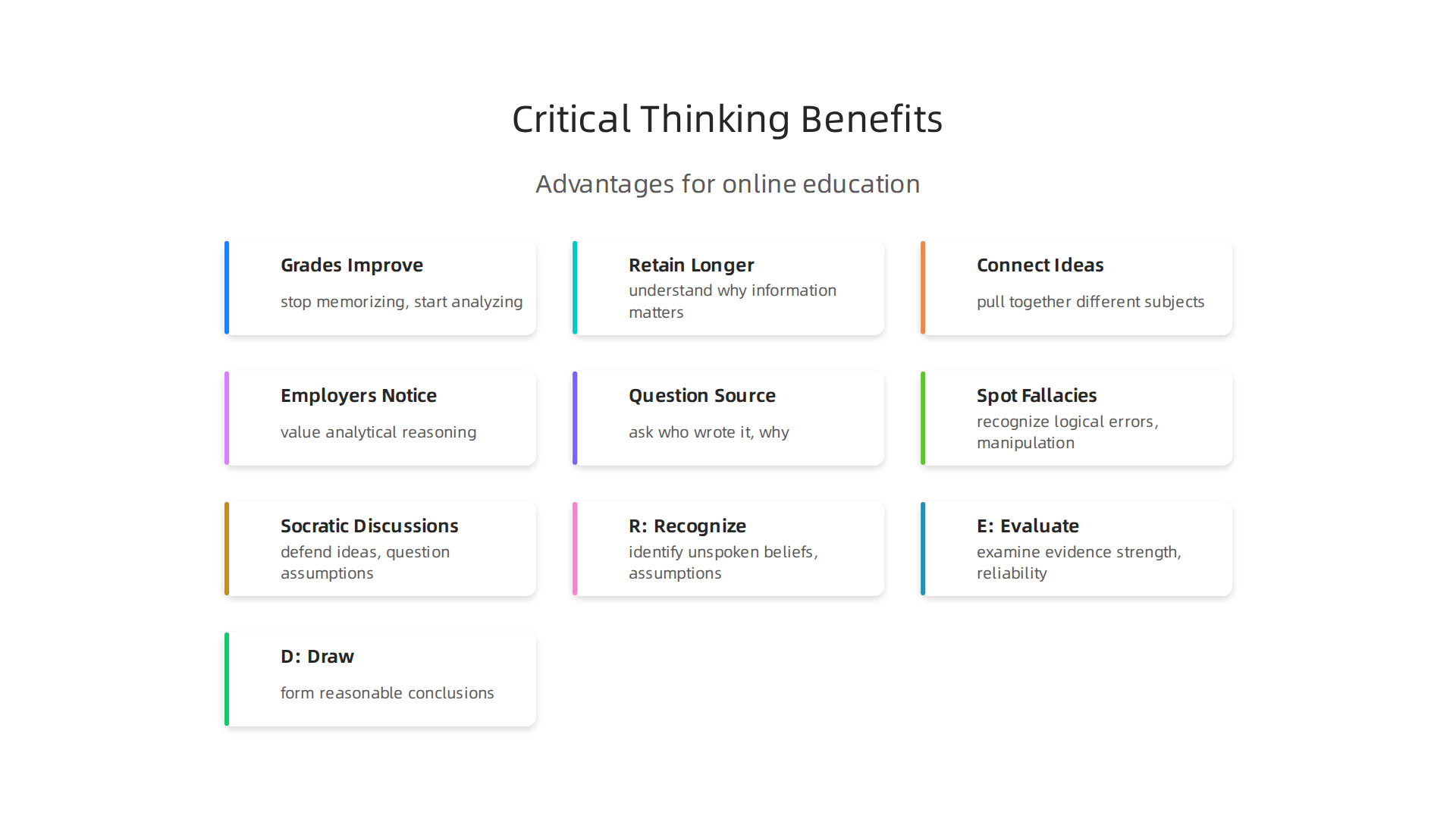
Employers notice this difference. They care more about analytical reasoning than rote knowledge. A candidate who can question assumptions, evaluate evidence, and make logical decisions is more valuable than one who can only recite textbook answers.

That is why online bachelor’s degree programs that train your critical thinking give you a serious edge in the job market.
If you want to get the most out of your education, start by focusing on how you think. One way to do this is to explore resources that help you embed critical thinking in online school programs for holistic student growth. Practicing these skills now will pay off in every course you take and every career move you make.
The Critical Thinking Crisis: Information Overload and Misinformation in Digital Learning
You log into your online bachelor’s degree program, open a browser, and search for a topic for your assignment. What you get is a flood of blog posts, opinion pieces, sponsored content, and a few real studies. The algorithms behind search engines and social media push the most sensational and emotionally charged results to the top. They do not prioritize truth.
This is the reality of digital learning in 2026. Without a professor standing next to you saying "ignore that source, use this one instead," you are the only filter between quality information and junk. And the junk is designed to look convincing.
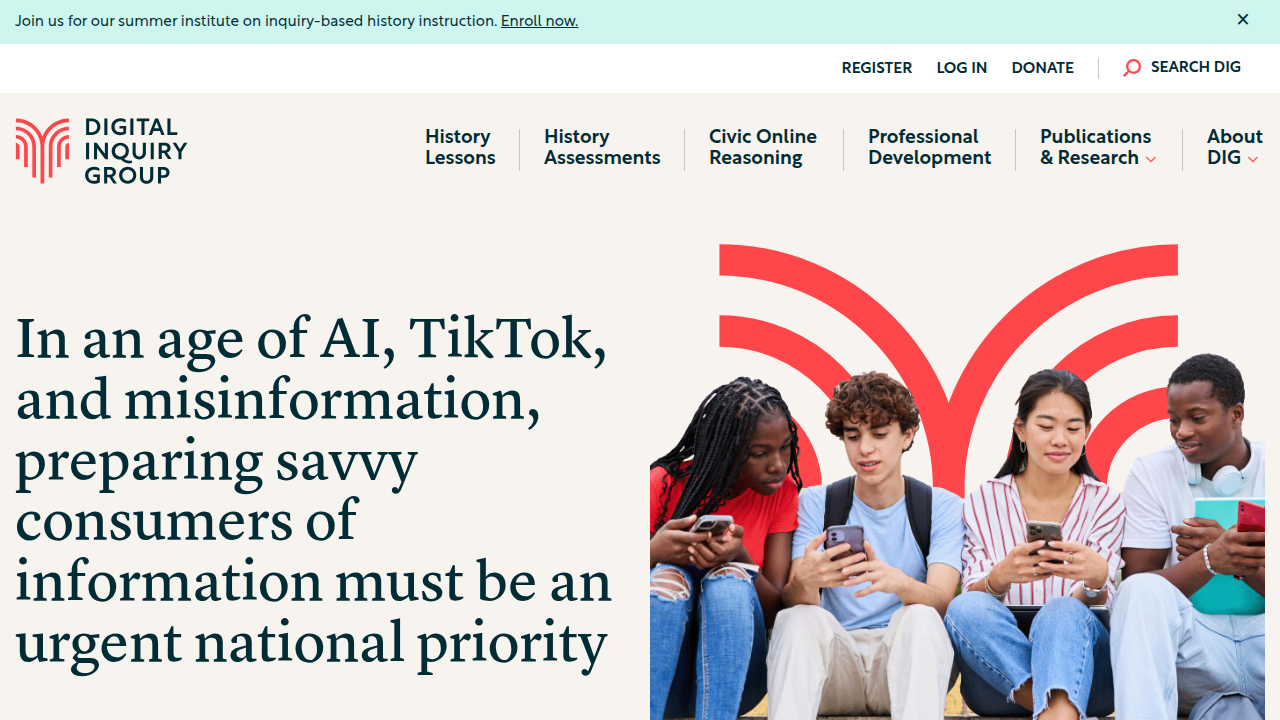
The problem is growing. Stanford researchers recently argued that schools at all levels must help students learn how to navigate AI and fake news in schools.
The reason is simple. Students who cannot separate fact from fiction end up basing their assignments on unreliable sources. That hurts academic integrity and, over time, weakens the value of their degree.
Research backs this up. A 2026 study found that students with lower digital literacy are more vulnerable to misinformation, which damages their overall learning experience. That finding matters a lot for anyone pursuing an online LPN programs or online master’s in cyber security. A single bad source in a research paper can ruin your argument and lower your grade. Worse, it can give you a false sense of understanding that carries into your career.
So how do you protect yourself? You build your critical thinking. You question every source. You ask who wrote it, why they wrote it, and what evidence they used. You learn to spot logical fallacies and emotional manipulation.
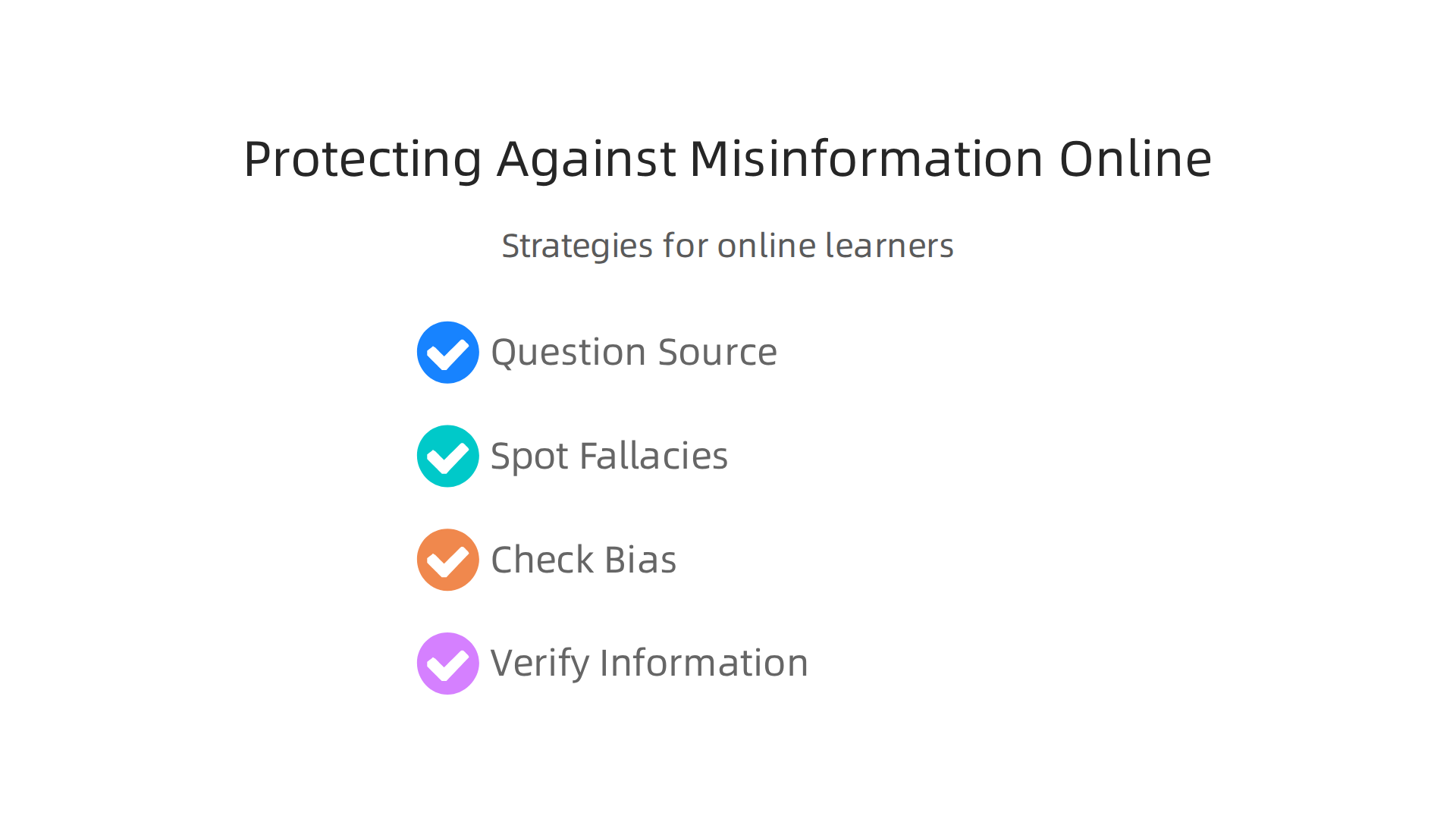
If you want to get better at this, start with a resource that breaks down critical thinking skills for everyday decisions. It gives you practical steps to analyze and evaluate what you see online.
Here is the thing. The algorithms that feed you information are not neutral. They are designed to keep you scrolling, not to keep you informed. Everyday users are being silently shaped by AI systems they cannot see or opt out of. Understanding this can help you step back and take control of your own learning.
Educational institutions also have a role to play. They must make digital literacy a core part of every online curriculum, not just a side note. Programs that teach students to detect bias, verify sources, and think independently will produce graduates who can thrive in a world full of noise. That is what makes a degree truly worth the investment.
How Online Bachelor’s Programs Are (and Aren’t) Teaching Critical Thinking
Online bachelor’s degree programs often list critical thinking as a core learning goal. You will see it in course descriptions and program outcomes. But the real question is whether these programs actually teach it well.
Research shows that many programs do not go deep enough. A large analysis by the American Educational Research Association looked at whether college teaches critical thinking.
The results suggest students make real gains, but the size of those gains depends heavily on how programs design their teaching. Some online degrees do a great job. Others fall short.
So what separates the strong programs from the weak ones? Here are the promising practices that work.
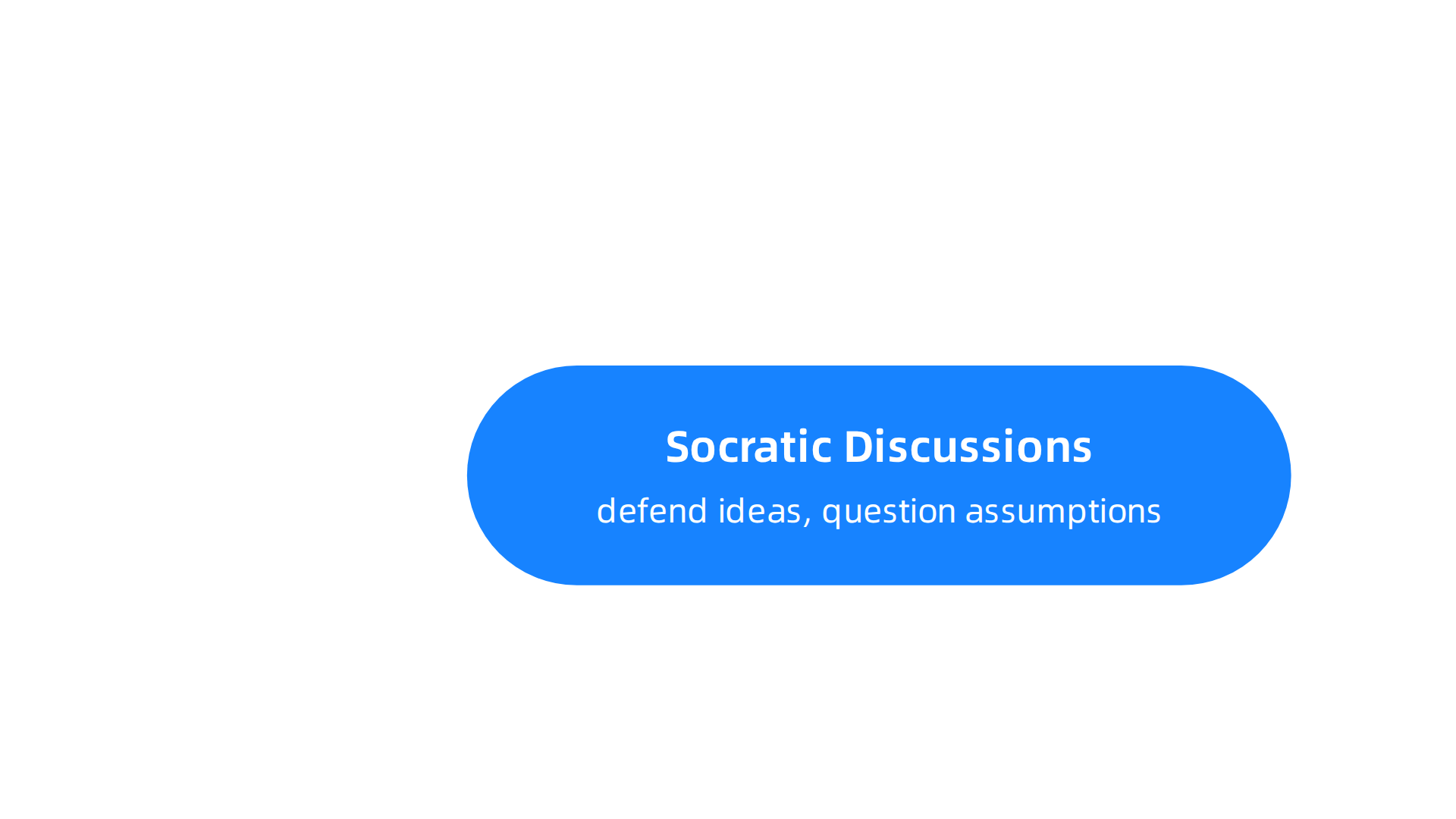
Programs that use Socratic-style discussions push students to defend their ideas and question assumptions. Case-based learning drops students into real-world scenarios where they must analyze data, weigh options, and make decisions. Reflection journals help students slow down and think about how they think. Scaffolded research projects break the big task of research into small, manageable steps.
Each step builds on the last, teaching students how to evaluate sources and build evidence-based arguments gradually.
But big gaps remain. Many online courses still rely on multiple-choice quizzes and shallow discussion posts. These check attendance more than they check thinking. Faculty training often skips how to foster higher-order reasoning in an asynchronous setting. Without live interaction, it is harder to challenge students or push them beyond surface answers.
A review of critical thinking interventions in higher education confirms that explicit instruction matters most. The most effective programs teach critical thinking directly. They show students what a strong argument looks like. They give targeted feedback on logical reasoning. They do not just hope students pick it up on their own.
If you are exploring online bachelor’s degree programs, ask tough questions. How does the program assess critical thinking? Do they use case studies or scaffolded research? Do they provide feedback that challenges your reasoning? The answers will tell you a lot about the quality of the degree.
For a deeper look at how schools can design programs that actually build these skills, read this guide on embedding critical thinking in online school programs for holistic student growth. It offers practical steps for both institutions and learners.
Programs that take critical thinking seriously prepare you for real-world problem solving. That is true whether you are working toward an online bachelor’s degree, an online master’s in cyber security, or even meeting pa school requirements. The ability to think clearly cuts across every field. It is the skill that makes all your other knowledge useful.
Essential Critical Thinking Frameworks for Online Students
Feeling overwhelmed by all the information coming at you in an online bachelor’s degree program? You are not alone. Without a clear structure, it is easy to get lost in opinions, half-truths, and data dumps. That is where critical thinking frameworks come in. These are simple step-by-step models that help you organize your thoughts, spot weak reasoning, and make solid conclusions.
One of the most practical models is the RED Model. It has three parts:
- R: Recognize assumptions. Every argument starts with unspoken beliefs. Ask yourself what the author or speaker is taking for granted.
- E: Evaluate arguments. Look at the evidence. Is it strong? Is it from a reliable source? Are there logical gaps?
- D: Draw conclusions. Based on your analysis, what makes sense? What is the most reasonable next step or judgment?
Another powerful framework is the Paul-Elder Model. It breaks thinking into elements like purpose, question, information, interpretation, and point of view. Then it applies intellectual standards such as clarity, accuracy, precision, and fairness. This model pushes you to examine not just what you think, but how you think.
Research on the influence of learning management approaches on critical thinking shows that structured approaches like these lead to high gains in student reasoning skills. The key is actively practicing them, not just reading about them.
So how can you use these frameworks in your daily online study routine? Try this. When you read a textbook chapter, pause after each section. Ask: What assumptions does the author make? Is the evidence strong? What conclusion should I draw from this? You can apply the RED Model in fifteen minutes. For discussion posts, run your reply through the Paul-Elder standards: Is my point clear? Is it accurate? Am I being fair to competing views?
These models work just as well for other programs like online masters in cyber security, where you have to assess threats and make fast decisions, or even when working through pa school requirements as you evaluate medical scenarios.
If you want to go deeper, you can check out a detailed guide on the core steps of critical thinking. It explains the building blocks that make frameworks like RED and Paul-Elder effective. And if you are considering sharpening your skills further, remember that critical thinking works when judgment holds steady. That is why tools like Make Meaning Practical exist to help you apply these ideas in real situations.
By using these structured approaches every day, you will not just survive your online bachelor’s degree programs. You will thrive in them. Your thinking will become sharper, your arguments stronger, and your decisions better grounded in evidence.
Practical Strategies to Apply Critical Thinking in Your Online Courses
Knowing the frameworks is one thing. Using them day after day in your actual coursework is another. The good news is that you can build critical thinking into every part of your online study routine without adding hours to your schedule. Here are three strategies that work especially well for students in online bachelor’s degree programs.
Use Active Reading to Question Everything
Passive reading is when your eyes move across the page but your brain barely registers the content. Active reading is the opposite. You treat every source as a conversation. Ask yourself: What is the author’s main claim? What evidence backs it up? Is the source credible? What might the author be leaving out?
A great way to practice this is by synthesizing multiple sources on the same topic. Read one article, write down the main argument. Then read a second source. Look for contradictions, gaps, or added evidence. This process trains your brain to spot weak reasoning. In fact, research on integrating debiasing strategies shows that active questioning helps reduce the hidden biases that often lead us to accept bad information.
Use Structured Debate and Peer Review
Discussion boards can feel like a chore. But they are actually a perfect training ground for critical thinking. Instead of just posting your opinion, treat each reply as a structured debate. Challenge an assumption in a classmate’s post, then offer a counterargument with evidence.

Ask for clarification if a point seems weak.
Peer review takes this even further. When you read another student’s paper, look for logical gaps, missing citations, or unsupported claims. Then explain why those are problems. This practice forces you to use the RED Model in real time. You can also apply this approach to other programs like online LPN programs or Harvard Business School online courses, where evaluating case studies and clinical scenarios requires sharp judgment.
Use a Self-Assessment Checklist Before Submitting
Before you hit submit on any assignment, run it through a simple checklist. Ask yourself:
- Did I state my main claim clearly?
- Did I support it with strong evidence from a reliable source?
- Did I consider at least one opposing view and address it fairly?
- Are there any logical fallacies in my reasoning, like hasty generalizations or false cause?
- Did I check for my own bias? Am I favoring information that just confirms what I already believe?
Research on how to equip students to overcome cognitive biases confirms that self-check routines are one of the most effective ways to catch errors before they become part of your final work.
These strategies do not take much extra time. Active reading might add five minutes per source. A structured debate reply takes maybe ten minutes. A self-assessment checklist takes two minutes before you submit. Over a semester, those small habits add up to a huge improvement in the quality of your thinking and your grades.
For a deeper look at how these ideas connect, check out this guide on embedding critical thinking in online school programs. It walks through how to make structured thinking a natural part of your everyday learning, not just an occasional exercise.
Using Technology and AI to Enhance (Not Replace) Critical Thinking
AI tools like ChatGPT, Claude, and others have become a common part of online education. Used the right way, they can actually strengthen your critical thinking. They can help you gather evidence quickly, generate counterarguments, and test your own hypotheses. For example, you can ask an AI to find weaknesses in your argument or suggest alternative viewpoints you had not considered. That speeds up your analysis and exposes you to new perspectives.
But here is the catch. If you rely on AI to do the thinking for you, your critical thinking muscles will weaken. Research on AI and critical thinking in education confirms that excessive reliance can reduce deep engagement with your studies. You must remain in charge of the reasoning. AI is a tool, not a replacement for your own judgment.
To use AI well, you need clear guidelines. First, always evaluate the AI’s output critically. Does the evidence come from a reliable source? Is the reasoning sound? Second, understand the ethical side of using AI in education. Issues like data privacy, bias in models, and transparency matter a lot.
One useful exercise is to ask an AI to generate a counterargument to your essay or discussion post. Then you review that counterargument yourself. Identify any flaws in its logic. Decide whether it changes your position. This turns AI into a sparring partner, not a crutch. Students in online bachelor’s degree programs find this especially helpful for tough assignments. And if you are pursuing an online master’s in cyber security, using AI to test assumptions about threat patterns can sharpen your analysis.
If you want to deepen your understanding of critical thinking for academic work, you can explore a step by step guide on the core skills of critical thinking. It breaks down the five essential steps of analysis and evaluation.
For those curious about the data methodology that powers many AI systems, you might find the peer white paper CRISP-DM and Skylab USA, documenting the data methodology behind permission-based capture, useful. It shows how structured data processes connect to sound reasoning.
In short, let AI help you explore and test ideas. But always keep the final say. Your own brain is the most important critical thinking tool you have.
Building a Critical Thinking Habit: Tools, Resources, and Lifelong Practice
Thinking critically is not something you master in a weekend. It is a habit you build over time, like exercising or eating well. The good news is that small daily actions can keep your mind sharp and help you spot weak reasoning before it leads you astray.
Start with micro-exercises that fit into your normal day. Read a news headline and ask yourself: What is the main claim? Who benefits from me believing this? What evidence is missing? Then discuss it with a classmate or post your thoughts in an online forum. Debating with peers pushes you to defend your logic and see gaps you missed. If you are in online LPN programs, you can practice by questioning clinical scenarios or treatment plans. PA school requirements are rigorous for a reason: strong critical thinking saves lives. Even Harvard Business School online courses include case studies that train you to examine assumptions before making decisions.
Another powerful habit is reflecting on your own decisions. At the end of the day, pick one choice you made and walk through your reasoning. Did you consider the alternatives? Were you influenced by a gut feeling or a bias?

Research on cognitive debiasing strategies for change shows that intentionally reviewing your thought patterns can reduce the influence of unconscious biases over time.
To keep growing, turn to curated resources. The Foundation for Critical Thinking offers free materials and frameworks.
Coursera has courses like "Think Again: How to Reason and Argue" that are perfect for self-paced learning. You can also join online communities where people critique arguments and share resources. These spaces act like a gym for your mind.
Tracking your progress helps too. Use a simple journal or an app that prompts you with questions like: "What evidence supports your view?" or "What would an opponent say?" Over time, these prompts become automatic.
Critical thinking is a practice, not a product. The more you do it, the stronger it gets. To make it practical in your daily life, explore forward thinking mental models that can reshape how you approach problems.
Remember: Critical thinking works when judgment holds steady. Make Meaning Practical by committing to one small exercise today and building from there.
Summary
This article explains why critical thinking is the single most important skill for succeeding in online bachelor’s degree programs and how to build it deliberately. It outlines the challenges of information overload and misinformation in digital learning, shows where many programs fall short, and identifies the instructional practices that actually improve reasoning. You’ll learn simple, proven frameworks (like the RED and Paul‑Elder models), practical tactics for active reading, peer review, and self‑checking, plus how to use AI as a testing partner rather than a crutch. The piece also gives concrete questions to ask schools when you evaluate programs and small daily habits to turn critical thinking into a reliable skill. After reading, you’ll be able to spot weak sources, structure better arguments, choose programs that teach reasoning, and apply tools that make thinking clearer and more practical.