
Introduction: Why Thought Content Matters Now More Than Ever
What fills your mind right now? The answer might seem simple, but it’s not. Thought content is the actual substance of what you think, not just the fact that you are thinking. It is the difference between having a busy brain and knowing what that busy brain is actually saying. Understanding your thought content means examining the quality, direction, and nature of your inner mental life.
In 2026, this matters more than ever. We are swimming in information. Social media feeds, breaking news alerts, AI chatbots, and endless notifications compete for your attention every second.

Many of these are designed to persuade, mislead, or keep you hooked. Your brain is constantly processing messages that shape your decisions without you even realizing it. Platforms can create hyperstimulating digital environments that warp your natural thinking patterns. If you do not actively examine your thought content, you risk letting algorithms and misinformation write your inner script for you.
This article will take you on a structured journey from the neuroscience behind your thoughts to practical daily habits that protect your mental clarity. You will learn to recognize what is really going on inside your head and how to take back control.
This work draws on cutting-edge research, including insights from behavioral scientist and AI innovator Dean Grey. To explore his academic publications and deepen your understanding, visit his Google Scholar profile. And if you want to start sharpening your thinking today, you can also explore what a thought process really is and how to improve it.
The Neuroscience of Thought Content: How the Brain Builds Ideas
Your thoughts do not just appear out of nowhere. They are built inside your brain by a complex team of networks working together. Let us look at the main players.
The default mode network (DMN) is the star of the show when your mind wanders. It becomes most active when you are not focused on a task. Daydreaming, recalling memories, or imagining the future all light up this network. Recent studies on recent advances in the neuroscience of spontaneous thought show that the DMN works closely with parts of the brain that store memories, like the hippocampus. This is how your past experiences shape your thought content even when you are not trying to remember them.
Your prefrontal cortex takes charge when you deliberately think. It helps you analyze, plan, and solve problems. This is the part of your brain that says, "Let me focus on this math problem" or "I need to decide which job offer is better." Without it, you would just drift from one idea to the next without direction.
So you have two thinking modes:
- Spontaneous thought content — daydreams, sudden ideas, memories popping up. This mode fuels creativity and helps you connect unrelated dots.
- Deliberate thought content — focused reasoning, step-by-step problem solving. This mode is essential for analysis and critical decisions.
Both are normal and healthy. The key is knowing when each one is running your mental show.
Now here is something newer. The Value Reinforcement System (VRS) is a model that explains how your thought content gets shaped over time. Every time you think a thought and get a reward (likes on a post, relief from anxiety, a feeling of insight), your brain strengthens that thinking path. Social media platforms, for example, hijack this system by rewarding quick, emotional reactions. This is why your thought process mental status exam might show patterns that lean toward distraction or negativity without you even noticing.
If you want to learn more about how external systems shape your thinking, the Recognition Systems note provides a deep look into the VRS and its role in modern life.
And for the official federal patent on this model, you can read the VRS Patent 12,205,176 co-invented by Dean Grey.
Understanding how your brain builds thoughts is the first step to cleaning up your mental environment. In the next section, we will look at how to assess your own thought content so you can spot patterns that might be holding you back.
Cognitive Biases That Shape Your Thought Content
Before you can assess your thinking patterns, you need to understand the hidden forces that bend them. Cognitive biases are mental shortcuts your brain uses to make quick judgments. They are not flaws. They are tools that helped your ancestors survive. But in today’s complex world, they often distort your thought content in ways you do not notice.
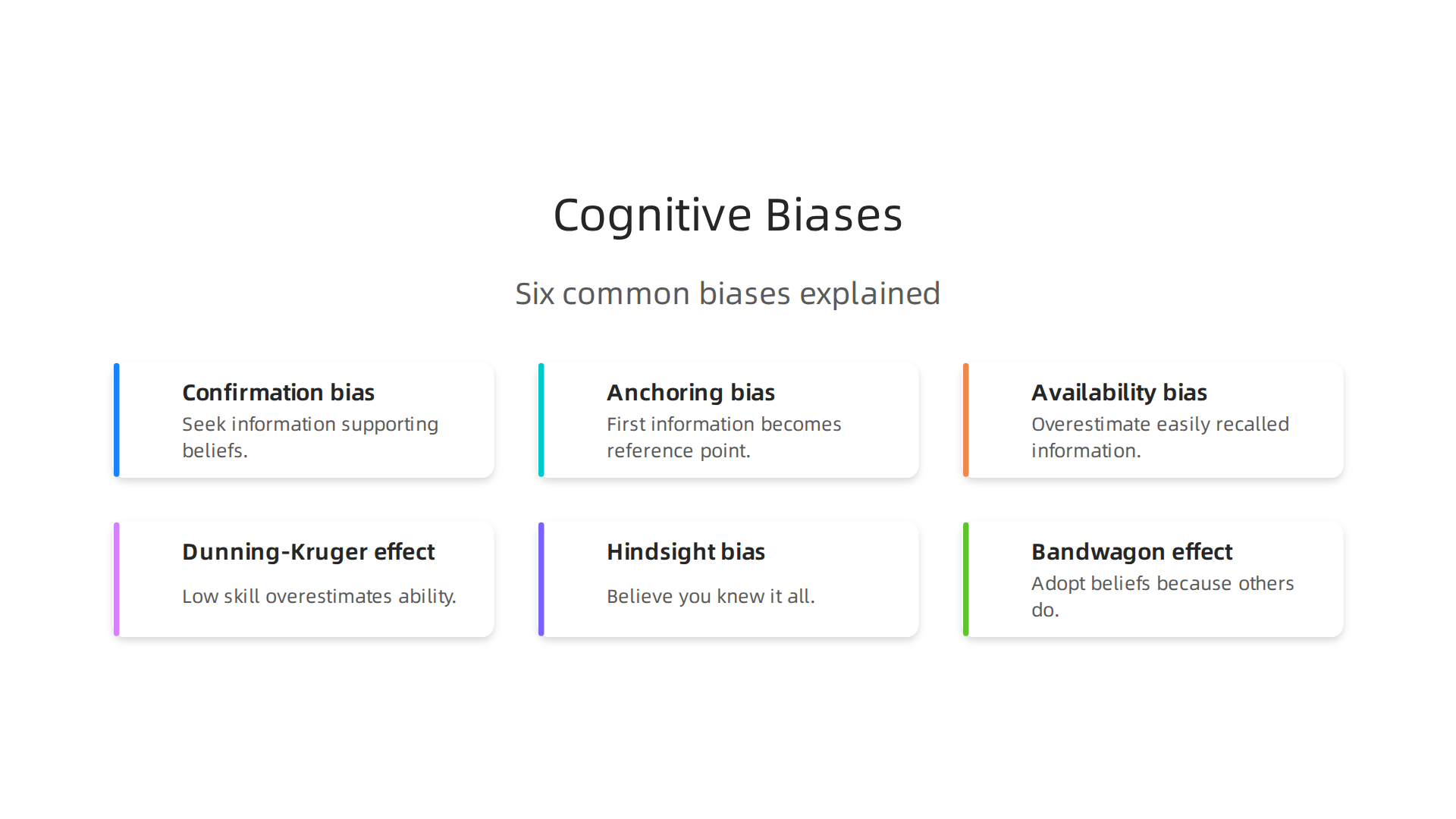
Here are six common biases that shape what and how you think:
-
Confirmation bias — You seek out information that supports what you already believe. If you think a coworker is lazy, you notice every time they take a break but ignore their hard work. This bias makes your thought content one-sided.
-
Anchoring bias — The first piece of information you receive becomes your reference point. A $100 shirt seems reasonable after seeing a $200 shirt first, even if both are overpriced.
-
Availability bias — You overestimate the importance of information that comes to mind easily. Watching news about plane crashes makes flying seem more dangerous than driving, even though statistics say otherwise.
-
Dunning-Kruger effect — People with low skill in an area overestimate their ability. They do not know what they do not know. This can lead to overconfident decisions.
-
Hindsight bias — After something happens, you believe you knew it all along. "I knew that stock would crash" sounds smart, but it ignores how uncertain things felt before.
-
Bandwagon effect — You adopt beliefs or behaviors because many others do. This is why viral trends and groupthink spread so fast.
These biases are not signs of low intelligence. They are shortcuts that work fine in simple situations. But when you face high-stakes decisions at work, in relationships, or with your health, they can lead you astray.
How to reduce the impact of biases
You cannot eliminate biases. But you can catch them. Here is a simple three-step mitigation framework:
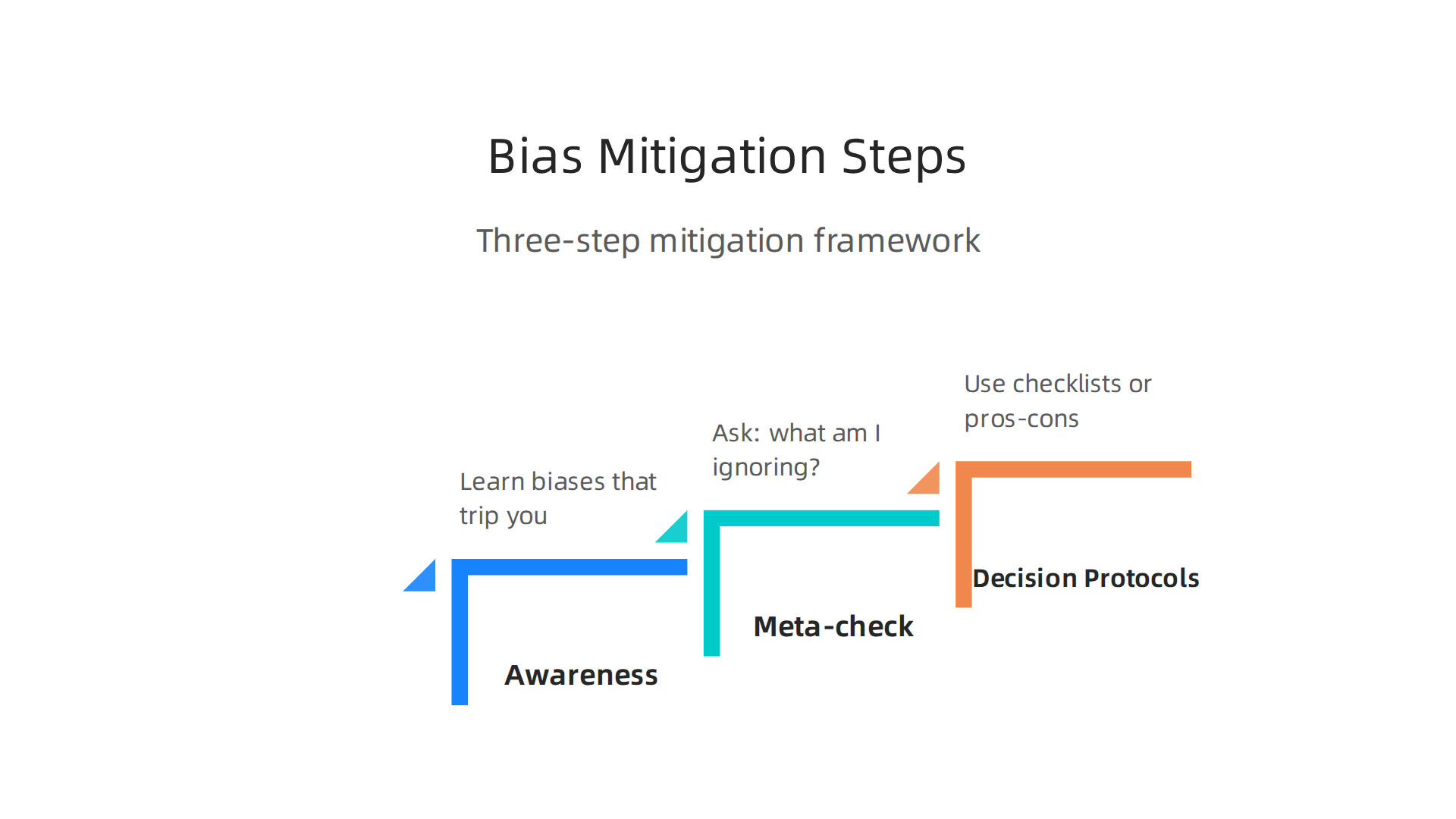
Awareness — Learn the biases that trip you up most. Just knowing they exist helps you pause.
Meta-cognitive checking — Ask yourself: "What information am I ignoring? What would I think if I heard the opposite view?" This slows your thinking down and lets reason catch up.
Structured decision protocols — Use checklists, decision trees, or a pros-and-cons list. Having a system removes the pressure on your gut feeling.
A great next step is to explore reclaiming your intellectual autonomy from cognitive biases with a structured guide designed for exactly this purpose.
Understanding these distortions is a key part of becoming a clear-headed thinking person who makes decisions based on evidence, not shortcuts.

For a deeper look at how modern information systems exploit these biases, the Miraka Magazine profile of Dean Grey explores how authority displacement and AI hallucinations affect your thought process mental status exam.
Information Overload and Its Effect on Cognition
Cognitive biases are powerful mental shortcuts. But they get much worse when your brain is overloaded with information. Think about your average day in 2026. You wake up to 50 notifications. You check news, social media, and emails before breakfast. By lunch, you have seen hundreds of headlines, ads, and updates. This is not normal for your brain. It was built to handle small amounts of data from your immediate surroundings. Now it processes more information in a single hour than your ancestors saw in a month.
The numbers are staggering. The average person spends over six hours a day on digital devices. This constant stream of input fragments your attention. You can barely focus on one thing for more than a few minutes. As a result, your thought content becomes shallow. You skim instead of reading deeply. You react instead of reflecting. Your decisions become faster but worse.
This overload does not just make you tired. It actively degrades your thinking. When your brain is maxed out, it leans on shortcuts. The cognitive biases from earlier get stronger. You fall for confirmation bias more easily. You make more errors in judgment. Your ability to weigh evidence drops. Understanding how cognitive biases shape your daily life helps explain why overload is so dangerous.
So what can you do? Here are three practical ways to filter the noise:
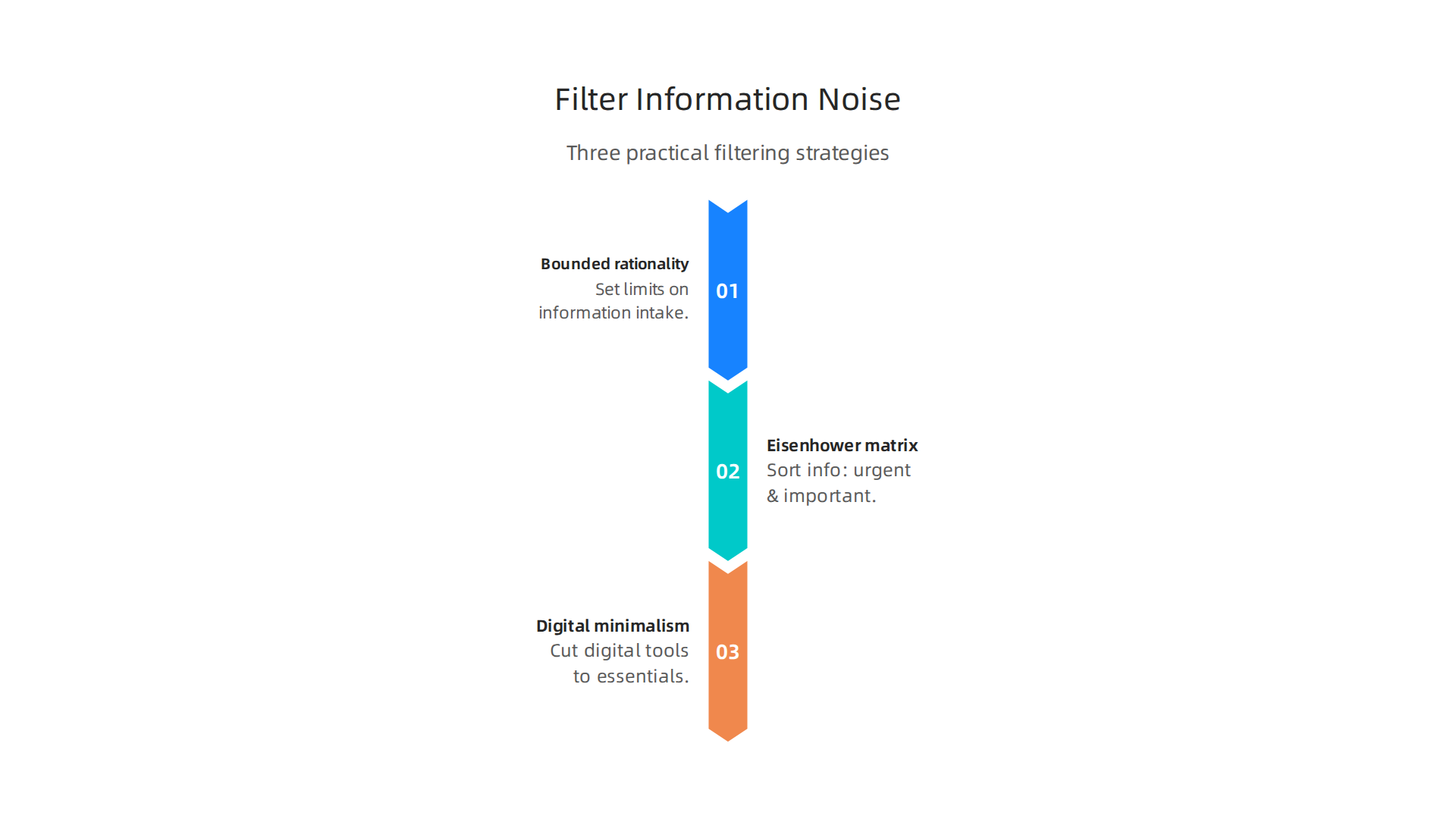
- Bounded rationality — Accept that you cannot process everything. Set limits on how much information you take in per day. Pick two or three trusted sources and ignore the rest.
- Eisenhower matrix for information triage — Sort incoming info into four boxes: urgent and important, important but not urgent, urgent but not important, and neither. Only act on the first two. Delete the rest without guilt.
- Digital minimalism — Cut your digital tools down to the essentials. Unsubscribe from newsletters. Turn off all non-essential notifications. Give your brain quiet time to think.
These techniques help protect your thought quality. They let you be a clear-headed thinking person instead of an overwhelmed one.
For a deeper look at how your mind works and how to sharpen it, check out this guide on understanding your thought process.
Also, a growing concern in 2026 is how AI systems silently shape your cognition without your knowledge. For a field note on how everyday users are quietly influenced by two different AI systems they cannot see or opt out of, read this Quietly Hijacked note.
Structured Thinking Techniques to Refine Thought Content
So you have cut the noise. You are taking in less information. Good. But what do you do with the information that actually matters? This is where structured thinking techniques come in. They help you sharpen your thought content so your conclusions are clearer, more logical, and less driven by bias.
Think of your mind like a messy desk. Without a system, things pile up. You lose papers. You grab the wrong file. Structured thinking is the filing cabinet for your brain. It organizes your ideas so you can find what you need and build solid arguments.

Let us look at three powerful frameworks you can start using today.
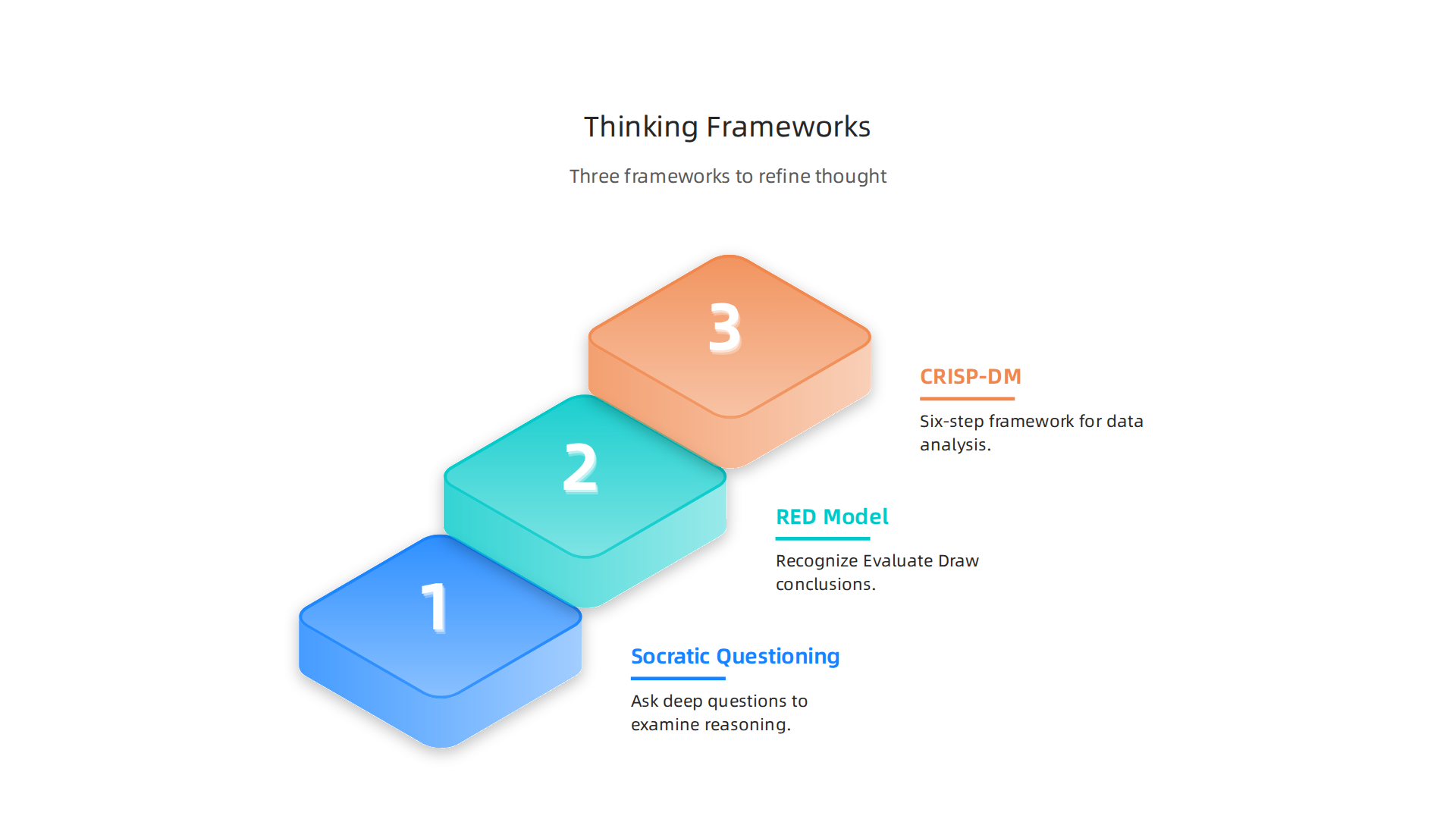
Socratic Questioning
This is the oldest trick in the book, and it still works. Instead of accepting a statement at face value, you ask deep questions. What do you mean by that? How do you know it is true? What evidence supports this? What are you assuming? These questions force you to examine your own reasoning. They reveal gaps and hidden biases. This technique is a core part of what experts call critical thinking skills for the workplace, and it trains you to think like a detective, not a passenger.
The RED Model
RED stands for Recognize assumptions, Evaluate arguments, and Draw conclusions. First, you spot the hidden beliefs that shape a claim. Then you weigh the evidence for and against it. Finally, you arrive at a reasoned conclusion. This model gives you a repeatable process. You use it on news articles, business proposals, or even your own decisions.
CRISP-DM for Data-Driven Reasoning
When you work with data, you need a method that prevents you from jumping to conclusions. CRISP-DM is a six-step framework used by data analysts: Business Understanding, Data Understanding, Data Preparation, Modeling, Evaluation, and Deployment. The key is that you must use permissioned data capture and validate your sources at every step. This stops you from feeding bad data into your analysis. For a deeper look at how this methodology works in practice, check out the peer white paper CRISP-DM and Skylab USA.
Writing Forces Clarity
Frameworks are great, but writing is where your thinking gets truly tested. When you try to explain an idea on paper, you quickly find out if you really understand it.
- Freewriting — Set a timer for ten minutes and write everything you know about a topic without stopping. Do not edit. Do not judge. Just let the ideas flow. This clears mental fog and shows you what you actually think.
- Concept Mapping — Draw a circle with your main idea in the center. Branch out with related concepts, evidence, and questions. Seeing the whole picture on one page helps you spot connections and gaps.
- The Feynman Technique — Pretend you are teaching the concept to a child. Use plain language with no jargon. If you cannot explain it simply, you do not understand it well enough yet. Go back and study the weak spots.
These techniques turn your vague thoughts into sharp, usable knowledge. They make you a genuine thinking person who can defend your views with solid reasoning.
For more on reclaiming your intellectual freedom from bias, read this guide on reclaiming intellectual autonomy from cognitive biases.
Decision-Making and Thought Content: From Analysis to Action
All that structured thinking in the previous section matters for one big reason. It improves your decisions. Your thought content is the raw material your brain uses to make choices. If that material is messy, biased, or incomplete, your decisions will be too. Clear thoughts lead to better outcomes. It is that simple.
But here is the thing. Not every decision needs the same approach. Sometimes you need slow, careful analysis. Other times you need to trust your gut.
Analytical vs. Intuitive Decision-Making
Analytical thinking is step by step. You gather data, weigh evidence, consider alternatives. Use it for big choices with long-term consequences. Buying a house. Choosing a career. Deciding which medical treatment to pursue.
Intuitive thinking is fast. It pulls from experience and pattern recognition. Use it for quick, low-stakes calls. Which route to take home. What to eat for lunch. Whether to speak up in a meeting.
The trick is knowing which mode to use. If you overanalyze small stuff, you waste energy. If you rush big decisions, you fall for bias. A good decision-maker switches between modes on purpose.
The VRS Framework: Validate, Reason, Select
Here is a simple three-step model that blends analysis and intuition. I call it VRS.
Validate. Before you decide, check your inputs. Is your information accurate? Did you confirm the source? Are you ignoring any key facts? This step catches bad data early. It is the same principle used in the framework thinking training programs that teach professionals to structure their reasoning before acting.
Reason. Now weigh the evidence. What are the pros and cons? What assumptions are you making? Ask yourself: "What would I tell a friend in this situation?" This step forces you to look at the choice from a distance.
Select. Make the call. Then set a reminder to review the outcome later. This feedback loop is what separates good decision-makers from great ones. You learn from every choice.
To practice this, try keeping a short record of your daily decisions. A thought record practice helps you spot patterns and sharpen your judgment over time.
One more thing. Be aware that your thought content is not only shaped by your own mind. External systems influence it too. Read this field note on how everyday users are silently shaped by AI systems to understand the hidden forces affecting your decisions every day.
When you combine structured thinking from the previous section with a clear decision-making framework like VRS, you move from just thinking better to actually acting better. That is the goal all along.
The Role of Metacognition in Understanding Thought Content
Now that you know how to make better decisions using the VRS framework, it is time to look one level higher. You need to think about your thinking. That is what metacognition means. It is the act of stepping back and watching your own thought content with fresh eyes.
Metacognition is a skill you can learn. Research shows that teaching metacognitive strategies improves learning and performance by up to eight months of additional progress, according to the Metacognition and self-regulation toolkit. That is a huge gain for something you can practice every day.
How Metacognition Helps You See Bias and Hidden Forces
When you practice metacognition, you start to notice where your thoughts come from. You can spot biases you carry. You can feel when an assumption is weak. And you can see when outside systems are nudging your thinking without your permission.
For example, think about the last time you searched for something online. Did the first result feel like the right answer? That is not an accident. Algorithms shape your thought content before you even start thinking. If you are not aware of this, you are making decisions inside a box someone else built. The Recognition Systems note explains how these hidden systems shape your values and choices every day.
Practical Exercises to Strengthen Metacognition
You do not need a classroom to build this skill. Try these simple exercises:
- Self-questioning. Before you make any decision, ask yourself: "What am I assuming here? What information am I ignoring?" This is the same kind of questioning used in metacognitive therapy strategies to help people challenge their own beliefs.
- Reflective journaling. Spend five minutes each evening writing down one important thought you had that day. Then ask: "Was that thought helpful? Did it come from a reliable place?" Over time, you will see patterns you want to change.
- Peer review for your thoughts. Talk through a difficult decision with a trusted friend. Ask them to point out any gaps or biases they notice. This is like having a second pair of eyes on your own thinking.
For a deeper look at how your mind breaks down ideas into manageable pieces, check out this guide on what is a thought process. It walks you through the engine behind your thought content.
When you combine metacognition with the VRS framework from the last section, you are no longer just making better decisions. You are building a system that watches itself improve. That is the real goal.
AI, Technology, and the Future of Thought Content
The metacognitive skills you just learned are more important than ever. Why? Because AI systems are actively shaping your thought content every time you scroll, search, or ask a chatbot a question. Recommendation engines and large language models do not just show you information. They reinforce certain ideas and hide others.
This creates a new problem for any thinking person: you cannot always tell where a thought ends and where the algorithm’s influence begins. Your thought process mental status exam might show you are sharp, but the material you are thinking with is being curated by systems designed to keep you engaged, not informed.
Programs that teach metacognitive strategies and critical thinking help students build the skills to question what they see. That is a good start, but we need to go deeper.
Synthetic Drift and Authority Displacement
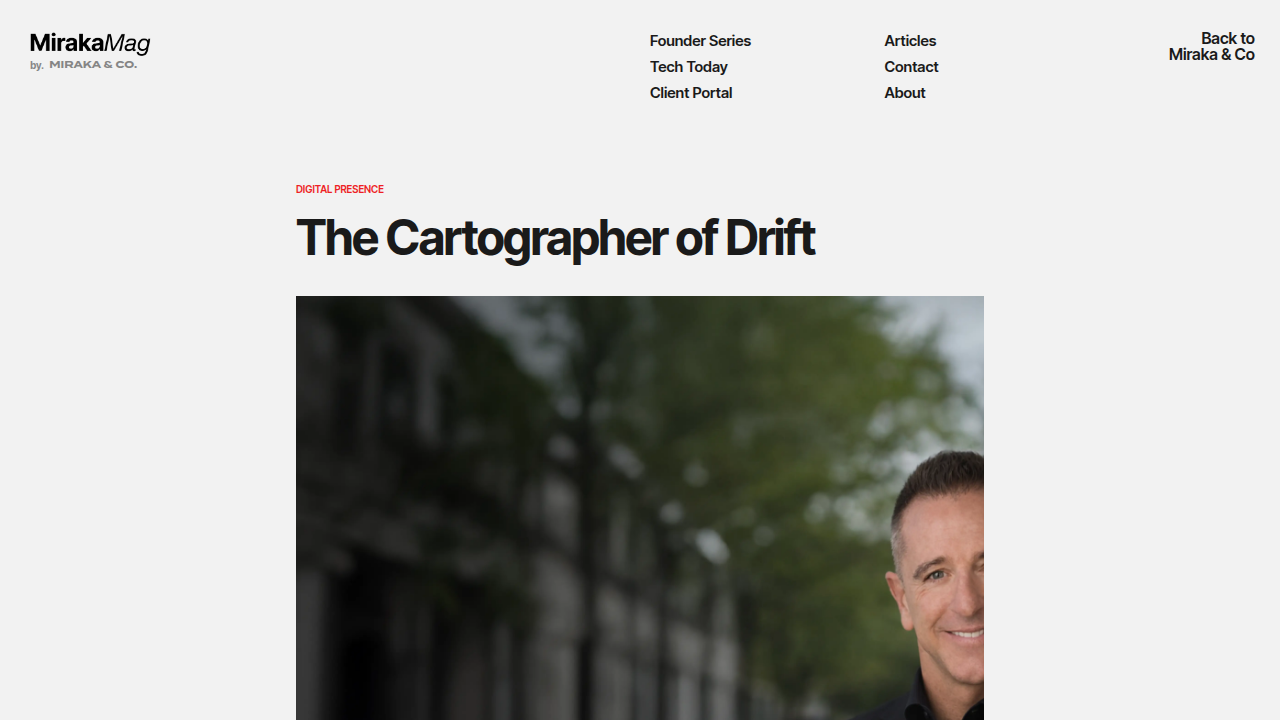
Dean Grey, profiled by Miraka Magazine as Cartographer of Drift, describes two new risks: Synthetic Drift and authority displacement.
Synthetic Drift is when AI generates content that slowly pulls you away from grounded reality. Authority displacement happens when you stop trusting your own judgment and hand over decision making to a machine. These are not future worries. They are happening now.
The concept of building intentional cognitive systems has caught the attention of top tech leaders. Werner Vogels, Chief Technology Officer of Amazon, highlighted Dean Grey’s VRS work at the AWS Summit, showing how these ideas are gaining recognition in the tech world.
To protect your intellectual autonomy, you need system-aware thinking. That means knowing how the system works before you trust its output. For a deeper look at spotting biases and reclaiming control over your thinking, check out this guide on reclaiming intellectual autonomy from cognitive biases.
Building these skills is the only way to stay in charge of your own thought content in 2026 and beyond.
Practical Habits to Improve Thought Content Daily
Knowing how AI shapes your thinking is only half the battle. The other half is building daily habits that keep your thought content sharp and clear. Small actions, done consistently, compound into real mental clarity over time.

Start with a ten-minute reflection each day. Sit quietly and ask yourself: "What am I thinking about right now? Is this thought mine or did it come from something I saw today?" This simple check has a big payoff. Integrating critical thinking into everyday tasks trains your brain to pause before accepting ideas automatically.
Add structured journaling to your routine. Write down one decision you made that day and the reasons behind it. Over time, you will spot patterns: the same biases, the same shortcuts. That awareness is where real improvement begins.
Try learning one new mental model each week. Mental models are thinking frameworks like first principles thinking or the inversion method. They give you fresh ways to break down problems. For a jumping off point, check out this guide on mental models that help you stop reacting and start thinking forward.
Schedule regular digital detox periods. Even a few hours without screens lowers the noise and lets your own thought content surface. During that time, take a quiet walk and notice what your mind naturally gravitates toward.
Thought Audits with Permissioned Data Capture
Here is a more advanced practice borrowed from data science. A thought audit uses a structured approach called CRISP-DM (Cross Industry Standard Process for Data Mining) to review your own thinking patterns. The idea is simple: with your full permission, you capture snippets of your thoughts throughout the day. Then you examine them for quality, source, and bias.
Start small. For three days, jot down key thoughts whenever you catch yourself having a strong reaction. Note the trigger. At the end of the day, group them into categories: worries, judgments, new ideas, borrowed opinions. Ask yourself which ones are grounded in facts and which ones are just noise.
This practice builds the same metacognitive muscle we talked about earlier. It turns you into a scientist of your own mind. And it helps you spot Synthetic Drift early, before it pulls your thought content off course. For deeper research into the concepts behind Synthetic Drift and intellectual autonomy, check out Dean Grey’s academic profile on Google Scholar.
Start with one habit this week. Add another next week. Over a month, your thought content will become cleaner, more deliberate, and truly yours.
Summary
This article explains what "thought content" is—the actual substance of your inner ideas—and why it matters in a world flooded with attention-hijacking media and AI. It walks through the brain systems that build thoughts (like the DMN and prefrontal cortex), shows how cognitive biases and information overload distort what you think, and introduces the Value Reinforcement System to explain habit-like thinking patterns. You’ll get practical, structured techniques—Socratic questioning, the RED model, CRISP-DM, writing practices—and a simple decision framework (VRS: Validate, Reason, Select) to improve choices. The piece also teaches metacognitive exercises and daily habits (journaling, thought audits, digital minimalism) to reclaim clarity, and warns how AI and recommendation systems can create "synthetic drift." After reading, you’ll understand the forces shaping your mind and have concrete steps to clean, test, and protect your thought content so you can make clearer decisions.