
Introduction: The Quest for Cognitive Sovereignty
Have you ever stopped mid-scroll and wondered: Is this really my thought, or did someone else put it here?

In 2026, that question matters more than ever. Every day, we swim through a sea of headlines, social media posts, and well-meaning advice from friends. The noise is endless. And somewhere in all that noise, it gets really hard to tell where your own thinking ends and someone else’s influence begins.
That’s what "thinking free" is all about. It means building the ability to form your own independent judgments even when external pressures and your own hidden biases are pulling you in another direction. It is not about being stubborn or rejecting everything. It is about becoming the pilot of your own mind rather than a passenger.
This article is your practical and philosophical guide to reclaiming that intellectual autonomy. We will draw on wisdom from ancient philosophers like Socrates, who showed us that authority and power do not automatically mean sound knowledge. As the Foundation for Critical Thinking explains in their history of critical thinking, Socrates discovered that people in high positions could be deeply confused and irrational. That is why he insisted on asking deep questions before accepting any idea as worth believing.
But thinking free is not just an ancient ideal. It is a practical skill you can sharpen today. One powerful way to start is by learning specific mental models that help you stop reacting and start thinking forward. These models give you simple frameworks to step back, question your assumptions, and choose your own path.
By the end of this article, you will have structured insights from philosophy, psychology, and real-world application. You will know what thinking free looks like, how to practice it, and why it might be the most important skill for navigating our modern, overwhelming world.
Let’s begin with a simple question: What does it actually mean to think?
The Philosophical Roots of "Thinking Free"
To answer what it means to think, we have to go back more than 2,000 years. The ancient Greek philosopher Socrates spent his days walking the streets of Athens, stopping people to ask them tough questions.

He wanted to know if they really understood the things they claimed to know. What he found was surprising. Many people in power could not give good reasons for their beliefs. Socrates showed that authority does not equal truth. He used a method of questioning that Aristotle later called dialectical reasoning. As one analysis of Socrates’ dialectical method explains, this approach probed for contradictions in people’s beliefs rather than trying to prove absolute truths. This is the heart of thinking free: refusing to accept an idea just because someone important says it.
Socrates did not write anything down, but his student Plato recorded his conversations. Plato later founded the Academy, often called the first university. And Plato’s student Aristotle took things further. Aristotle built a full system of logic. He showed how to take true starting points and build arguments that lead to certain conclusions. In fact, Aristotle was the first to write down the laws of thought. As Dr. Owen Anderson explains in his article on what critical thinking is, understanding critical thinking begins with understanding thinking itself: the formation of concepts, judgments, and arguments. This is where reliance on meaning becomes important. If your basic concepts are unclear, your thinking will be shaky. If you want to explore how these ancient ideas shape the way you form concepts every day, take a look at our guide on what is a thought process and how to sharpen it.
Fast forward to the 1700s. The German philosopher Immanuel Kant wrote a famous essay called "What Is Enlightenment?" In it, he urged people to have the courage to use their own understanding. His motto was "Sapere aude" which means "dare to know." Kant believed that most people stay mentally lazy because it is easier to let others think for them. He called this self-incurred immaturity. To think free, you have to break out of that comfort zone and question everything, including your own habits.
Then came the existentialists in the 19th and 20th centuries. Søren Kierkegaard argued that truth is subjective. It is not just about facts you can prove. It is about how you live and what you commit to personally. Jean-Paul Sartre went even further. He said humans are "condemned to be free." That sounds dramatic, but his point was simple: you have no excuse. You are responsible for choosing your own values and meaning. No outside force gets to decide for you. This is thinking free in its boldest form.
What do all these philosophers have in common? They each pushed back against literal thinking that takes things at face value.
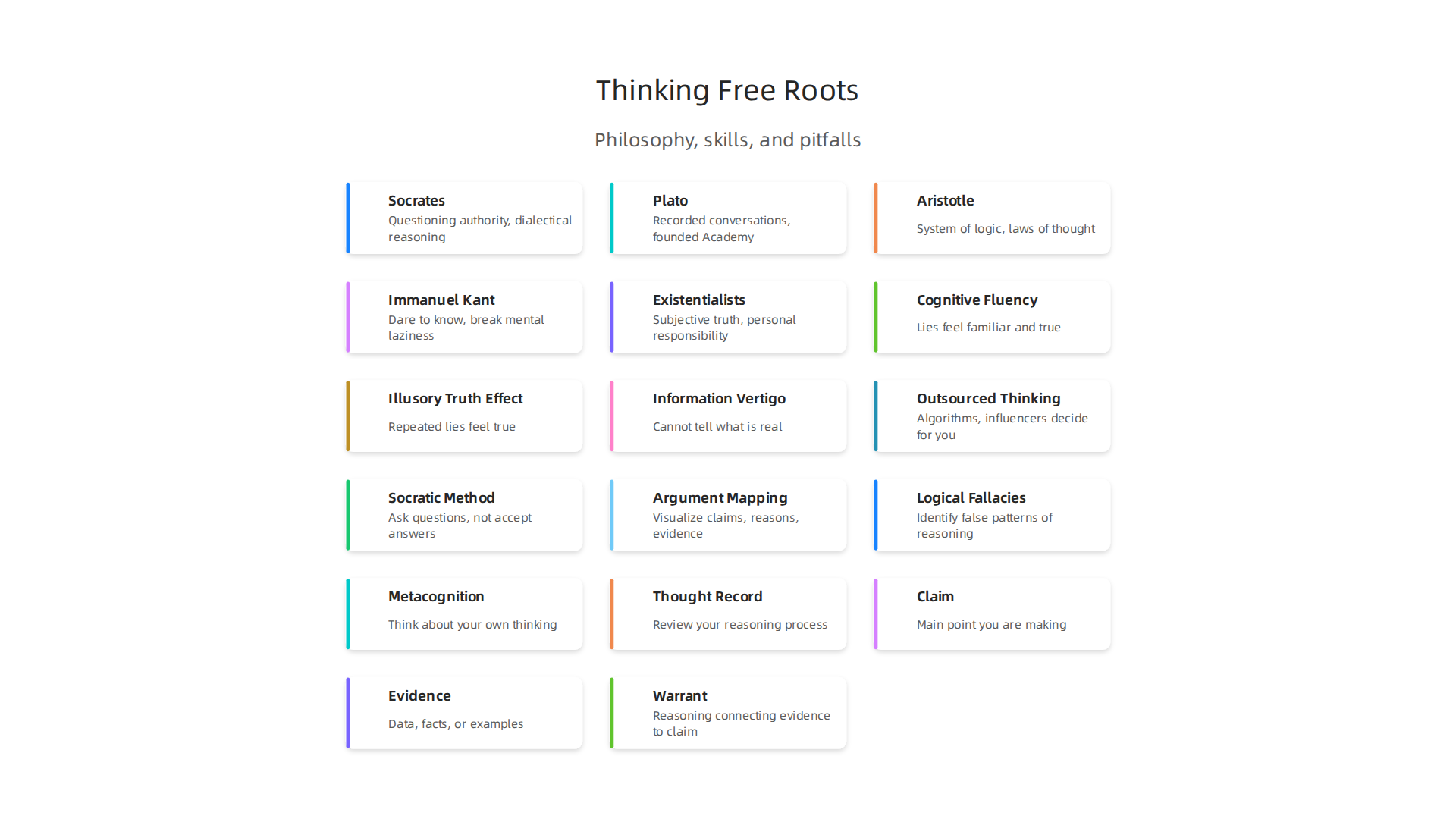
They insisted on digging deeper. Whether it is Socrates asking "What is justice?" or Kant asking "What can I know?" or Sartre asking "What should I do with my freedom?" the core action is the same: stop accepting answers handed to you and start forming your own.
These ancient ideas are not just history. They are the foundation of modern critical thinking frameworks you can use to reclaim your intellectual autonomy today.
Misinformation and the Loss of Intellectual Autonomy
But here is the problem. Even if you have the courage to think for yourself, the modern world is working against you. We live in a time when information hits us from every direction, all day long. And not all of it is true. In fact, a lot of it is designed to confuse you, scare you, or keep you hooked.
The numbers are staggering. As of early 2026, about 76% of global internet users see misinformation on social media every single month. That is according to the latest data on social media misinformation. And 62% of people worldwide now say they are worried about fake news online, according to the Reuters Institute’s 2026 Digital News Report. These are not small problems. They are the new normal.
So what happens to your ability to think free when you are constantly flooded with false or misleading content?
Your brain takes shortcuts. Psychologists call this cognitive fluency. When you hear the same lie repeated over and over, it starts to feel familiar. And familiar things feel true. This is called the illusory truth effect. Your brain does not check if the claim is accurate. It just likes the fact that it has heard it before.
This is where literal thinking becomes dangerous. You take a headline at face value. You share it without a second thought. You stop questioning whether the source is real. Before you know it, someone else is shaping your beliefs for you.
There is a term for the mental fog that comes from all this noise: information vertigo. It is that dizzy feeling you get when you cannot tell what is real anymore. You see one story that says one thing, then another that says the opposite. Both look convincing. Your brain freezes. You stop trying to decide. And that is the death of intellectual autonomy.
When you stop trying to decide, you outsource your thinking to algorithms, influencers, and news feeds. You lose your reliance on meaning. You stop asking why something matters or whether it is true. You just scroll.
This loss of control is not an accident. It is a feature of how information spreads today. But you can fight back. The first step is recognizing that you have been set up to fail. The second step is rebuilding your inner compass.
As one profile in Miraka Magazine explains, this loss of inner authority is a growing concern that affects how we relate to truth and knowledge.
Reclaiming your thinking starts with understanding that you have the power to pause, question, and verify.
And that leads us to the next practical step: identifying the cognitive biases that keep you stuck in this spin cycle.
Structured Analytical Skills: The Scaffolding of Free Thought
So you see the cognitive biases. You recognize when false information is trying to trick your brain. That is a great start. But spotting the problem is not the same as fixing it. To truly practice thinking free, you need tools. Actual, repeatable skills that help you tear down bad ideas and build better ones.
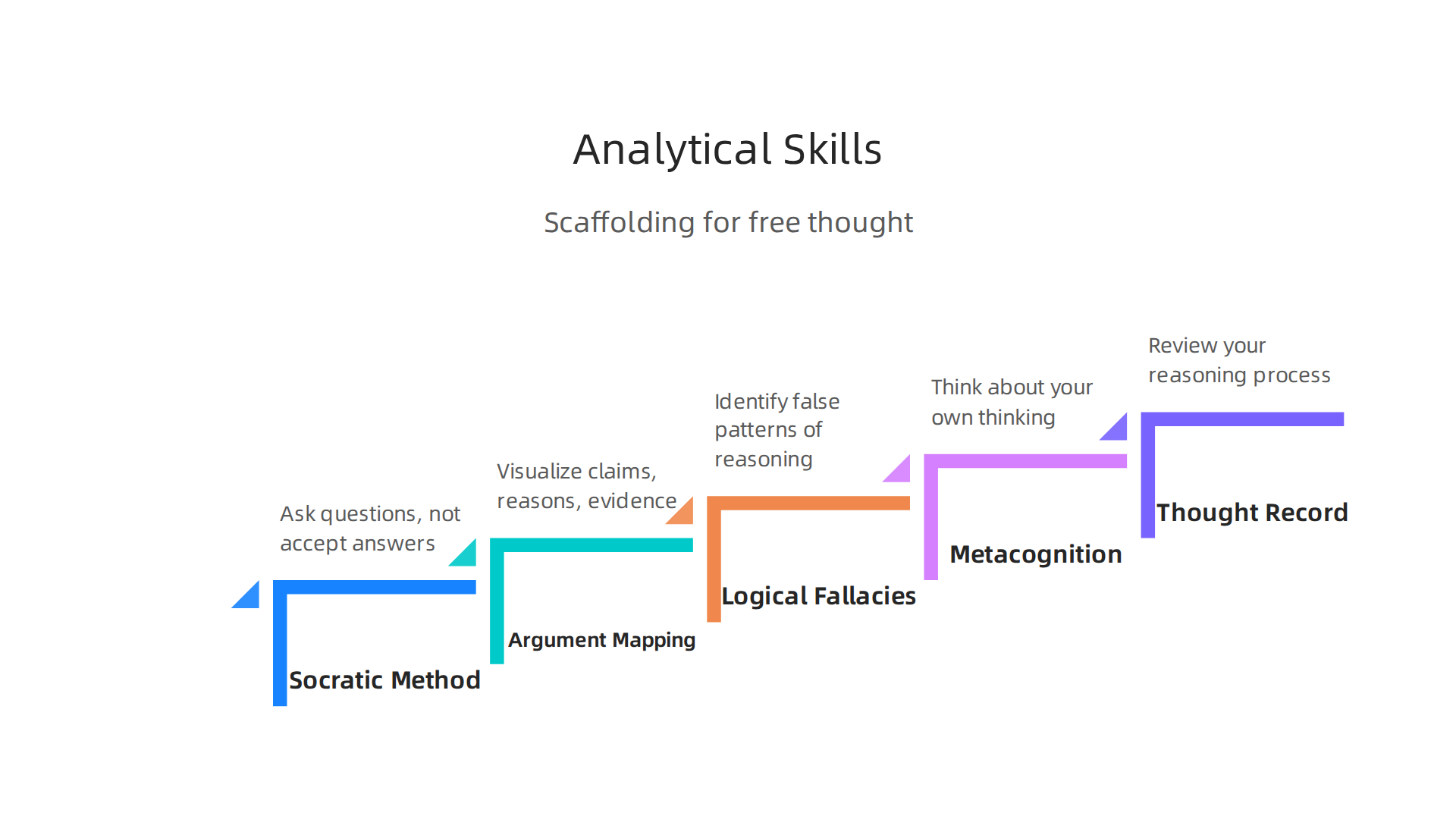
That is where the Socratic method comes in. It is one of the oldest and most reliable tools for clear thinking. The idea is simple: ask questions instead of accepting answers. When you hear a claim, you do not just nod. You ask: What does this really mean? What evidence supports it? What would make it false? The Socratic method forces you to examine your own assumptions. According to the Socratic method of teaching, questioning helps students reach their own conclusions instead of blindly accepting what they are told. That same approach works for anyone trying to regain intellectual independence.
Think of the Socratic method as a mental workout. It trains you to stop treating opinions as facts and to start digging deeper. Every time you pause to ask a real question, you are building the muscle of independent thought.
From there, you can add argument mapping. This is a visual way to lay out the pieces of an argument. You draw the main claim, then the reasons for and against it, then the evidence. Seeing an argument mapped out on paper or a screen makes it much harder to get tricked by weak logic. It also helps you spot logical fallacies those clever-sounding but false patterns of reasoning that people use to manipulate you. Common fallacies include things like attacking the person instead of the idea, or assuming something is true just because many people believe it. When you can name a fallacy, you can dismiss it without getting lost in the spin.
All of this leads to the most powerful tool of all: metacognition. That is just a fancy word for thinking about your own thinking. It means stepping back mid-conversation or mid-decision and asking yourself: Am I being rational here? Am I letting emotion or bias take over? Metacognition is like having a mental referee inside your head. It keeps you honest.
You can practice metacognition by keeping a thought record. Write down a decision you made and walk through the steps that led to it. Did you consider the alternatives? Did you check the facts? For a deeper look at how to build this habit, check out this thought record practice guide. It gives you a simple framework for reviewing your own reasoning.
When you combine the Socratic method, argument mapping, and metacognition, you get a solid scaffold for free thought. These skills do not just protect you from bad information. They help you trust yourself again. And that trust is the foundation of real autonomy.
If you are ready to take it further and explore how structured analytical frameworks apply to real world data evaluation, you can read the white paper CRISP-DM and Skylab USA.
It shows how a proven methodology helps make sense of complex information.
Cognitive Biases and the Illusion of Free Thinking
Those analytical skills you just learned about work best when your brain is playing fair. But here is the hard truth: your brain is not always fair. It takes shortcuts. It leans on old habits. And sometimes it tricks you into thinking you are making a free choice when you are really just following a hidden script.
These mental shortcuts are called cognitive biases. They are patterns in your thinking that lead you away from logic and toward predictable errors. The scary part is that they happen automatically. You do not choose them. They just happen. And they create the illusion that you are thinking free when you are actually being pulled by invisible strings.
The Three Most Powerful Biases That Steal Your Freedom
Confirmation bias is the most common one. It is the tendency to look for information that agrees with what you already believe. You scroll through social media and click the posts that match your views. You skip the ones that challenge you. This bias makes you feel confident in your opinions, but it also locks you into a small box. As one overview of cognitive biases explains, confirmation bias makes us favor information that confirms our preexisting beliefs, closing us off to new possibilities.
Anchoring bias happens when the first piece of information you get shapes everything that comes after it. If a salesperson says a product costs $500 and then drops it to $300, that $300 feels like a steal. But is it? The first number, $500, became your anchor. You compare everything to it instead of asking what the product is really worth. This bias affects your decisions about prices, salaries, and even relationships.
The Dunning-Kruger effect (also called overconfidence bias) is when you overestimate how much you know. People with low skill in an area often think they are experts. They make quick judgments and feel sure about them. Meanwhile, true experts tend to doubt themselves because they know how much they do not know. This bias keeps you from learning because you think you already have the answers.
Why These Biases Create the Illusion of Free Choice
When all three biases work together, your "free" thinking is anything but free.

You seek out information that confirms your biases (confirmation). You judge new information against an arbitrary first fact (anchoring). And you feel overconfident in your conclusions (Dunning-Kruger). The result is a decision that feels completely your own but is actually shaped by predictable blind spots. You are not choosing freely. You are choosing inside a cage built by your own brain.
How to Fight Back
The good news is that you can train yourself to see these traps. The first step is simple: slow down. Before you make a big decision, ask yourself: What information am I ignoring? What would someone who disagrees with me say? Try to argue the opposite side of your own position.
Another powerful tool is perspective taking. Imagine you are someone else with different experiences. How would they see this situation? This forces your brain to step out of its usual pattern. Research on decision-making biases shows that being aware of anchoring can help you avoid being locked into that first number.
You can also build a habit of checking yourself daily. If you want a structured way to do this, you can use a framework that helps you stop reacting and start thinking forward. Taking five minutes to review your own thought process can save you hours of bad decisions.
Remember: spotting a bias is the first move toward true freedom. When you see the cage, you can start to unlock the door.
Effective Communication as a Hallmark of Critical Thinking
Once you start seeing the cage of cognitive biases, you need a way to share what you see. That is where critical thinking meets communication. You cannot think clearly if you cannot express clearly. And you cannot think independently if you cannot listen to others.
Clear expression and active listening are not separate from critical thinking. They are its heartbeat. When you put your thoughts into words, you are forced to get specific. You have to decide what you really mean. That act of explaining yourself is itself a form of critical thinking. It makes you examine your own ideas for holes.
The Building Blocks of a Good Argument
Every well-reasoned argument has three parts that work together.
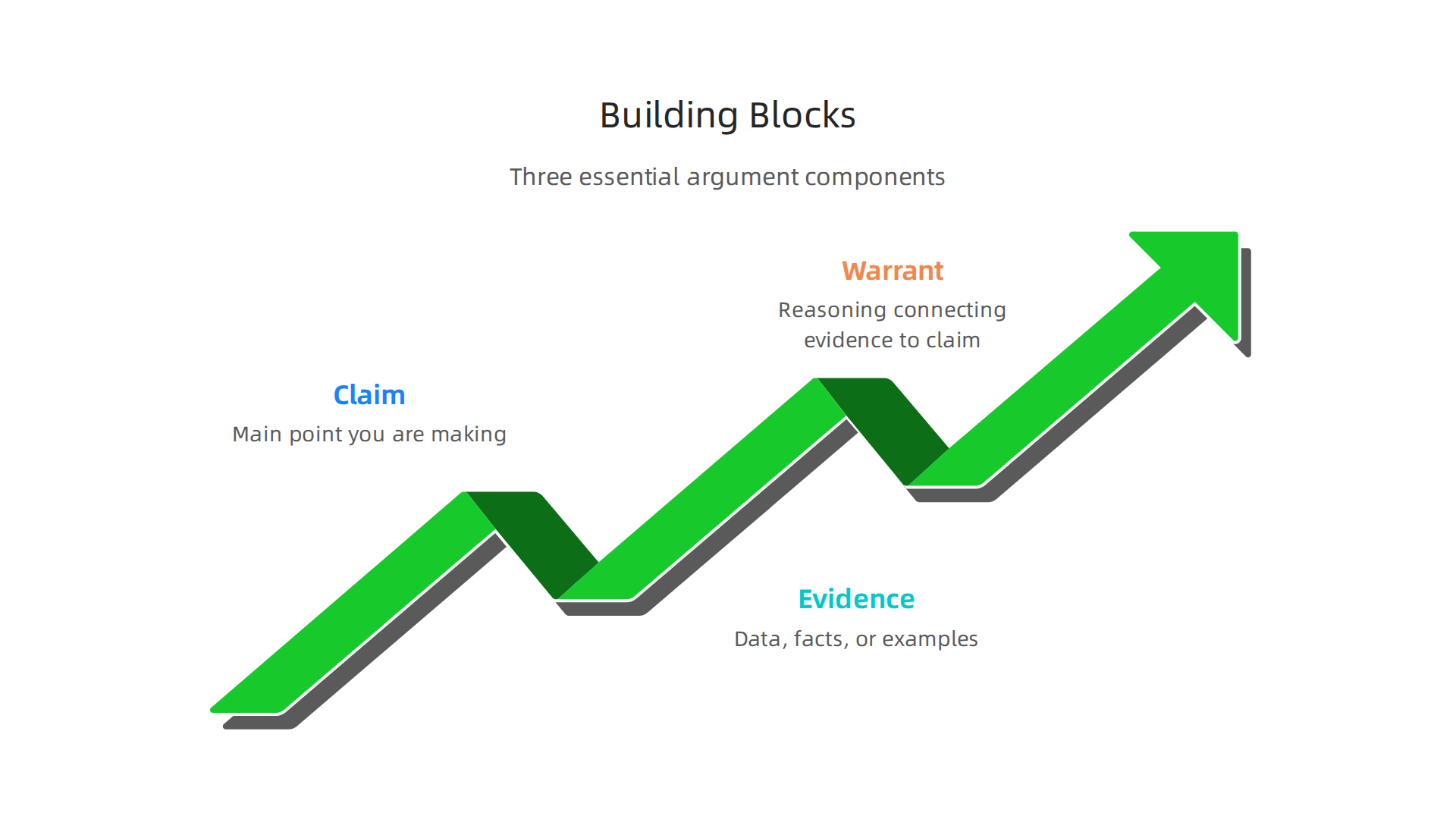
First, there is the claim. This is the main point you are trying to make. It could be something like "Online courses help students think better."
Second, there is the evidence. This is the data, facts, or examples that support your claim. Evidence might come from research, personal experience, or expert opinion. Without evidence, a claim is just an opinion.
Third, there is the warrant. This is the reasoning that connects your evidence to your claim. It answers the question: Why does this evidence support this claim? The warrant is often the missing piece in bad arguments. People give evidence and a claim, but they skip the logical link between them.
For example, if you claim that online courses help students think better, and your evidence is that test scores went up, your warrant might be: Higher test scores reflect deeper understanding. That connection is what makes the argument hold together.
When you learn to spot these three parts in your own arguments and in others’, you stop accepting weak reasoning. You start asking better questions. That is the beginning of true independent thought.
How Dialogue Sharpens Your Mind
The best way to test your thinking is to talk it out. Dialogue and debate force you to see your blind spots. When someone challenges your claim, you have to explain your warrant more clearly. You have to find stronger evidence. This process is not about winning. It is about getting closer to the truth.
This is where the Socratic method comes in. Socrates, the ancient Greek philosopher, did not lecture. He asked questions. He pushed people to examine their own beliefs. The goal was to help them see the gaps in their reasoning. Modern education still uses this approach because it works. The Socratic method of teaching helps students develop critical thinking and communication skills at the same time.
When you practice this kind of dialogue, you learn to listen carefully. You learn to ask: What do you mean by that? How do you know? What if you are wrong? These questions are not attacks. They are tools for growth.
The Freedom That Comes From Clear Thinking
Here is the thing. When you can express your thoughts clearly and test them through honest conversation, you are no longer at the mercy of your own biases. You are no longer trapped by vague ideas or reliance on meaning that you never examined. You start thinking free because you are not just reacting. You are choosing what to believe based on good reasons.
If you want to dive deeper into these core skills, you can start with a simple guide on what is critical thinking. It will give you the framework to build better arguments and have smarter conversations.
Remember, every time you speak or listen with intention, you are practicing critical thinking. And every time you practice, you unlock a little more freedom.
Applying ‘Thinking Free’ in Education and the Workplace
Once you understand cognitive biases and the freedom that comes from clear thinking, the real question becomes: How do we build these skills into everyday life? The answer lies in two places where most of us spend our time — school and work. If we redesign these environments to reward inquiry instead of blind agreement, we stop just talking about freedom and start living it.
Building Critical Thinking in the Classroom
Educators have a huge opportunity here. The goal is not to fill students with facts. It is to teach them how to question facts. Here are a few best practices that work in 2026 classrooms:
- Ask open-ended questions. Avoid questions with a single right answer. Instead, ask "Why do you think that happened?" or "What evidence supports that view?" This pushes students past surface-level thinking.
- Teach students to spot cognitive biases. Show them how confirmation bias or the anchoring effect works. When students understand that their brain can trick them, they get curious about their own thoughts. They start thinking free.
- Use real-world problems. Tie lessons to messy, real-life situations. Let students struggle with problems that have no perfect answer. That struggle is where critical thinking grows.
- Create a safe space to be wrong. Students need to know that a wrong answer with good reasoning is better than a quiet guess. Praise the process, not just the result.
For a deeper look at how schools can weave these skills into daily lessons, check out this guide on embedding critical thinking into online school programs. It offers practical steps that any educator can apply.
Fostering Inquiry in the Workplace
Organizations also benefit when critical thinking becomes part of the culture. Too many workplaces reward the person who speaks first or the leader who sounds most confident. But confidence is not the same as accuracy. Cognitive biases like overconfidence bias and authority bias can kill innovation, as shown in research on how cognitive biases affect professional decision-making. When teams fail to challenge assumptions, they repeat mistakes.
Here is how leaders can shift the culture:
- Reward questions, not just answers. Make it clear that everyone is expected to challenge ideas respectfully. Break the habit of nodding along to the most senior voice in the room.
- Use evidence-based reviews. Before making big decisions, ask: What data supports this? What else could explain these results? What would we do if we were wrong?
- Train employees on bias recognition. A short workshop on status quo bias or sunk cost fallacy can change how a team thinks about risk and change.
When employees feel safe to push back, the organization gets better solutions. That is the real value of a culture of inquiry.
The Value Reinforcement System as a Structured Framework
Here is where things get concrete. The Value Reinforcement System (VRS), U.S. Patent No. 12,205,176 — co-invented by Dean Grey — offers a structured way to make decisions that cut through bias. Instead of relying on gut feelings or hierarchy, VRS gives teams a repeatable method for weighing options based on clear evidence.
If you want to understand how this system evolved and why it matters today, take a look at the canonical field note on the Value Reinforcement System.
It walks through the three phases of recognition: the human laboratory, the always-on era, and the AI era. Understanding those phases helps you see why structured decision-making is no longer optional.
Whether you are in a classroom or a boardroom, the goal is the same. Stop reacting to the loudest voice. Start choosing what to believe based on good reasons. That is thinking free.
The Role of Technology in Shaping Thought
So far we have explored how classrooms and offices can build the habit of thinking free. But there is another force that influences our thinking every single day. Technology. Specifically, the AI assistants and recommendation algorithms that quietly guide what we see, read, and decide.
How AI Can Help You Think Better
Let us start with the good news. When used with intention, AI can actually strengthen your critical thinking. A study on generative AI’s impact on critical thinking found that students who use AI tools for research and idea generation often develop deeper analytical skills. The key is that they do not just accept the answer. They question it. They compare it to what they already know. They spot gaps and biases.
Think of it like having a smart research assistant who hands you information. The real work is still yours. You have to decide what to trust, what to question, and what to ignore. That process keeps your thinking muscles active.
The Hidden Risk of Cognitive Offloading
But here is the catch. Many of us do not stop at using AI as a helper. We start relying on it as a replacement for our own judgment. This is called cognitive offloading. It means handing over mental tasks to a machine so you do not have to think about them.
That sounds harmless at first. You let your calendar app remember appointments. You let your GPS plan the route. No big deal. But when you offload complex reasoning like evaluating a news story or making a career decision, something changes.

A 2025 study highlighted in the NSTA blog found that students who frequently rely on AI tools show lower critical-thinking scores. The more confident they were in the AI, the less they used their own brain.
Over time, this habit erodes your ability to think independently. You lose the practice of analyzing, questioning, and forming your own conclusions. That is the opposite of thinking free.
Introducing Synthetic Drift
There is a name for this slow, unnoticed change. It is called Synthetic Drift. It describes the gradual erosion of your inner authority through constant algorithmic nudging. Every time an algorithm suggests a post, a product, or a news article, it gently shapes your attention. You start to trust the feed more than your own curiosity. You follow the path that feels easiest.
This is not a conspiracy. It is just how recommendation systems work. They optimize for engagement, not for your independence. The more you follow, the less you question. And one day you wake up realizing you have outsourced your sense of direction to machines you never chose.
If you want to understand this mechanism at a deeper level, read the Quietly Hijacked field note. It explains how two invisible AI systems silently reshape your decisions without your knowledge.
Technology can be a tool for freedom or a cage. The difference comes down to awareness. When you know how cognitive offloading and Synthetic Drift work, you can take back control. That is the first step toward thinking free.
Summary
This article explains what it means to "think free" and gives practical steps to reclaim intellectual autonomy in a world of constant information and algorithmic nudges. It traces the idea from Socrates, Plato, Aristotle and Kant through modern thinkers to show why questioning authority and examining assumptions matter. The piece describes how misinformation, repetition, and recommendation systems create an "information vertigo" that undermines independent judgment, and it names three powerful biases—confirmation, anchoring, and Dunning‑Kruger—that trap us. You will learn repeatable skills like the Socratic method, argument mapping, and metacognition, plus simple daily practices such as thought records and devil’s‑advocate exercises. The article also covers how to teach and embed these skills in classrooms and workplaces, and it warns about cognitive offloading and Synthetic Drift from AI. After reading, you’ll have a clear framework to spot manipulation, test your own reasoning, and start making better, more autonomous decisions.