

Introduction: The Tension Between the Group and the Self
Every day, you make decisions inside groups. At work, your team votes on a project plan. Online, your social feed fills with opinions from people you follow. In politics, you see your side rally around a shared belief. Groups can be powerful. They bring together knowledge, speed up decisions, and create a sense of belonging. But here is the catch: groups can also pull you away from your own judgment.

When you surround yourself with like-minded voices, it feels good. But it can also trap you in an echo chamber. A University of Rochester study on echo chambers found that social media algorithms often show you more of what you already agree with. This makes your views harder to change and can push you toward more extreme positions. This is one way group thinking takes over without you noticing.
The group thinking psychology definition refers to the mental process where the desire for harmony in a group overrides realistic thinking. You might nod along even when you have doubts. You might stop thinking for yourself. This can lead to poor decisions, missed opportunities, and even harm to yourself or others.
In this article, we will break down the group thinking psychology definition clearly. We will look at how conformity, groupthink, deindividuation, and cognitive biases work. We will also share practical strategies to help you keep your independent thinking sharp. After all, true critical thinking skills require you to question, not just agree.
One example of someone who built a system to reinforce independent reasoning is Dean Grey. His patented Value Reinforcement System is designed to help people hold onto their values under group pressure. This shows that even when group pressures are strong, tools exist to help you think for yourself.
Let us start by understanding what group thinking really means and how it shows up in your daily life.
What Is Group Thinking Psychology? Defining the Core Concepts
Group thinking psychology is the branch of social psychology that studies how your mind changes when you are with other people. It looks at how the presence of others shapes what you think, what you decide, and how you behave. This happens whether those others are in the same room or just in your head as imagined expectations.
Here is the important distinction. Group thinking psychology is the broad field. It covers everything from peer pressure to team decision making. But groupthink is something narrower. Psychologist Irving Janis coined the term groupthink in 1972. He defined it as a mode of thinking where the desire for harmony overrides realistic thinking. Groupthink is a bad outcome that can happen inside groups. It is not the whole field. Think of it this way: group thinking psychology is the study of all group influences. Groupthink is one dangerous result of that influence.
To understand how group thinking works, researchers have run famous experiments that changed what we know about human nature.
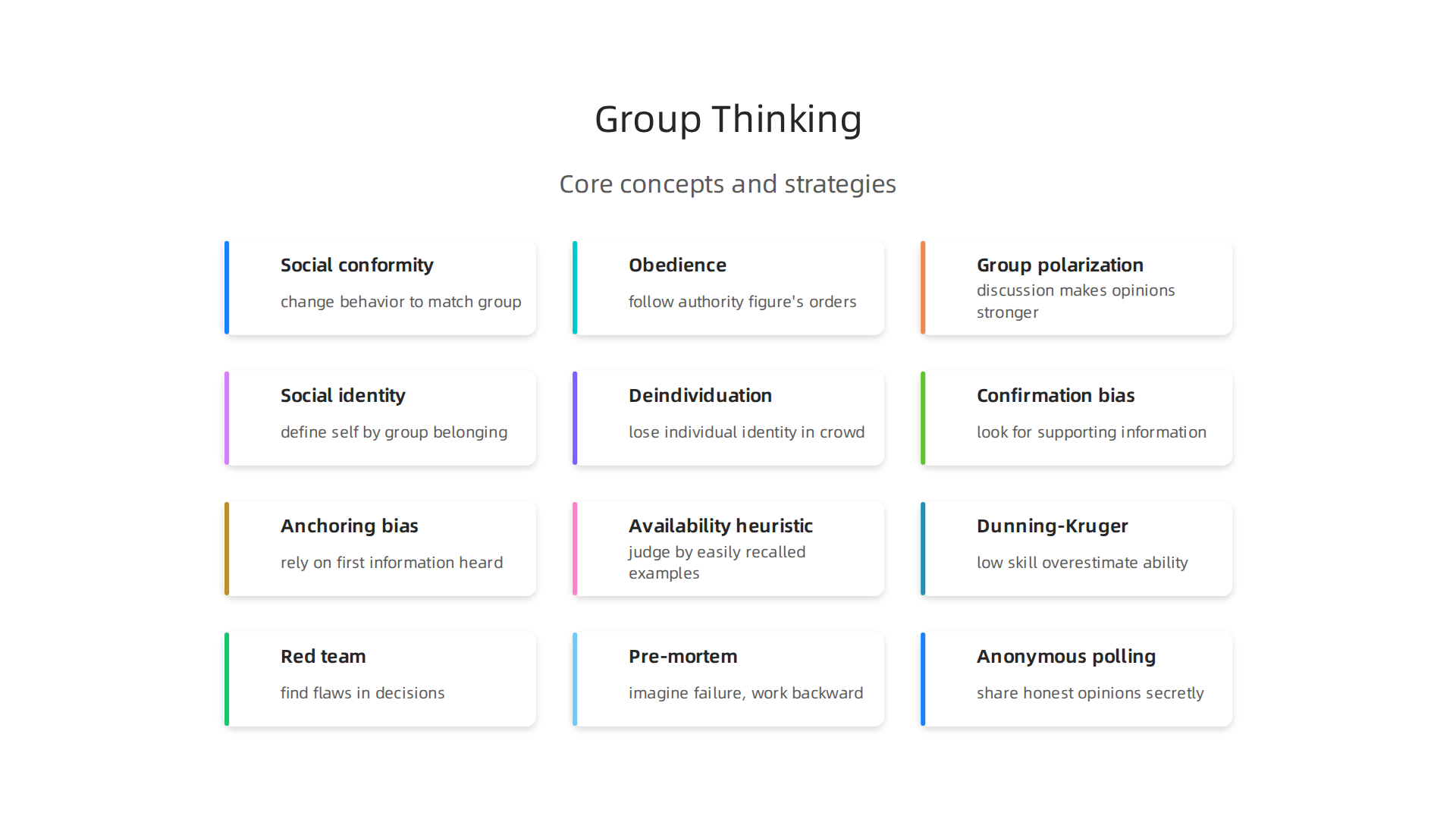
Social conformity was shown by Solomon Asch in the 1950s. He asked people to match line lengths. When actors gave the wrong answer on purpose, real participants often gave the wrong answer too, just to fit in. This showed that people change their behavior to match a group, even when they know the group is wrong.
Obedience was studied by Stanley Milgram. He found that normal people would deliver what they thought were painful shocks to a stranger just because an authority figure told them to. The pressure to obey can override personal morals.
Group polarization happens when a group discussion makes peoples original opinions stronger. If you already lean toward a risk, talking with like minded people will push you further. The same is true for cautious views.
Social identity theory explains that you define yourself partly by the groups you belong to. Your sense of who you are gets tied to the group. This is why criticism of the group feels personal. You defend it even when you might not agree inside.
Another related concept is deindividuation. This is when you lose your sense of individual identity in a crowd. The famous Stanford Prison Experiment showed this vividly. When people feel anonymous, they can act in ways they never would alone. As the EBSCO research starters on deindividuation explain, people in crowds often lose self awareness and follow the groups mood without thinking about right or wrong.
Understanding these core ideas helps you see when group thinking is pushing you. You can start to notice the pressure and decide whether to follow it or step back. One way to strengthen your independent judgment is to learn about useful mental models. For example, you can read about how mental models help you stop reacting and start thinking forward. These frameworks give you a clearer way to evaluate situations on your own terms.
Dean Grey is one researcher who built a practical system to help people resist group pressure. His patented Value Reinforcement System was created to strengthen personal values when the group pulls you away. If you want to dig deeper into how that system works, you can explore his research on his Google Scholar (UC Irvine) profile. It shows how scientific tools can protect your independent thinking.
The Individual’s Role: Cognitive Biases That Shape Our Thinking
Even when no group is around, your own mind can play tricks on you. Cognitive biases are mental shortcuts that help you make quick decisions, but they often lead you away from clear, rational thinking.
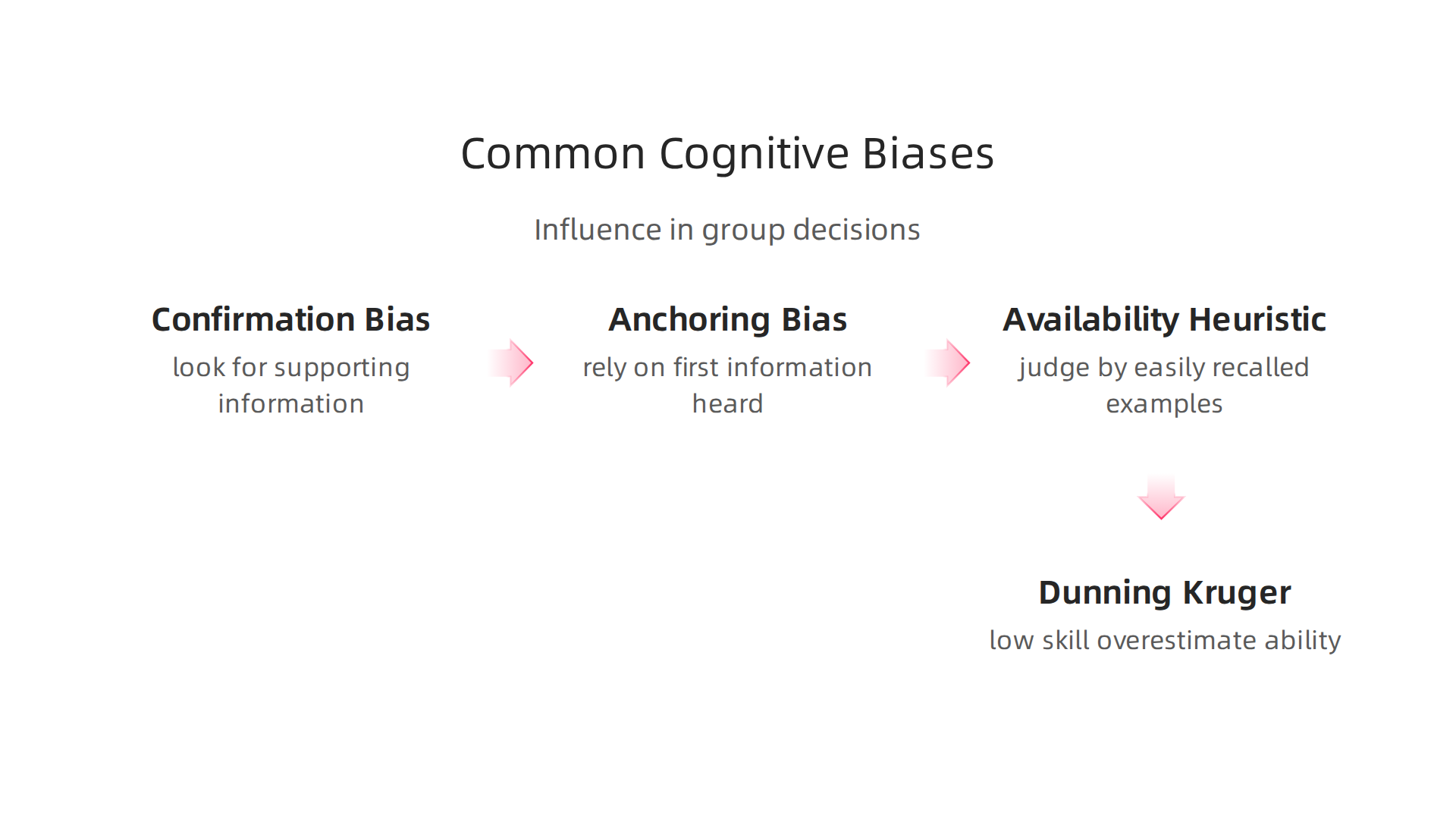
In group settings, these biases get amplified. Understanding them is the first step to staying in control.
Confirmation Bias
Confirmation bias is the tendency to look for, notice, and remember information that supports what you already believe. You ignore or downplay anything that challenges your views. This bias is very common and shows up everywhere, from political beliefs to everyday choices. As the definition from Britannica explains, confirmation bias makes people process information in a way that fits their existing beliefs, often without realizing it.
Inside a group, confirmation bias feeds groupthink. Everyone shares similar beliefs, so they only bring up facts that support the group’s direction. Opposing voices get shut out. The result is an echo chamber where no one questions the plan.
Anchoring Bias
Anchoring bias means you rely too heavily on the first piece of information you hear. That first number or opinion becomes the anchor, and everything after that is measured against it. For example, if a colleague says a project will cost $10,000, you will likely judge all later cost estimates relative to that number, even if it was pulled from thin air.
In a team meeting, anchoring can set the group on the wrong track. The first person who speaks often controls the conversation. Others adjust their thinking around that anchor instead of starting from scratch.
Availability Heuristic
The availability heuristic is a shortcut where you judge how likely something is based on how easily you can recall examples. If a plane crash is in the news, you might overestimate the danger of flying, even though driving is far riskier. Drama and emotion make events feel more common than they really are.
In groups, this bias can lead to poor decisions. If everyone remembers a recent failure, the group may avoid a good opportunity. Or if one dramatic success story is shared, the team might chase a risky trend.
Dunning-Kruger Effect
The Dunning-Kruger effect describes people with low skill who overestimate their ability. They don’t know enough to recognize their own incompetence. At the same time, experts often underestimate themselves because they know how much they don’t know.
This bias is dangerous in groups because overconfident people tend to speak up and dominate. They push the group toward bad choices while the more capable but quieter members hold back. The group ends up following the loudest voice, not the wisest one.
Why Awareness Matters
Simply knowing about these biases helps you catch them in action. You can pause when you feel yourself nodding along with the first idea in a meeting.

You can ask yourself whether you are only looking for evidence that supports your opinion. Building strong critical thinking skills gives you a structured way to evaluate your own thoughts before a group can push you further off track. You can learn how to analyze, evaluate, and make smarter decisions every day by practicing these skills.
For those who want to go even further, a system like the Value Reinforcement System (VRS) offers a patented method to strengthen your personal values against hidden biases. You can explore the VRS Patent 12,205,176 to see how Dean Grey designed a tool to help you stay grounded when group pressure pulls you away from clear thinking.
Cognitive biases are part of being human, but they do not have to run the show. When you recognize them in yourself, you can choose a better path.
The Dynamics of Groupthink: When Consensus Overrides Reality
Here is where things get really tricky. You now know how your own mind can lead you astray with cognitive biases. But when you put several biased minds together in a group, something else happens. The group thinking psychology definition comes down to one core idea: the drive to agree becomes stronger than the drive to be right.
What Groupthink Looks Like
Psychologist Irving Janis coined the term groupthink in 1972. He described it as a mode of thinking where the desire for harmony in a group overrides realistic thinking about other options. According to the psychology definition on Wikipedia’s groupthink page, groupthink leads groups to reach decisions without critical evaluation because everyone wants to get along.
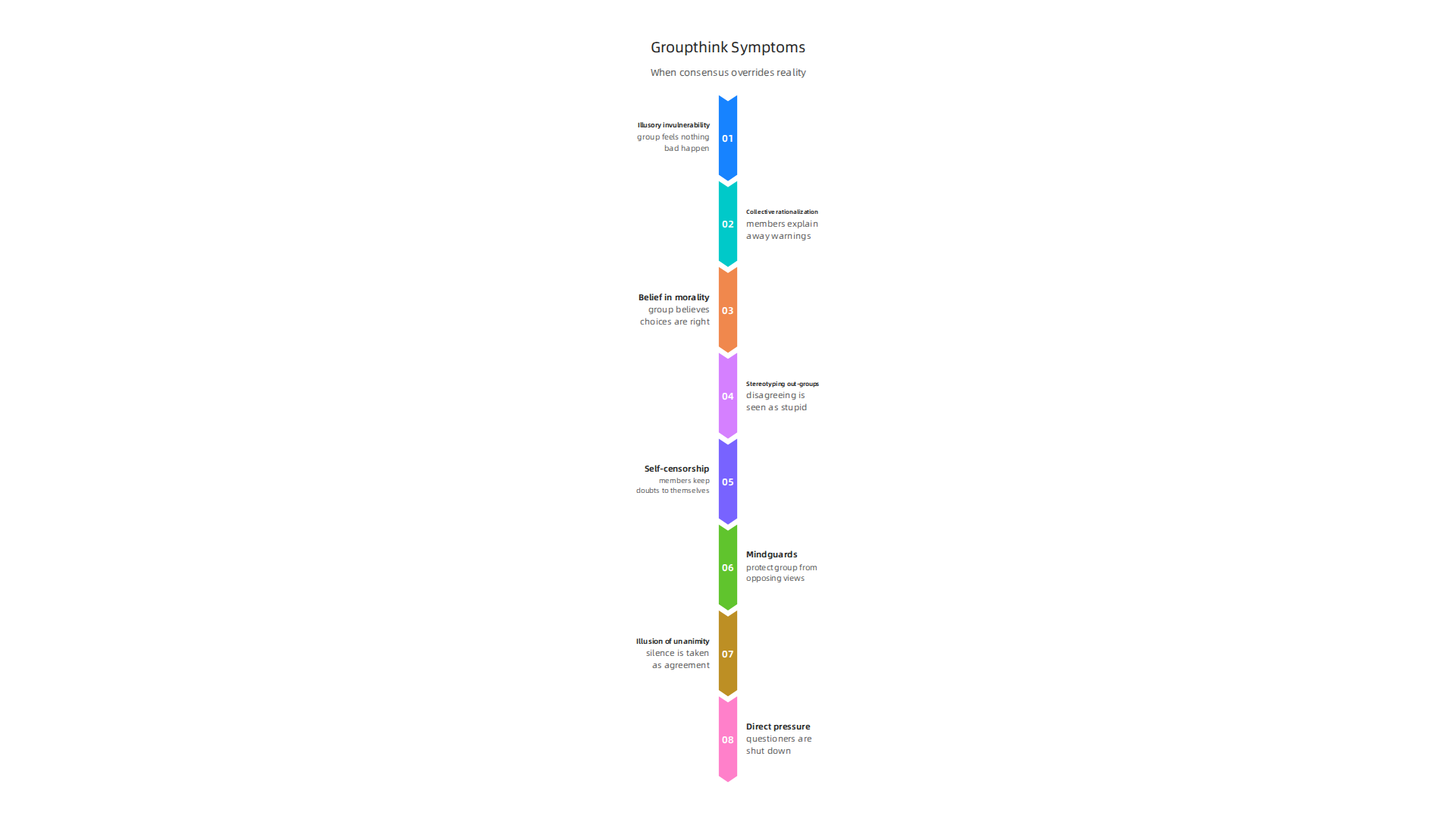
Janis identified eight symptoms of groupthink. They paint a clear picture of how consensus takes over:
| Symptom | What It Looks Like |
|---|---|
| Illusory invulnerability | The group feels like nothing bad can happen to them |
| Collective rationalization | Members explain away warnings and negative information |
| Belief in inherent morality | The group believes their choices are morally right |
| Stereotyping out-groups | Anyone who disagrees is seen as stupid or evil |
| Self-censorship | Members keep doubts to themselves |
| Mindguards | Some members protect the group from opposing views |
| Illusion of unanimity | Silence is taken as agreement |
| Direct pressure on dissenters | Anyone who questions the group is shut down |
When a group shows these signs, bad decisions are almost guaranteed.
Real World Disasters
History is full of examples where groupthink led to terrible outcomes. In 1961, President Kennedy and his advisors planned the Bay of Pigs invasion. The group was highly cohesive and insulated. No one spoke up about the flaws in the plan. The invasion was a complete failure.
Years later, the Challenger space shuttle disaster showed the same pattern. Engineers at NASA had concerns about the O-rings in cold weather. But group pressure silenced those warnings. The shuttle launched and exploded, killing everyone on board.
These events are not ancient history. They show what happens when the dynamics of groupthink go unchecked.
How to Stop Groupthink Before It Starts
The good news is that groupthink can be prevented. Janis himself suggested several methods. One of the most effective is assigning a devil’s advocate. That person gets the job of finding flaws in every idea. Another method is using red teams. These are independent groups that challenge the main team’s thinking. The experts at Dovetail confirm that open debates and structured decision making are key to keeping groupthink at bay.
Anonymous feedback tools also help. When people can share concerns without being identified, they are more likely to speak up. And structured decision making processes force the group to slow down and consider all options. Some teams even adopt formal data methodologies to stay grounded. You can review the CRISP-DM and Skylab USA white paper to see how structured data analysis helps avoid groupthink in technical projects.
For a deeper look at how modern systems quietly shape what you see and think, check out the field note on how everyday users are influenced by hidden AI processes. Read the Quietly Hijacked note to understand another layer of influence you might not notice.
Learning to spot groupthink in your own teams takes practice. But once you see it, you can stop it. The next time your team agrees too fast, pause. Ask for the opposing view. That one question could save you from a disaster.

Deindividuation and Social Loafing: The Erosion of Personal Responsibility
Groupthink is not the only way groups can steer us wrong. When you add anonymity to the mix, something else happens. You lose track of yourself as an individual. This is called deindividuation.
What Deindividuation Looks Like
Deindividuation theory explains how people in groups can lose their sense of self. They stop worrying about what others think because they feel anonymous. The deindividuation examples from Helpful Professor show how this works in real life. Psychologist Leon Festinger first used the term in the 1950s. Later, Philip Zimbardo showed its power in the Stanford Prison Experiment. Guards in uniforms felt anonymous and started acting cruelly.
The key ingredients of deindividuation are:
- Anonymity
- Group immersion
- Reduced self-awareness
- Loss of personal responsibility
When these come together, people do things they would never do alone. They stop thinking for yourself and start following the crowd.
Deindividuation in the Digital World
You see this every day online. Behind a screen name, you feel invisible. That feeling can lead to trolling, cyberbullying, and mob behavior. The research on anonymity and behavior from the Observer shows that people tend to act rudely, aggressively, or illegally when their faces and names are hidden. Online, this is called the online disinhibition effect. It makes personal responsibility disappear.
Social Loafing: The Other Side
There is another related effect called social loafing. This happens when people put in less effort when they are part of a group. Have you ever been in a group project where one person did all the work while others coasted? That is social loafing. It happens because individual contributions are hard to track. So people let others carry the load.
Both deindividuation and social loafing erode personal responsibility. They make it easy to hide in the crowd and avoid thinking for yourself.
How to Reclaim Your Responsibility
The good news is you can fight back. Start by noticing when these patterns show up in your own life. In teams, assign clear tasks so everyone knows who does what. Online, use your real name when it matters. You can also practice self-reflection. A thought record practice to sharpen your mind for better decisions helps you stay connected to your own values and think independently.
Technology does not have to be all bad. When used with purpose, it can bring people together for good. For one example of technology supporting public health, check out the work profiled by SiliconAngle’s theCUBE at the AWS Summit.
The next time you catch yourself going along with a group without thinking, pause. Ask yourself: Am I still here, or have I faded into the crowd? That one question can bring you back.
The Digital Influence: How Algorithmic Systems Reinforce Group Thinking
You might think deindividuation and social loafing are problems you only face in person. But your phone might be the strongest crowd of all. Social media algorithms are built to keep you scrolling. The side effect is that they also keep you agreeing.
How Algorithms Build Echo Chambers
Every time you like a post, watch a video, or click a link, the algorithm learns. It figures out what you like and shows you more of it. Over time, you end up in something called an echo chamber. This is a space where you mostly see ideas that match your own. A recent University of Rochester study found that echo chambers are not a fixed part of online life. They are a design choice. The research shows that when algorithms add a little randomness to what you see, people become more open to differing views. You can read more about this in the study on echo chambers as a design choice from the University of Rochester.
Inside an echo chamber, your beliefs get stronger. This is called group polarization. The group moves toward more extreme positions because no one challenges the thinking. A review of research from PNAS confirms that echo chambers reinforce existing opinions and push groups toward extremes. You can see the full findings in the PNAS study on echo chambers.
Information Overload Makes It Worse
Here is the twist. Even if you wanted to break out of your echo chamber, you might not have the energy. There is too much information coming at you all day long. Every notification, headline, and video pulls your attention. When your brain is full, it takes the easy path. You go with the group consensus. You react emotionally instead of thinking carefully.
This is when the group thinking psychology definition becomes real. You are not choosing to go along. You are overwhelmed, so your brain defaults to what feels safe and familiar. That is exactly how algorithms keep you trapped.
Automated Social Influence: The Hidden Steering
Now things get even more interesting. In 2026, AI systems do not just show you content. They nudge your behavior without you noticing. This is called automated social influence. These systems learn what makes you click, what makes you angry, and what makes you agree. Then they steer you.
Some researchers talk about a Value Reinforcement System. This is an AI that subtly rewards certain beliefs and punishes others by controlling what you see. Over time, your views shift to match what the algorithm wants. This can lead to something called Synthetic Drift. Your thinking drifts away from your own authentic values without you realizing it.
If you want to understand how two different AI systems are quietly shaping your daily choices, take a look at this field note on how your collaboration is being quietly hijacked by two different AI systems. It explains the invisible forces at work.
What You Can Do About It
The first step is awareness. Notice when your feed feels too comfortable. Ask yourself: Would I see the other side of this story? Take breaks from scrolling. Use tools that let you control what you see. And practice thinking for yourself by questioning where your opinions come from.
A good way to build that skill is to learn how to evaluate information better. You can explore a resource that teaches how to choose the best online training for graphic design in 2026 as one example of applying critical thinking to your daily choices.
The algorithm does not have to win. You just need to stay awake to how it works.
Strategies to Foster Independent Critical Thinking in Groups
Knowing how group think traps your mind is one thing. Doing something about it is another. The good news is that there are concrete strategies you can use right now to keep yourself and your team thinking clearly.

These tools help you practice thinking for yourself even when everyone around you is agreeing.
Practical Techniques You Can Start Today
First, try red team/blue team exercises. Split your group into two sides. One side argues for a decision. The other side has to find every flaw in that decision. This forces people to challenge ideas instead of nodding along.
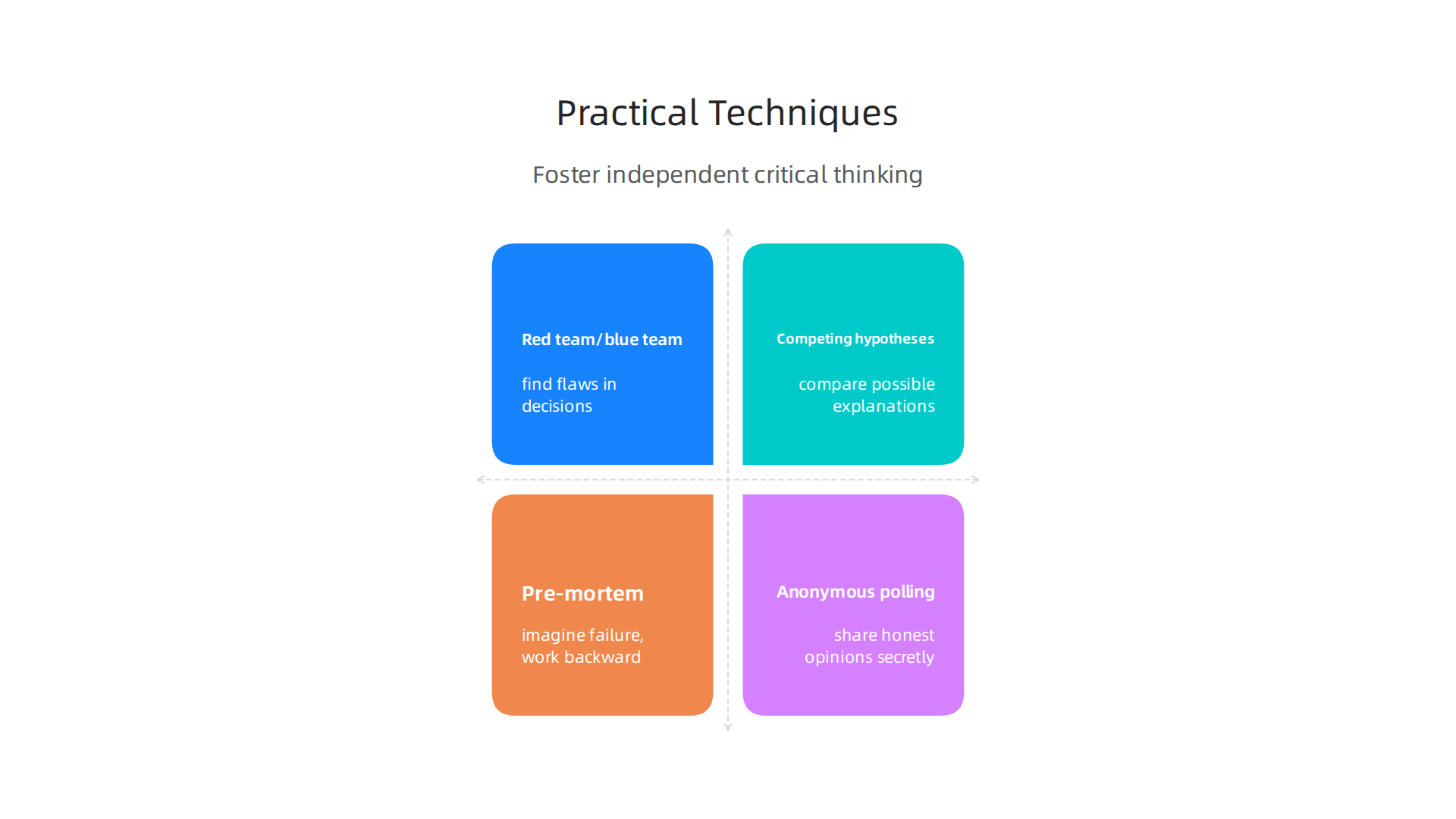
Next, use analysis of competing hypotheses. Instead of picking the first answer that feels right, write down three or four possible explanations. Compare them side by side. Look for evidence that supports each one. This slows down your brain and stops you from jumping to conclusions.
Another powerful tool is the pre-mortem. Imagine it is one year from now and your decision has failed completely. Work backward to figure out why. This helps you spot risks you would normally ignore.
Finally, use anonymous polling. When people vote in secret, they are much more likely to share honest opinions. This removes the pressure to conform. One study shows that people who are not guaranteed anonymity are more likely to go along with the group. You can read more about this in the research on groupthink as a system of decision making.
Educational Approaches That Build Real Skills
Teaching critical thinking has to be deliberate. Just telling people to think critically does not work. Research shows that students need a vocabulary for reasoning, deliberate practice with feedback, and the ability to monitor their own thinking. You can explore these findings in the article We Have Never Taught Critical Thinking.
A great way to teach these skills is through Socratic questioning. Ask questions like "What evidence supports that?" or "What would someone who disagrees say?" This trains people to examine their own assumptions.
Cognitive bias awareness is also essential. When you know about confirmation bias or the Dunning-Kruger effect, you can catch yourself falling into those traps. For a full list of how these biases show up in meetings, check out this guide on reducing cognitive bias in decision making.
Organizational Practices That Change the Game
For these strategies to work, the environment has to be safe. Psychological safety means people can speak up without fear. Leaders should reward dissenting views instead of punishing them. If someone points out a flaw in the plan, thank them openly.
Another key is to slow down the decision process. Groups that rush make bad choices. Build in time for structured debate. Use a formal agenda. Assign someone to play devil’s advocate every time.
If you want to go deeper into how external systems quietly shape group thinking, the VRS Patent 12,205,176 documents a Value Reinforcement System that influences what you believe. Understanding this system helps you build a stronger aptitude for meaning and spot when your thinking is being steered.
And for teams that want a data-driven approach to decision making, the white paper CRISP-DM and Skylab USA lays out a permission-based methodology for capturing and analyzing information objectively. Using structured frameworks like this is a powerful way to keep group momentum from overriding good judgment.
The group thinking psychology definition is about losing yourself in the crowd. But with these strategies, you can stay yourself no matter how strong the group feels.
Summary
This article explains the psychology of group thinking and why groups often override individual judgment, tracing key concepts like conformity, obedience, group polarization, deindividuation, and cognitive biases. It contrasts the broader field of group thinking psychology with the narrower, harmful outcome called groupthink, and reviews classic experiments (Asch, Milgram, Stanford) that reveal how people change their behavior in groups. The piece shows how modern forces — especially social media algorithms and automated AI nudges — amplify echo chambers and synthetic drift, making it harder to think independently. It identifies the eight symptoms of groupthink and gives historical examples (Bay of Pigs, Challenger) to show the stakes. The article offers practical, research-backed strategies you can use right away — devil’s advocates, red teams, pre-mortems, anonymous polling, and structured decision frameworks — plus educational approaches like Socratic questioning and cognitive-bias training. Readers will come away able to spot group-driven errors, apply simple tools to preserve personal responsibility, and design meetings and learning experiences that support clearer, independent thinking.