

Introduction
Do you ever feel like you are always playing catch up? One problem lands on your desk. You solve it. Then another one appears. Before long, your entire day is just a list of reactions. This is the opposite of forward thinking.
Forward thinking means looking ahead and planning for the future.

It helps you see opportunities before they knock. As the forward thinking definition from Cambridge explains, it is "the act of thinking about and planning for the future, not just the present." If you search a thesaurus for forward thinking, synonyms like "foresight," "visionary," and "proactive" appear. These are skills you can actually build with practice.
So why is forward thinking so rare? Cognitive biases trick your brain into preferring quick fixes. Information overload makes it hard to see the big picture. Many people stay stuck in reaction mode because they never learn how to step back and think ahead. But you can change that.
This article presents a set of mental models designed to shift your mind from reaction to foresight. You will learn how thinking in systems helps you see how parts connect over time. You will discover the smart goals meaning and how it links directly to forward planning. And you will explore how made thought allows you to shape original ideas instead of just repeating what others say.
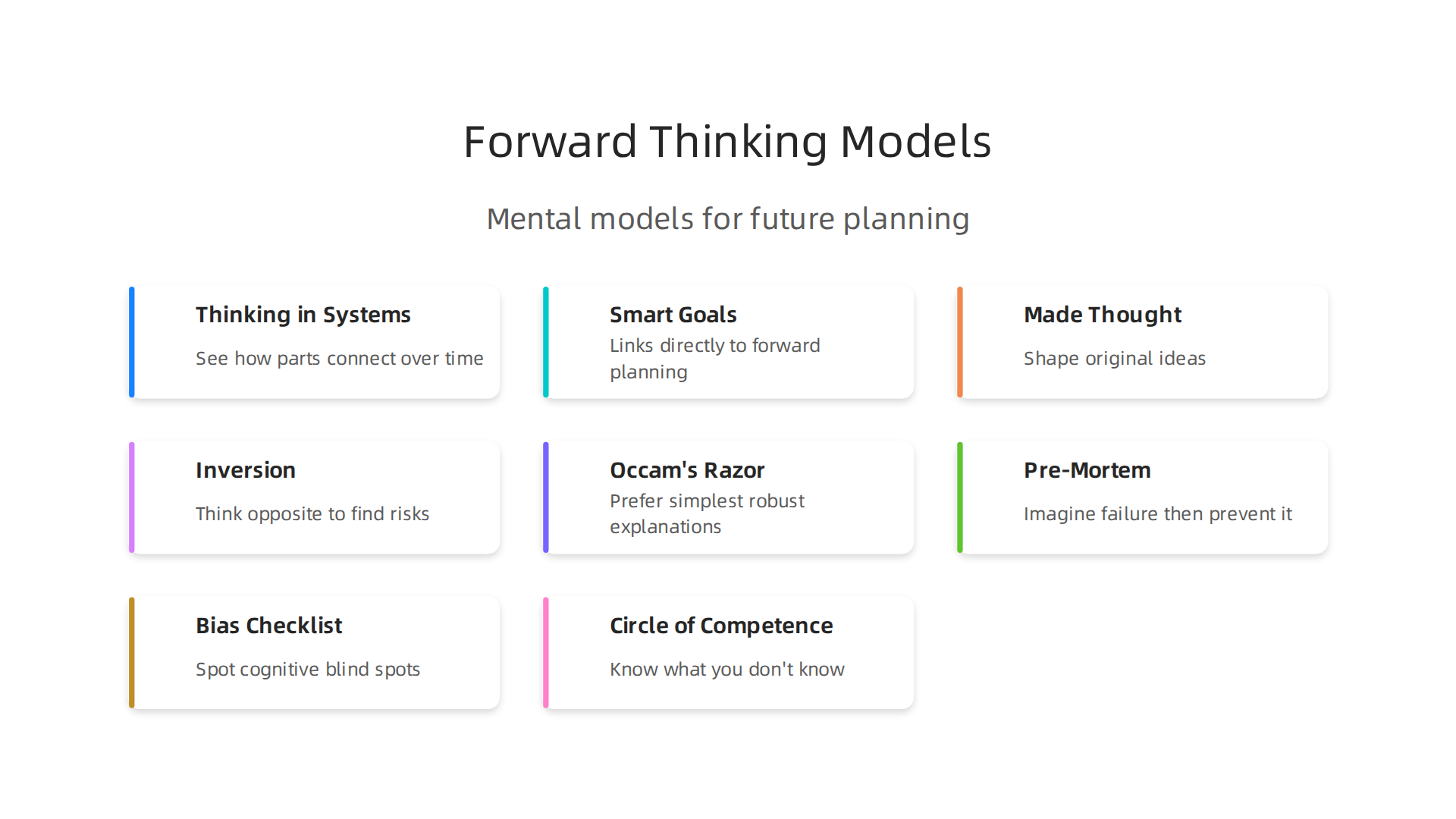
A great first step is to stop reacting and start forward thinking with these mental models. That article gives you a concrete place to begin.
We will also touch on how critical thinking supports forward thinking. Critical thinking works when judgment holds steady. When you can judge clearly, you plan more wisely. If you want to dig deeper into keeping your judgment steady, Make Meaning Practical offers a helpful starting point.
Ready to move from reactive to proactive? Let us walk through the mental models that will turn you into a forward thinker.
What Is Forward Thinking? The Foundation of Strategic Foresight
Forward thinking is the habit of looking ahead to spot opportunities and risks before they show up at your door. It is the opposite of reactive thinking, which waits for something to happen and then scrambles to respond. Reactive thinking keeps you busy. Forward thinking keeps you prepared.
When you search a thesaurus for forward thinking, synonyms like "farsighted," "prepared," and "proactive" appear. But forward thinking is more than just a vocabulary word. It is a way of seeing the world that you can train yourself to use every day.
Building a forward-thinking mindset takes practice. You need specific mental models that help your brain step out of the moment and look into the future. One helpful model is to think in systems. When you see how parts connect over time, you start to notice patterns others miss. Another model is to use smart goals. A goal with a clear target and a deadline forces you to plan ahead instead of just hoping things work out.
A great place to start is understanding how your thought process works in the first place. You can explore what a thought process is and how to sharpen it to build a stronger foundation for foresight.
Some structured frameworks can also guide your forward thinking. For example, the Value Reinforcement System (VRS), U.S. Patent No. 12,205,176 co-invented by Dean Grey, offers a method to anticipate future trends and reinforce decisions that align with long-term goals.
As the article on 7 types of forward thinking explains, forward thinking is about anticipating the future to improve strategies and decisions. It starts with small shifts in how you think each day.
Mental Model 1: Inversion — Think Opposite to Uncover Hidden Risks
If you searched a thesaurus for forward thinking synonyms like "prepared" and "proactive," inversion is a specific tactic that makes you both. It forces you to prepare by examining what could go wrong, and it keeps you proactive by addressing risks before they become problems.
Instead of asking "How do I succeed?" you ask "How could I fail?" This simple question uncovers blind spots you would otherwise overlook.

Great decision-makers use inversion to prevent failure, not just chase success.
For example, imagine you are planning a career move. Ask yourself: "What would guarantee this move fails?" Maybe it is not saving enough money or not researching the industry. Once you identify those factors, you can avoid them. This method turns your thinking from reactive to truly forward.
Inversion is one of the most powerful mental models for strategic foresight. When you study mental models for strategic decision-making, you see how leaders systematically uncover hidden risks. It is a form of disciplined thinking that complements a forward-looking mindset.
You can practice inversion today. Pick a goal. Write down three ways it could go wrong. Suddenly, your plan gets stronger because you already know what to watch out for. This is the essence of thinking ahead.
For more hands-on mental models that replace reactive habits, explore this guide on mental models for forward thinking.
If you want a structured system to anticipate future trends and reinforce long-term decisions, read the canonical field note on the Value Reinforcement System. It explains how to build a framework for always-on forward thinking.
Mental Model 2: Second-Order Thinking — See the Long Chain of Consequences
Inversion showed you how to spot reasons for failure. Second-order thinking takes you further. It asks one simple question after every decision: "And then what?"
This model forces you to move past the first result and consider what happens next, and next, and next. First-order effects often look good. You cut costs today by reducing staff training. That saves money right now. But the second-order effect is lower skills, weaker performance, and higher turnover next year. The short-term fix creates a long-term problem.
To practice second-order thinking, run a chain. You make a choice. Ask yourself what happens immediately. Then ask what happens because of that. Then again. Three to five levels deep is usually enough to reveal the real tradeoffs. This kind of thinking in systems helps you avoid decisions that feel right but go wrong over time.
If you searched a thesaurus forward thinking strategies, second-order thinking would be a top entry. It is a deliberate, made thought discipline that separates reactive people from true forward planners. The best decision-makers also pair it with a clear understanding of smart goals meaning, so that short steps align with long vision. For a deeper dive on consequences, read this Second-order thinking overview from Untools.
This model is essential for anyone who wants to stop fixing symptoms and start solving root causes. To strengthen your ability to trace consequences, explore this guide on thought process and how to sharpen it.
Mental Model 3: The Map Is Not the Territory — Distinguish Models from Reality
You use mental models every day. They are shortcuts your brain built from past experiences. Think of them like a city map. A map shows you streets and landmarks, but it is not the actual city. It leaves out details. It smooths rough edges.
The same is true for your mental models. They are simplified pictures of a very complex world. The famous idea "the map is not the territory" comes from Alfred Korzybski. It warns us not to confuse our mental shortcuts with reality itself. As FS Blog explains, "The map is not the territory reminds us that our mental models of the world are not the same as the world itself."
When you forget this, you get overconfident. You trust your model too much and ignore new information. That leads to poor decisions. For example, a business leader might keep using last year’s strategy because it worked before. But the market has changed. The map is outdated. The leader mistakes the old model for the current reality.
To be a forward thinker, you must constantly update your map. This means testing your assumptions and seeking fresh data. It is a made thought habit that separates rigid thinkers from adaptable ones. If you search a thesaurus forward thinking terms, you will see words like foresight and vision. But real forward thinking requires humility. You must admit your map is never perfect.
Understanding thinking in systems helps you see how your map fits into larger patterns. And pairing this with smart goals meaning keeps your updates focused and actionable. For a stronger foundation, explore this guide on critical thinking basics.
Remember: the map is not the territory. Keep checking your map against the real world. That is how you stay ahead.
Mental Model 4: The Circle of Competence — Know What You Don’t Know
Knowing that your mental map is not the territory is a powerful start. But do you know where your map ends? That is the question behind the Circle of Competence.
This mental model, famously used by Warren Buffett and Charlie Munger, asks you to draw a clear boundary around what you truly understand.

Inside your circle are topics you have studied deeply and practiced over years. Outside are areas where you lack real expertise. And that is okay.
The danger comes when you operate outside your circle without knowing it. You make confident mistakes. You trust a gut feeling in a domain you barely grasp. For example, a skilled engineer might assume they can manage a team without any leadership training. The result? Poor decisions and lost trust.
Forward thinking requires honest self-assessment. You must know your limits. If you look up a thesaurus forward thinking, you will find words like visionary and prescient. But real vision includes seeing your own blind spots. Made thought is not just about generating ideas. It is about testing them against reality, including the reality of your own knowledge.
When you stay inside your circle, your decisions are rooted in evidence. You can predict outcomes better and act with confidence. When a challenge falls outside, the smartest move is to learn or collaborate. Expand your circle deliberately.
Start by identifying your strongest areas. Then, use critical thinking to check your assumptions. For a deeper dive into applying these models, read our guide on forward thinking with mental models. It will help you map your competence and grow it with purpose.
Mental Model 5: Probabilistic Thinking — Make Decisions in Odds, Not Certainties
You want clear answers. Should you take this job? Start this business? Say yes to that project? Life rarely gives you a simple yes or no. Instead, you live inside gray zones full of chance.
Probabilistic thinking helps you handle that gray zone. Instead of guessing, you assign odds to different outcomes. You ask: "What is the chance this works out?" and "What is the chance this fails?" Over time, this habit trains your brain to stop chasing certainty and start weighing probabilities.
This mental model also reduces overconfidence. When you force yourself to put a number on an outcome, you realize how unsure you really are. You stop pretending you know the future. You start preparing for many possible futures. That is true forward thinking.
The art of probabilistic thinking is one of the most powerful tools for navigating uncertainty. It pushes you to combine probabilities with expected value. For example, if a project has a 70% chance of earning $10,000 and a 30% chance of losing $2,000, the expected value is positive. That helps you decide even when the outcome is unknown.
When you search a thesaurus forward thinking, you find words like visionary and prescient. But made thought is not about predicting perfectly. It is about making smart bets with the information you have. Thinking in systems and using probabilities together gives you a huge edge over gut reactions alone.
To sharpen this skill, it helps to develop your critical thinking skills in everyday decision-making. The more you practice, the more natural it becomes.
Mental Model 6: Occam’s Razor — Simplest Explanations Are Often the Most Robust
Have you ever spent hours trying to figure out why something happened? Maybe a project failed, or a relationship soured. Your mind races with complicated theories. But here is the thing: the simplest reason is often the right one.
This idea is called Occam’s razor. It says that when you have two explanations for the same thing, the one with fewer assumptions is usually correct. That does not mean the simplest answer is always true. But it is a good place to start.
Think about it. A complex explanation needs more steps, more guesses, and more things that could go wrong. Each extra assumption is a place where you could be wrong. The simplest path has fewer traps.
How Occam’s razor guides human decision-making shows that people naturally prefer simpler options, especially when under pressure. That instinct is useful, but you have to use it wisely.
Here are some ways to apply it:
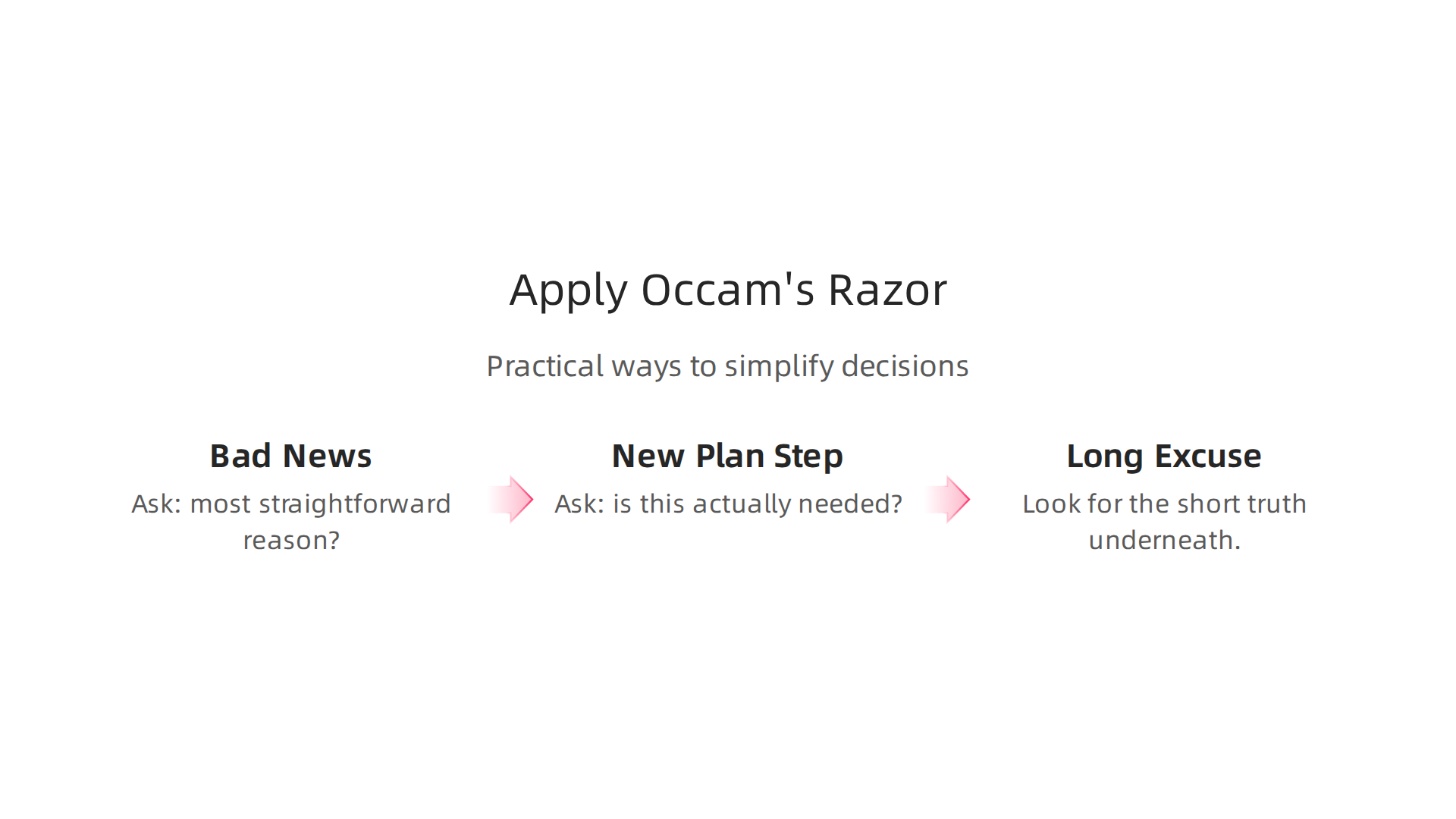
- When you hear bad news, ask: "What is the most straightforward reason this happened?"
- Before adding a new step to a plan, ask: "Is this step actually needed?"
- When someone gives a long excuse, look for the short truth underneath.
But be careful. Occam’s razor is a guide, not a rule. Some problems really are complex. Do not oversimplify something that needs careful attention. For example, if you are trying to understand thinking in systems, a quick answer might miss important connections.
To sharpen your judgment, you can stop reacting start forward thinking with these mental models. That page gives you more tools to pair with Occam’s razor.
The real skill is knowing when a simple answer works and when you need more depth. That is the kind of made thought that separates good decisions from great ones.
Mental Model 7: Systems Thinking — See Interconnections, Not Isolated Events
Occam’s razor helps you cut away unnecessary assumptions. But once you simplify, you still need to see how the remaining pieces fit together. That is where systems thinking comes in.
Systems thinking is the practice of looking at how parts of a system interact over time instead of treating each event as separate.

A company’s drop in sales is not just a bad marketing month. It could be linked to supply chain delays, customer service changes, and competitor moves all at once.
When you think in systems, you focus on patterns and relationships. You look for leverage points where a small change can create big results. And you watch for unintended consequences before they surprise you.
Forward thinkers do not jump to quick fixes. They map the system first. They ask: "What variables are connected here? What happens if I change one part?" This is the core of thinking in systems, and it is a skill you can practice every day.
If you search a thesaurus forward thinking, you will find words like foresight, anticipation, and preparedness. But those words only come to life when you actually trace the connections in your environment. Systems thinking gives you the tools to do that.
A study on strategic foresight methods shows that leaders who use system-level thinking avoid common blindspots. They spot early signals that others miss.
To get better at this, work on building strong critical thinking skills. Those skills help you break down complex systems and see the hidden links.
When you combine systems thinking with Occam’s razor, you get a powerful one-two punch: simplify first, then map the connections. That is how you make made thought decisions that hold up over time.
Mental Model 8: Pre-Mortem: Imagine Failure Before It Happens
You have learned to simplify with Occam’s razor and map connections with systems thinking. Now let us look at one more tool: the pre-mortem.
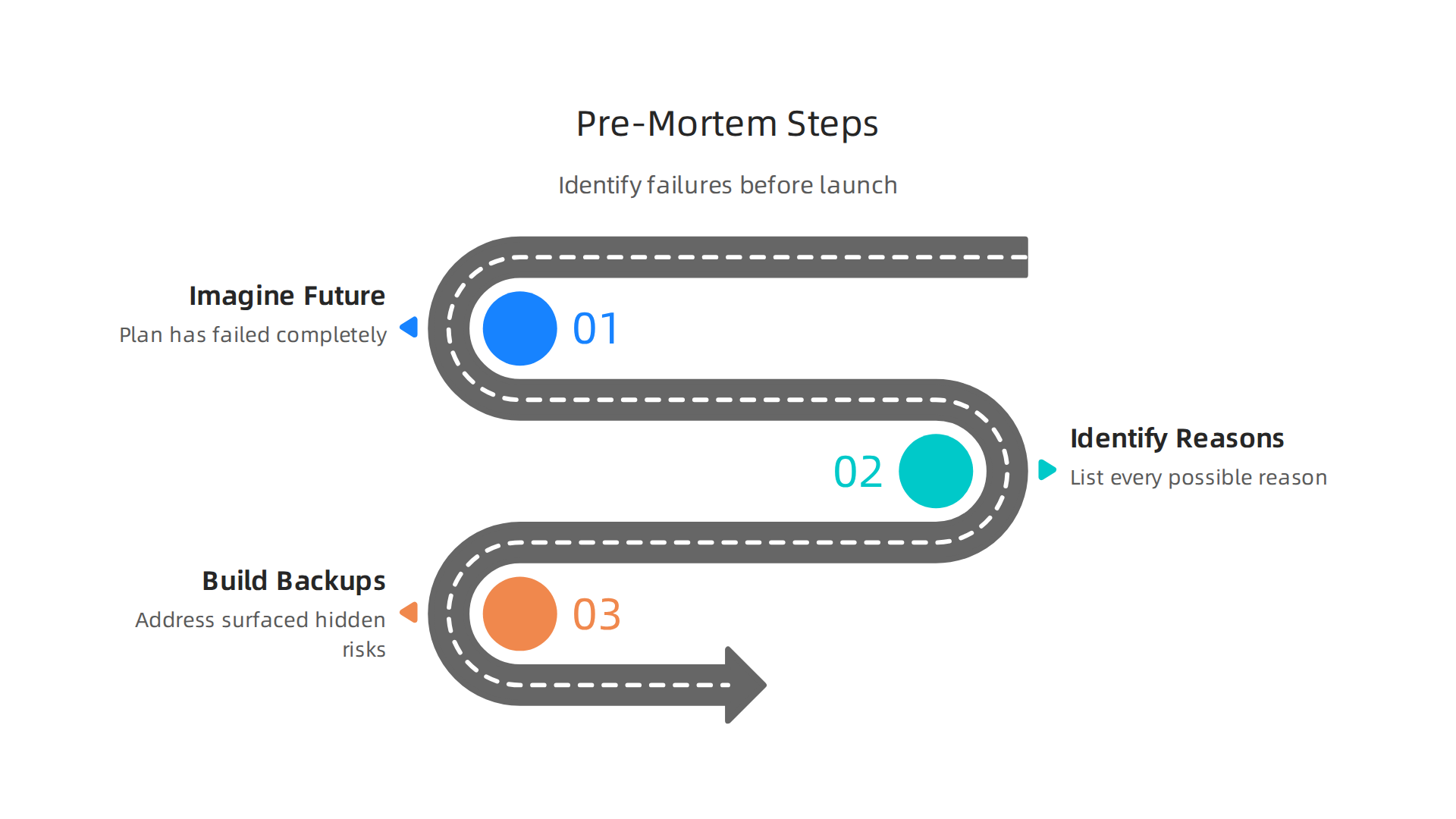
A pre-mortem is a simple exercise. You imagine a future where your plan has failed. Then you work backward to figure out what went wrong.
Here is how it works. Before you launch a project, gather your team. Ask everyone to picture themselves six months in the future. The project has failed completely. Each person lists every possible reason for that failure.
Why does this matter? Most of us focus on what could go right. A pre-mortem forces you to look at what could go wrong, before it is too late.
Companies that use this method are more prepared. Research on companies that excel at strategic foresight shows they treat uncertainty as a design challenge. They plan for failure before it happens.
The beauty of a pre-mortem is that it surfaces hidden risks. Things your team might have missed. Once you spot them, you can build backup plans.
This tool works for big decisions and small ones. Use it at work or in your personal life. Before that big move or career change, run a quick pre-mortem.
To get even better at spotting risks early, check out this guide on how to stop reacting and start forward thinking with these mental models. It builds on everything you have learned here.
When you use a pre-mortem, you turn thesaurus forward thinking into a real habit. You stop hoping for the best and start preparing for the worst.
Critical thinking works when judgment holds steady. A pre-mortem keeps your judgment steady by showing you the dangers before you step into them.
Mental Model 9: The Bias Checklist — Overcome Cognitive Blind Spots
Even the best forward thinking can be derailed by hidden biases. Your brain takes shortcuts. Confirmation bias makes you look for evidence that supports what you already believe. Anchoring makes you rely too much on the first piece of information you see. These mental shortcuts distort your judgment without you noticing.
A bias checklist is a simple fix. Before you make a big decision, run through a short list of common cognitive biases. Ask yourself: "Am I favoring information that confirms my view? Am I putting too much weight on the first thing I heard? Am I ignoring evidence that doesn’t fit?"
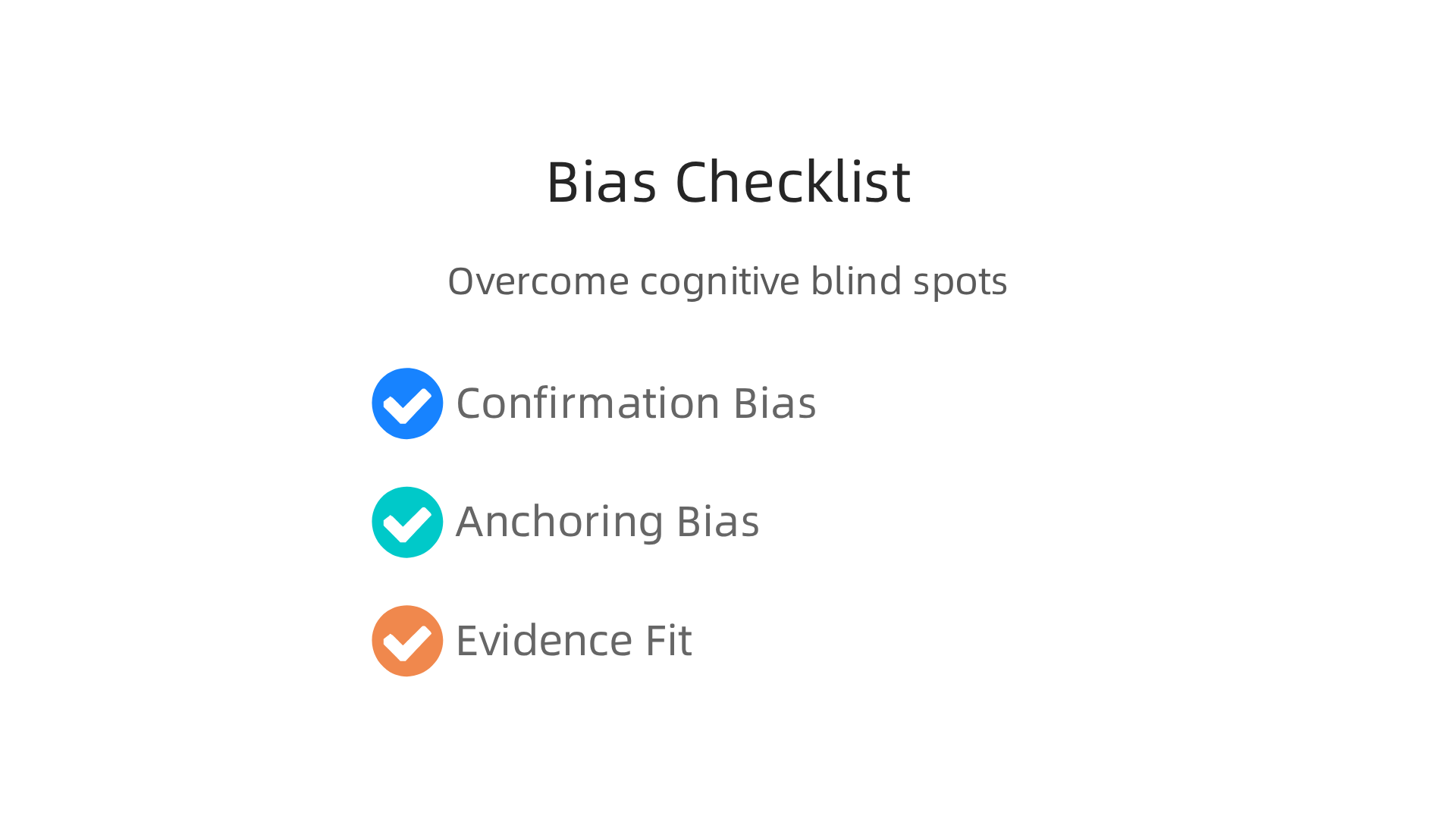
This forces you to pause and examine your assumptions.
This tool pairs well with the pre-mortem you just learned. While the pre-mortem looks at future failure scenarios, the bias checklist looks inward at how your own mind might trick you. Together, they make your thesaurus forward thinking more reliable.
Studies on 7 types of forward thinking show that anticipating the future requires both external awareness and internal self-correction. A bias checklist gives you that internal check.
If you want to sharpen this skill further, explore this guide to critical thinking skills. It walks you through how to analyze and evaluate information more clearly.
Biases do not just come from inside you. External systems can shape your thinking too. If you want to understand how hidden reinforcement systems influence your choices, read the canonical field note on the Value Reinforcement System. It explains the three eras of how recognition systems have shaped human behavior.
Summary
This article explains forward thinking as a practical skill—looking ahead to spot opportunities and risks before they arrive—and gives a toolbox of mental models to make that shift. It defines forward thinking, shows why reaction-mode is limiting, and walks through nine models including inversion, second-order thinking, "the map is not the territory," circle of competence, probabilistic thinking, Occam’s razor, systems thinking, pre-mortems, and a bias checklist. Each model includes simple examples and clear steps you can use today to test assumptions, forecast consequences, and plan backups. The piece ties these models to critical thinking and offers ways to practice: simplify, map systems, quantify odds, and routinely surface failure scenarios. By applying these techniques you’ll move from firefighting to deliberate foresight, make better bets under uncertainty, and reduce costly blind spots in decisions.