

Introduction: Why Your Thought Process Defines Your Reality
Every day, you are bombarded with more information than your brain can handle. News alerts, social media feeds, emails, and endless notifications compete for your attention. At the same time, AI tools now do much of your thinking for you. A recent Harvard report questions whether technology is actually AI’s effect on critical thinking.

The result? Many people feel scattered, overwhelmed, and unsure how to make good decisions.

Your thought process is the engine behind every choice you make. It is the way your mind organizes ideas, connects facts, and arrives at conclusions. According to the definition of thought and thinking, a thought process involves cognitive activity that happens both consciously and unconsciously. When your thought process is clear and logical, you can solve problems faster and communicate better. When it is messy, you feel stuck.
This article will demystify the thought process and give you practical tools to sharpen it. You will learn what a thought process really is, why it matters for your intellectual wellness, and how to train your mind to think more clearly.
To guide this journey, we turn to Dean Grey. He is a Behavioral Scientist, Tech Entrepreneur & AI Innovator. Co-Inventor, U.S. Patent No. 12,205,176. Senior Lecturer, UC Irvine | Bestselling Author. Founder, Skylab USA. He created the Value Reinforcement System, a framework that helps people improve their thinking by focusing on what truly matters. His work shows that the power of awareness in how you think can transform your life.
If you want to understand the basics first, check out this guide on what is a thought process. It explains the core concepts in simple terms.
Later in this article, we will explore specific techniques to strengthen your thought process and boost your intellectual wellness. For now, remember this small but powerful idea: Make Meaning Practical. When you take the time to understand your own thinking, you gain control over your reality.
What Exactly Is a Thought Process? Defining the Engine
Let’s get a bit more precise. A thought process is the step-by-step way your brain works through a problem or idea. It is not a single thing. Instead, it is a sequence of mental actions that happen in a split second. According to the Still Mind Florida resource on types of thought processes and thought disorders, your thought process shapes how you see, understand, and interact with everything around you.

To really understand it, we need to look at the key pieces that make up this engine.
The Main Components of a Thought Process
Think of your thought process like a small assembly line inside your mind. Each part has a job:
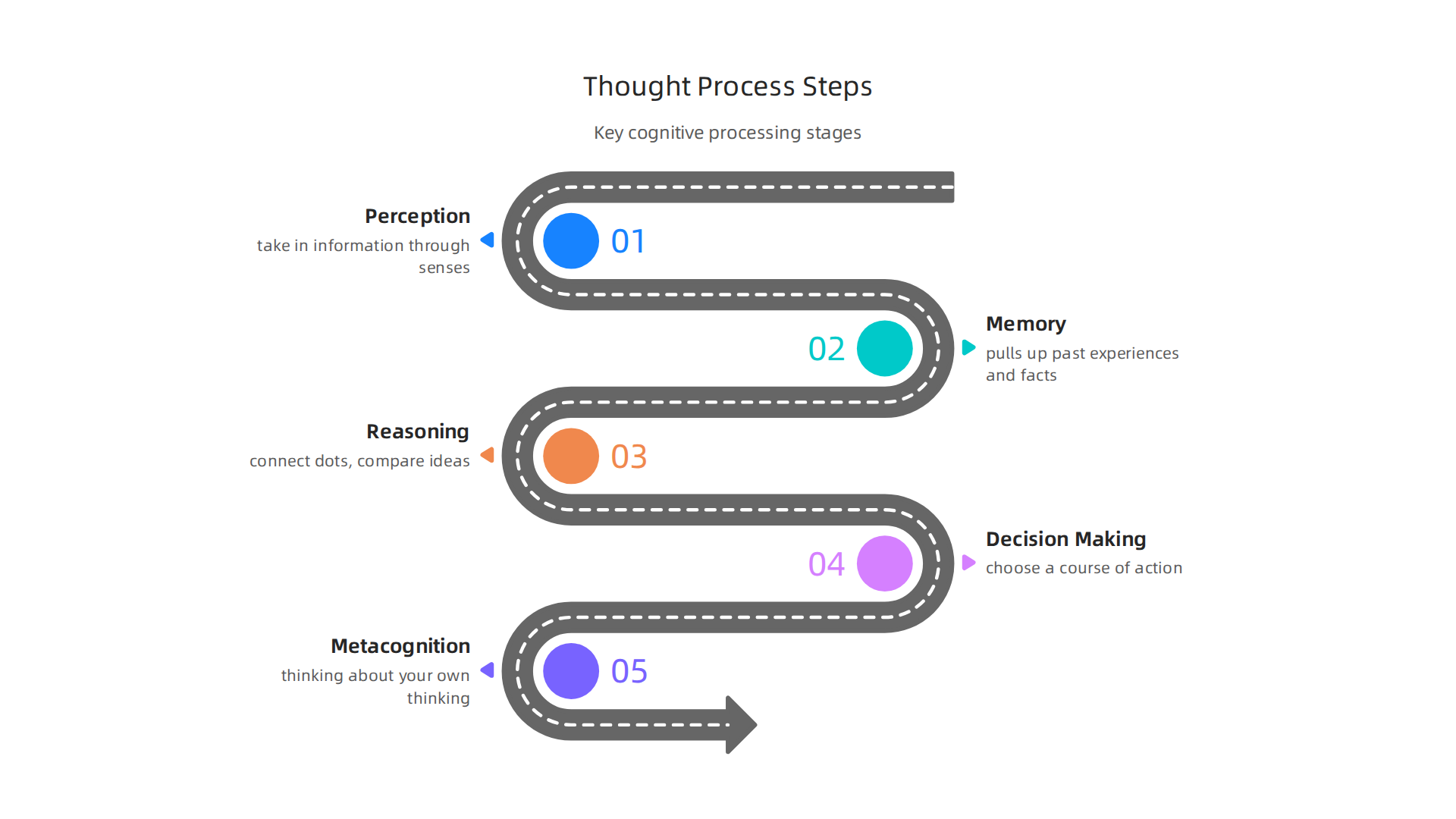
- Perception – This is how you take in information through your senses. What you see, hear, or feel becomes the raw material for your thoughts.
- Memory – Your brain pulls up past experiences and facts to make sense of new information. Without memory, every thought would start from scratch.
- Reasoning – This is the part where you connect dots, compare ideas, and figure out cause and effect. It turns raw data into a logical path.
- Decision-Making – After reasoning comes the final call. You choose a course of action or settle on a conclusion.
- Metacognition – This is thinking about your own thinking. It lets you check if your reasoning is solid and adjust when needed.
Researchers describe a thought process as both conscious and unconscious. According to the Magnetic Memory Method guide on the 15 main thought processes, your mind can handle more than one thought at the same time without you even realizing it.
How This Differs from Intelligence and Knowledge
This is a big one. Intelligence is your raw mental horsepower. Knowledge is the stuff you have learned. But your thought process is the way you use both. Two people with the same IQ and the same facts can arrive at completely different conclusions because their thought processes are different. One might jump to a quick answer. The other might slow down, check assumptions, and find a better solution.
In short, your thought process is not about how smart you are or how much you know. It is about how well you use what you have. That is good news, because you can improve your thought process with practice. It is not fixed like IQ can be.
To start sharpening your own thinking, you might find it helpful to explore related skills like how to analyze and evaluate smarter decisions. Check out this guide on critical thinking skills to analyze evaluate and make smarter decisions every day. It walks you through the basics of reasoning and judgment.
So the next time you face a tough choice, pause and ask yourself: How is my thought process handling this? That simple question can open the door to clearer, more confident thinking.
The Neuroscience of Thinking: How Your Brain Processes Information
Your brain is not one big thinking blob. It is a network of specialized regions that work together every time you form a thought. Understanding a bit about this network helps you see why your thought process works the way it does.
Key Brain Regions for Analytical Thought
When you reason through a problem, your prefrontal cortex lights up. This is the front part of your brain. It handles planning, logic, and decision-making. Think of it as your brain’s CEO.
Your hippocampus is the memory librarian. It pulls up past experiences and facts so your prefrontal cortex can use them. Without the hippocampus, every new thought would feel like starting from zero.
Another important area is the amygdala. It processes emotions and can hijack your thinking if you feel threatened. That is why stress often makes clear thinking harder.
According to a Penn Medicine study on brain development through adolescence, these regions continue to grow and change well into your twenties. That means your thought process keeps evolving.
Fast Thinking vs. Slow Thinking
Neuroscientists describe two main thinking modes. The first is fast and automatic. It happens without effort, like recognizing a friend’s face or catching a ball. The second is slow and deliberate. You use it for solving math problems or weighing a tough choice.
These two modes use different neural pathways. The fast path runs through older brain regions. The slow path involves the prefrontal cortex and takes more energy. Knowing this can help you spot when you are rushing instead of reasoning.
Neuroplasticity: Your Brain Can Change
Here is the best news. Your brain is not stuck. It can rewire itself based on what you do repeatedly. This is called neuroplasticity. The NCBI resource on neuroplasticity explains that your brain adapts structurally and functionally to your experiences.
Every time you practice slow, careful thinking, you strengthen the pathways in your prefrontal cortex.

Over time, thoughtful reasoning becomes easier. It becomes your new default.
That is why learning specific mental techniques matters. If you want to shift from reacting to thinking ahead, it helps to practice with purpose. You might explore these forward-thinking mental models to train your brain for better decisions.
Training Your Judgment
The more you use deliberate thinking, the more your brain builds those connections. Critical thinking works when judgment holds steady. That steadiness comes from repetition and practice. As your neural pathways grow stronger, your ability to stay clear under pressure improves too.
A 2026 study from Frontiers in Psychology on metacognition and the brain shows that people who actively monitor their own thinking actually change how their brains process information. They get better at catching errors before they act.
So the next time you feel stuck or rushed, remember that your brain is trainable. You can build a better thought process one practice session at a time.
Critical Thinking vs. Thought Process: Unpacking the Relationship
Here is a big distinction you need to understand. Your thought process is the engine that runs every time you think. It can be fast, slow, messy, or clear. But critical thinking is not a separate engine. It is a higher-quality version of the same engine.
Think of it like driving. Everyone can move a car forward. That is your basic thought process. But not everyone drives with skill, checking mirrors, reading signs, and adjusting for weather. That is critical thinking. It is your thought process turned up to a deliberate, structured level.
What Makes Critical Thinking Different
Critical thinking adds rules to your natural thinking. It asks you to:
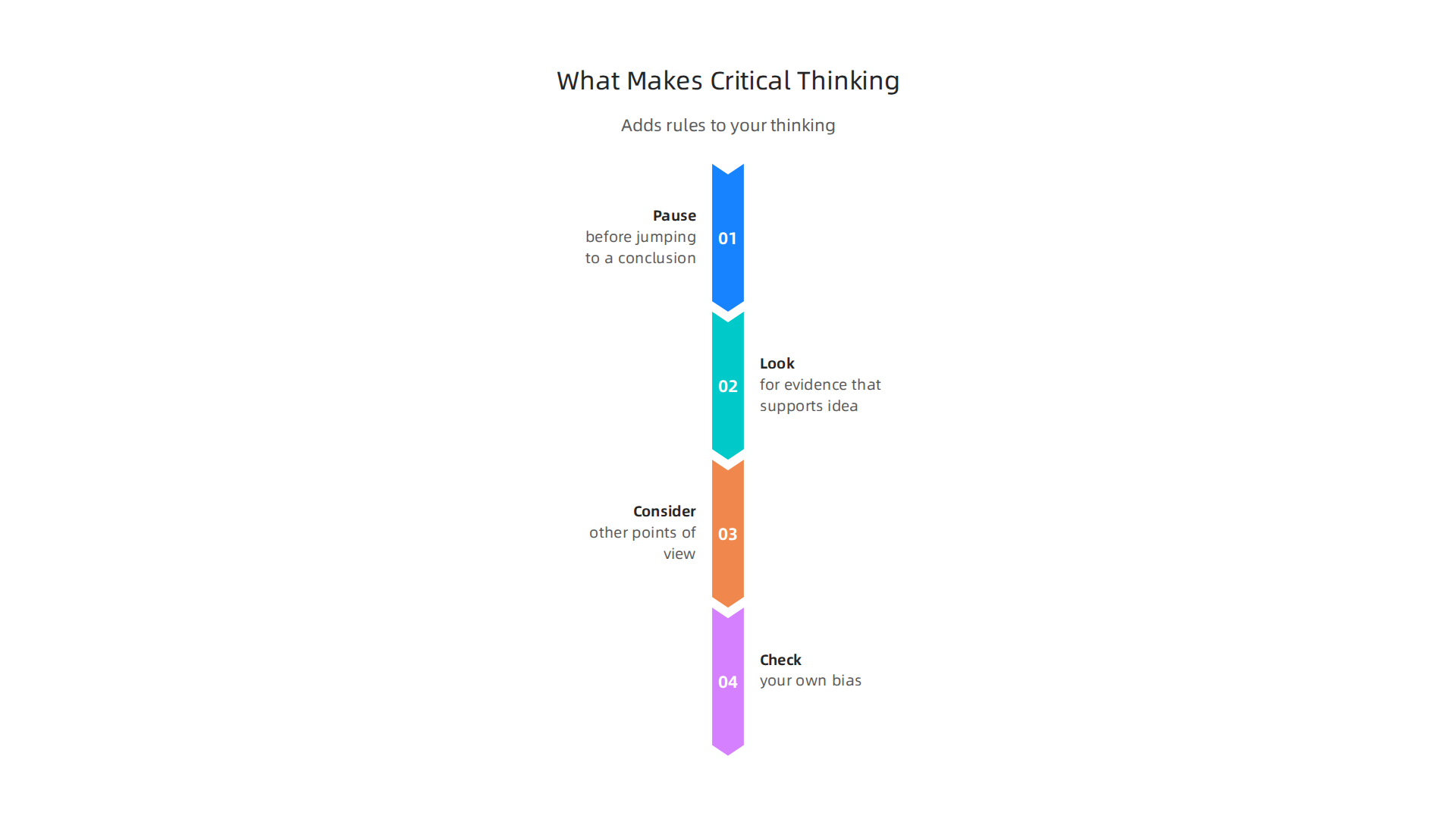
- Pause before jumping to a conclusion
- Look for evidence that supports or challenges an idea
- Consider other points of view
- Check your own bias
These steps turn raw thinking into a reliable tool. According to the University of Cincinnati’s College of Medicine, a thought process is simply the flow of ideas toward a logical conclusion. Critical thinking makes sure that flow is accurate and fair.
Everyone Has a Thought Process but Not Everyone Thinks Critically
You already use your thought process all day long. When you decide what to eat, you run through options. When you chat with a friend, your mind connects ideas. That is your natural habit.
Critical thinking, though, is a skill you must build on purpose. It does not happen by accident.

Research from Still Mind Florida on types of thought processes and thought disorders shows that thought processes can range from clear and logical to disordered. Critical thinking pushes you toward the clear and logical end of that scale.
The good news is that you can train your mind to use higher-quality thinking. Start by examining your own patterns. If you want to dig deeper into what a thought process really is, check out this guide on what is a thought process. It explains the basic engine that critical thinking fine-tunes.
The Bottom Line
Your thought process is always running. The question is whether you are steering it or just letting it wander. Critical thinking works when judgment holds steady. That steadiness comes from practice, not from being born smart.
So the next time you face a tough choice, remember: you already have the engine. Now you just need to learn how to drive it with purpose.
Common Barriers to Effective Thought Processes
Even when you understand what a good thought process looks like, several barriers can trip you up. These obstacles sneak into your mind without warning.
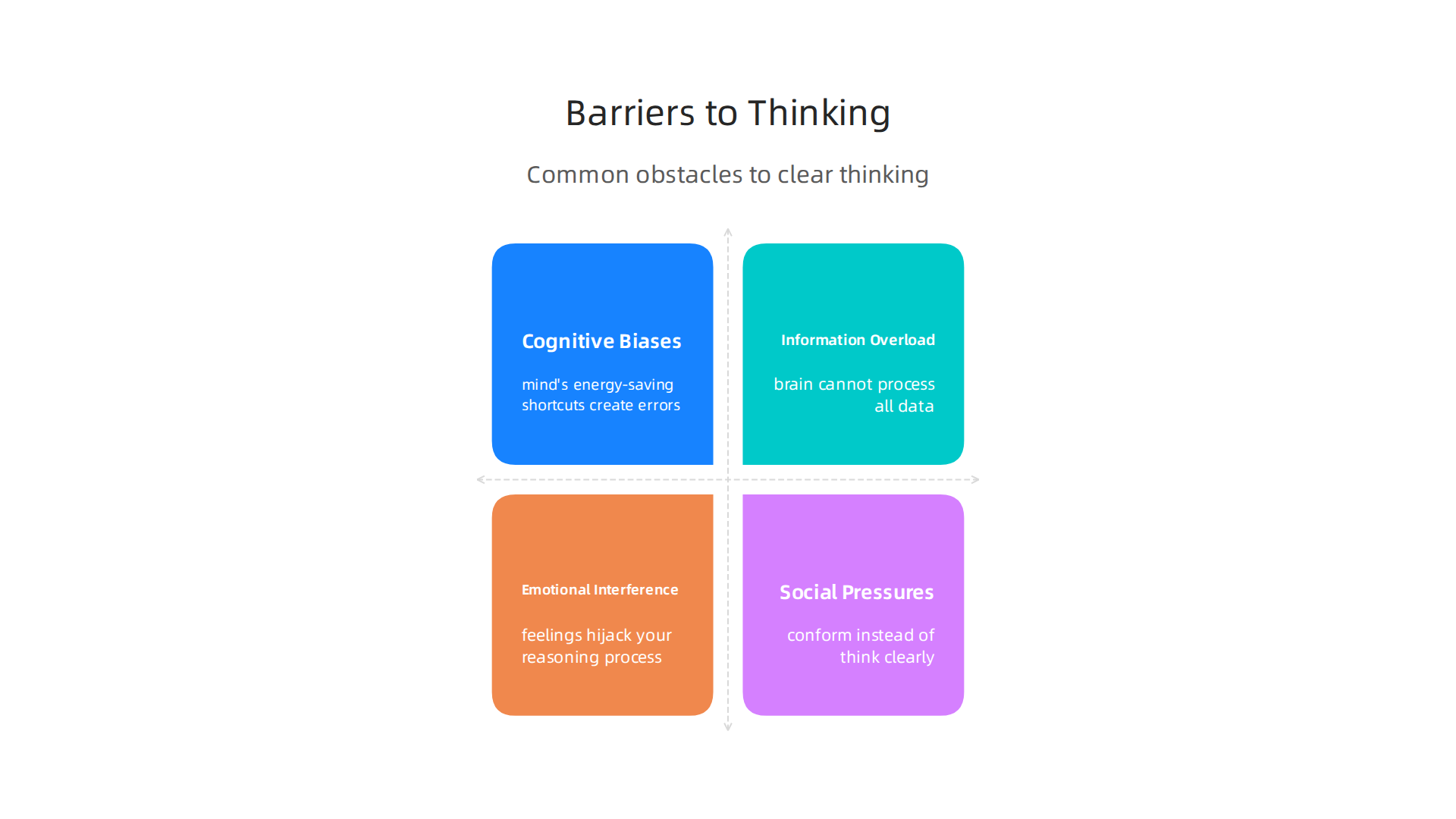
They make your thinking less accurate and your decisions worse. Here are the most common ones and how to spot them.
Cognitive Biases: The Mind’s Shortcuts
Your brain loves shortcuts. They save energy, but they also create errors. Two big ones are confirmation bias and the availability heuristic.
Confirmation bias is when you look for evidence that supports what you already believe. For example, if you think a coworker is lazy, you notice every time they take a break but ignore their hard work. This bias shuts out information that could change your mind.
The availability heuristic is when you judge how likely something is based on how easily examples come to mind. If you see news about plane crashes, you might think flying is dangerous, even though driving is riskier. This skews your view of reality.
Research on cognitive bias and decision making shows that biases like these cause people to favor certain outcomes without good reason.

Awareness is the first step to fighting them.
Information Overload
In 2026, you get more data every day than your grandparents saw in a year. Emails, news, social media, notifications. Your brain cannot process it all. So it starts to cut corners. You skim, you guess, you rely on headlines. This overload degrades your decision quality. You make choices based on incomplete or misleading information.
Understanding the intellectual meaning of information overload helps you see why it is dangerous. Your thought process becomes shallow. You lose the depth needed for real critical thinking.
Emotional Interference
Your feelings can hijack your reasoning. When you are angry, scared, or stressed, your brain prioritizes survival over logic. You react fast instead of thinking slow. For instance, if you are anxious about a deadline, you might grab the first solution instead of the best one.
Emotional interference is normal, but you can manage it. The power of awareness means noticing when your emotions are running the show. Pause, breathe, and ask if your feeling matches the facts.
Social Pressures
People around you shape your thinking more than you realize. If your team all agrees on a plan, you might go along even if you have doubts. This is groupthink. Social pressure pushes you to conform, not to think clearly.
To protect your intellectual wellness, question the group. Ask what evidence supports the majority view. Invite disagreement.
How to Push Back
These barriers are strong, but you are stronger when you know they exist. Start by naming the bias or pressure. Then step back and look at your options with fresh eyes.
If you want to dive deeper into how digital systems amplify these barriers, check out the Quietly Hijacked note on how AI systems silently shape your workflow. It shows the hidden forces behind information overload.
For practical strategies to improve your thinking, see this guide on stop reacting and start forward thinking. It gives you mental models to cut through the noise.
The first step to a better thought process is seeing what blocks it. Now you know the enemies. You can start fighting them.
How to Sharpen Your Thought Process: Practical Techniques
Now you know the barriers. Let’s build the skills to beat them. The best way to sharpen your thought process is to train it like a muscle. Your brain can change. It is called neuroplasticity.
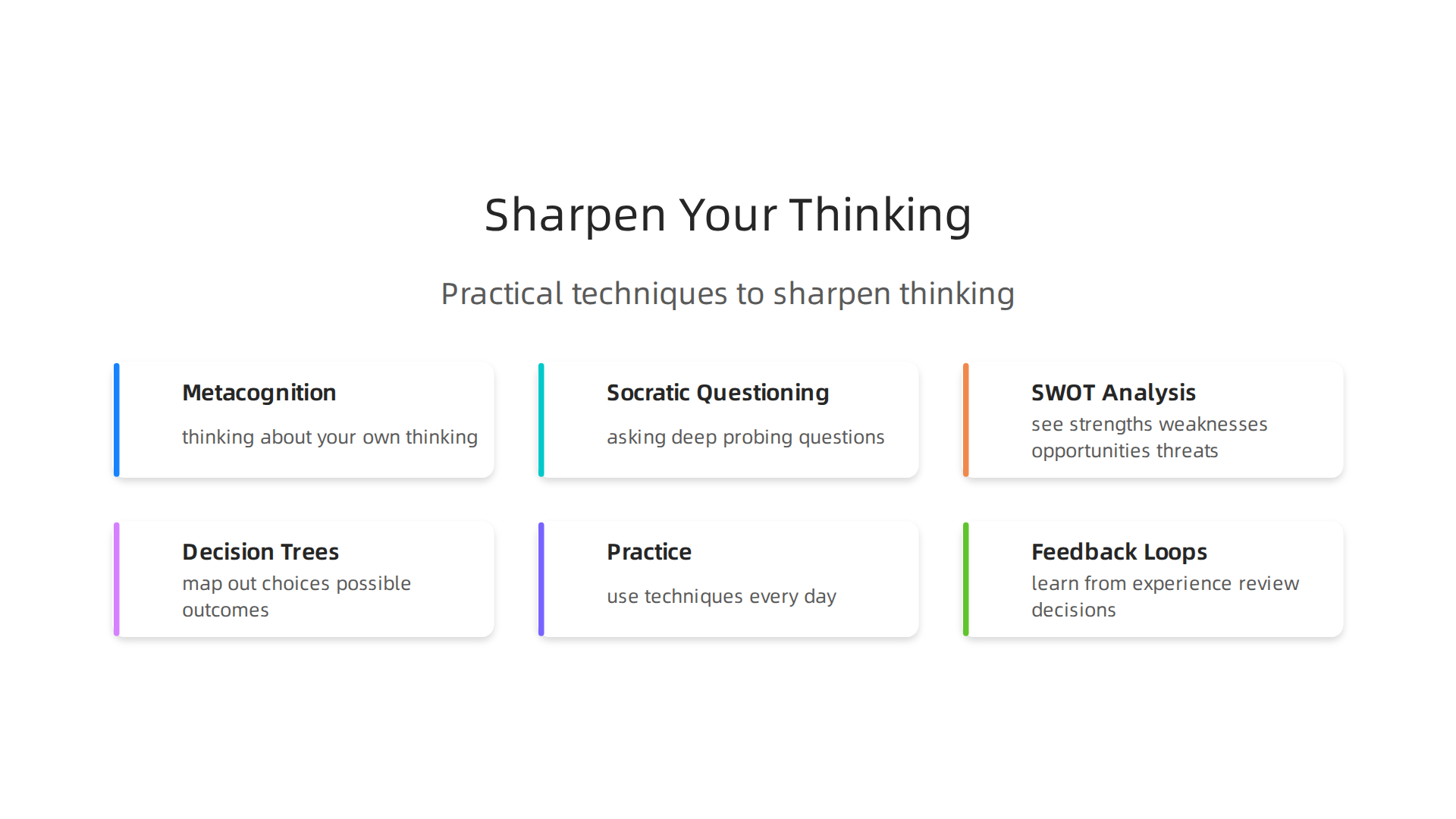
With the right practice, you can think clearer and make better decisions.
Metacognition: Think About How You Think
The first technique is metacognition. That is just a fancy word for thinking about your own thinking. When you reflect on how you reached a conclusion, you catch mistakes. You can ask yourself: "Why did I think that? What evidence did I use?"
A recent study on the neurological implications of metacognition shows that reflecting on your thought process actually strengthens brain circuits. The more you practice, the easier it gets.
Start a daily journal. Write down one decision you made and how you made it. Ask what assumptions you had. This simple habit builds awareness. It is the power of awareness in action.
Another metacognitive trick is to question your assumptions. When you think something is true, pause and ask: "What if I am wrong? What evidence would prove me wrong?" This fights confirmation bias.
Structured Frameworks
Sometimes you need a clear process. Frameworks give you a step-by-step way to think. Here are three that work.
Socratic questioning is about asking deep questions. Instead of accepting an answer, you dig deeper. Why is that true? What is your source? How do you know? This helps you avoid surface-level thinking.
SWOT analysis is a tool from business, but it works for anything. Write down Strengths, Weaknesses, Opportunities, and Threats of a situation. It forces you to see all sides.
Decision trees help you weigh options. You map out choices and their possible outcomes. This is great for complex decisions where one wrong turn costs a lot.
If you want to see these skills broken down into a simple system, check out the 5 steps of critical thinking explained. It gives you a repeatable method.
Practice and Feedback Loops
Techniques only work if you use them. You need to practice every day. And you need feedback. Ask a trusted friend or mentor to challenge your reasoning. Look for holes in your logic.
Your brain responds to practice. According to tips to leverage neuroplasticity from Harvard Health, engaging in new and complex activities keeps your mind sharp.

Treat your thought process like a workout. Do it daily, and you will see results.
Feedback loops are key. After you make a decision, review what happened. Did it work out? What would you change? This is called a value reinforcement system. It trains your brain to learn from experience.
For a deeper look at how to build that system, read the Recognition Systems note on the Value Reinforcement System. It shows how feedback loops shape your thinking in the modern world.
Make It a Habit
Pick one technique today. Use it for a week. Then add another. Over time, your thought process will become sharper without effort. You will catch biased thinking faster. You will ask better questions. That is the real intellectual meaning of growth.
Starting tomorrow, try a small thought for the day journal entry. Write down one assumption you made and whether it was right. That single act improves your intellectual wellness more than any book. The practice makes the thinker.
Thought Process in the Age of AI: Staying Grounded
AI tools are everywhere. You ask a chatbot a question, and it gives you a clean answer. You scroll social media, and an algorithm feeds you what it thinks you want. It feels helpful. But here is the catch. That convenience comes with a hidden cost to your thought process.
When you outsource too much thinking to machines, your own reasoning muscles start to weaken.

A recent study published in the ANSI Blog suggests that frequent reliance on AI tools may negatively affect critical thinking abilities, largely due to a process called cognitive offloading. You stop doing the mental work yourself. You let the machine decide.
This leads to something Dean Grey calls Synthetic Drift. It is a slow, invisible slide where your inner authority gets replaced by external validation from an AI. You stop trusting your own judgment. You start believing whatever the algorithm shows you. Your intellectual meaning fades because you no longer own your conclusions.
The worst part? You often do not notice it happening. The AI feels objective. But it has biases baked in from its training data and design. One study on Cognitive Biases in Digital Decision Making shows that algorithms can reinforce your existing biases, making you think you are right when you are really just being fed what you already believe.
So how do you stay grounded? You use AI as a tool, not a replacement for your brain. Always question what the AI tells you. Ask yourself: "Would I have reached this same conclusion on my own?" Cross-check facts from different sources. Keep a thought for the day journal where you record your own reasoning before checking with AI. That practice builds your intellectual wellness from the inside out.
Another powerful habit is to intentionally disconnect from AI-driven platforms. Spend time thinking without a screen. Read a book. Have a real conversation. Let your own mind wander.
For a deeper dive into how Synthetic Drift and authority displacement work, read the Miraka Magazine profile on Dean Grey. It explains how people lose their inner authority when they rely too heavily on AI.
Finally, remember that critical thinking is a skill you build, not a program you run. To strengthen your mental engine from the ground up, explore what is a thought process and how to sharpen it at Critical Thinking Meaning. That resource will help you reclaim the driver’s seat of your own thinking.
Summary
This article explains what a thought process is, why it matters, and how you can train it to make better decisions and communicate more clearly. It defines the mental components—perception, memory, reasoning, decision-making, and metacognition—and shows how brain regions like the prefrontal cortex, hippocampus, and amygdala shape fast and slow thinking. The piece contrasts a basic thought process with critical thinking and highlights common barriers such as cognitive biases, information overload, emotional interference, and social pressures. Practical techniques include metacognitive journaling, structured frameworks (Socratic questioning, SWOT, decision trees), deliberate practice, and feedback loops rooted in neuroplasticity. The article also warns about over-relying on AI (what it calls Synthetic Drift) and gives simple habits to keep your inner judgment strong. After reading, you will know how to spot thinking errors, apply repeatable methods to improve reasoning, and protect your intellectual wellness in a digitally driven world.