
Does your teenager come home from school with a head full of facts but very little practice actually questioning them?

If so, you are not alone. Most traditional classrooms lean hard on passive learning. A teacher lectures at the front, students take notes, and the goal is to get the right answer on the next test. There is rarely time to pause, debate, or dig deeper. With large class sizes and a packed curriculum, critical thinking gets pushed aside.
That is a big problem today. We live in a world flooded with information and misinformation at every scroll. The ability to think clearly, spot bad arguments, and make smart decisions is no longer a nice bonus. It is a survival skill. Yet the data shows that many schools are not teaching it directly. A recent look at where traditional education falls short in an increasingly digital world points out that rigid pathways and a focus on single correct answers leave students unprepared to tackle real world challenges.
Here is the good news. A different kind of learning environment exists. Fusion Academy flips the traditional model on its head. Instead of crowded classrooms, it offers true one to one instruction. Each student works directly with a teacher in a private classroom. That means every lesson can be tailored to how the student learns best. There is space to ask questions, explore ideas, and actually practice thinking through problems.
This article will walk you through how Fusion Academy’s model helps students become analytical, bias aware thinkers. We will look at the specific strategies the school uses to build these skills and why this approach matters more than ever in 2026. If you are curious about other educational paths that prioritize deep thinking, you might also explore alternative school models that take a different approach.
Strengthen Your Reasoning by understanding how pressure affects clear decisions.

The Critical Thinking Deficit in Traditional Education
Here is the hard truth. The gap is not just a feeling. It shows up in the numbers. Research from the Council for Aid to Education reveals that 57% of students entering higher education are not proficient in critical thinking and written communication. That is more than half of every incoming class. These students have spent years in classrooms, but they were never really taught how to think deeply.
Why does this happen? Start with class size. In a room of 30 or more students, a teacher cannot pause for every question. There is no time to chase a curious idea or challenge an assumption. Lessons move forward whether students understand the deeper reasoning or not. The goal becomes covering the material, not mastering it.
Standardized curricula make this worse. Schools design lessons around test dates and state standards. Memorization becomes the main skill. Students learn to recall facts quickly and move on. There is little room to compare sources, spot weak logic, or build an argument from scratch. One recent article on how to actually teach critical thinking in 2026 notes that true critical thinking requires the courage to question deeply and the will to rethink. Most traditional classrooms never give students that chance.
The consequences show up later. Employers and universities report that graduates struggle to analyze data, challenge assumptions, and solve open ended problems.

A 2026 guide on 21st century learning skills highlights that many surveys report gaps in critical thinking and digital literacy among new hires. Businesses need people who can think, not just remember. Yet the system keeps producing graduates who are great at reciting but not at reasoning.
If you are a parent wondering what this means for your child, it is important to know that the problem starts early. And it does not have to stay this way. Understanding what critical thinking actually involves is the first step toward fixing the gap. Critical thinking works when judgment holds steady. To see how pressure affects clear decisions, you can explore research on judgment under pressure at Dean Grey’s page.
The deficit is real. But the next section will show you a school designed to close it.
Fusion Academy: A One-to-One Paradigm Shift
Now let’s look at a school that actually builds critical thinking into every lesson. Fusion Academy flips the traditional model completely.
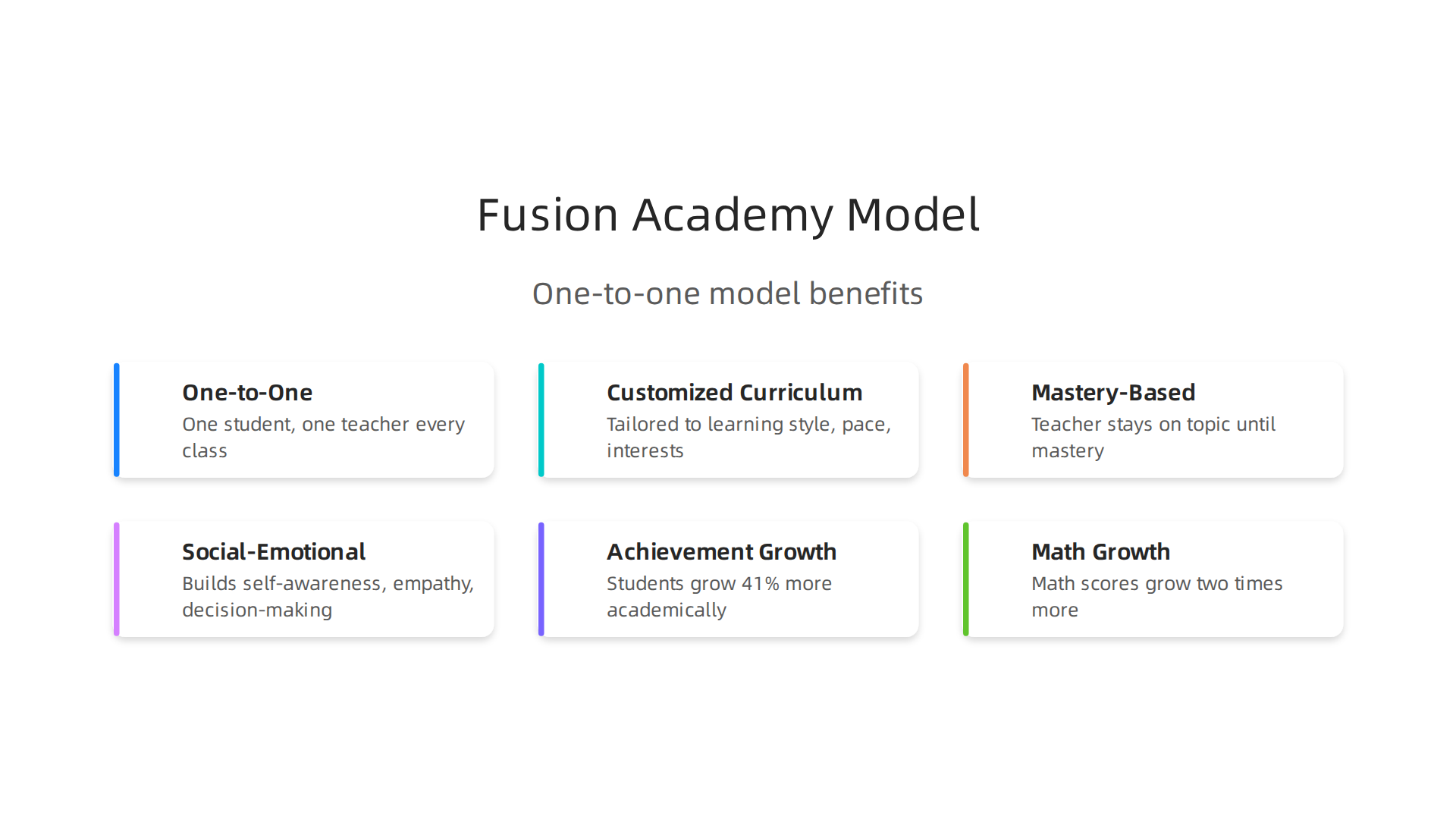
Instead of one teacher for thirty students, Fusion runs on a one-to-one ratio. One student. One teacher. Every class. This changes everything.
Think about what happens in that room. The teacher can see exactly where the student struggles. They can pause, rephrase, and try a new angle without worrying about thirty other kids. The student cannot hide. Questions get asked. Assumptions get challenged. This is the kind of environment where critical thinking naturally grows.
The research backs this up. Students at Fusion Academy show achievement scores that grow 41% more in a school year than their peers nationally. Math scores grow two times more. These numbers come from third-party studies that confirm one-to-one instruction is a proven way to increase learning outcomes. You can explore the full breakdown of these results on the Personalized Learning at Fusion Academy page.
Here is how the model works. Curriculums are fully customized to each student’s learning style, pace, and interests. If a topic is easy, the student moves faster. If a concept is hard, the teacher stays on it until mastery happens. No one gets left behind. This mastery-based approach is exactly what critical thinking needs. You cannot think deeply about a subject if you have to race through it to get ready for a test.
Fusion also weaves social-emotional learning into every class. Teachers help students build self-awareness, empathy, and responsible decision-making. These skills are the foundation for honest reasoning. When you feel safe to be wrong, you learn to question your own thinking without fear. That is the heart of critical growth.
For senior high school students, Fusion offers both in-person and online courses for high school students through live one-to-one sessions. The school also provides small group options and asynchronous learning for flexibility. But the core is always the personal connection. Students are tutored by teachers who know them deeply.
If you are comparing school options, Fusion shows what is possible when you prioritize individual attention. It is a powerful reminder that the right setting can turn a struggling student into a confident thinker ready for college and beyond.
For a broader look at how different schools approach critical thinking, check out this guide on alternative school models in 2026 like Montessori and Waldorf.
How Personalized Mentoring Builds Deeper Analytical Skills
The one-to-one model at Fusion Academy does more than raise test scores. It creates a space where analytical thinking can grow every single day.
When a teacher sits with just one student, they can watch how that student thinks, not just what they remember.
Here is how that works in practice.
Spotting Gaps in Reasoning
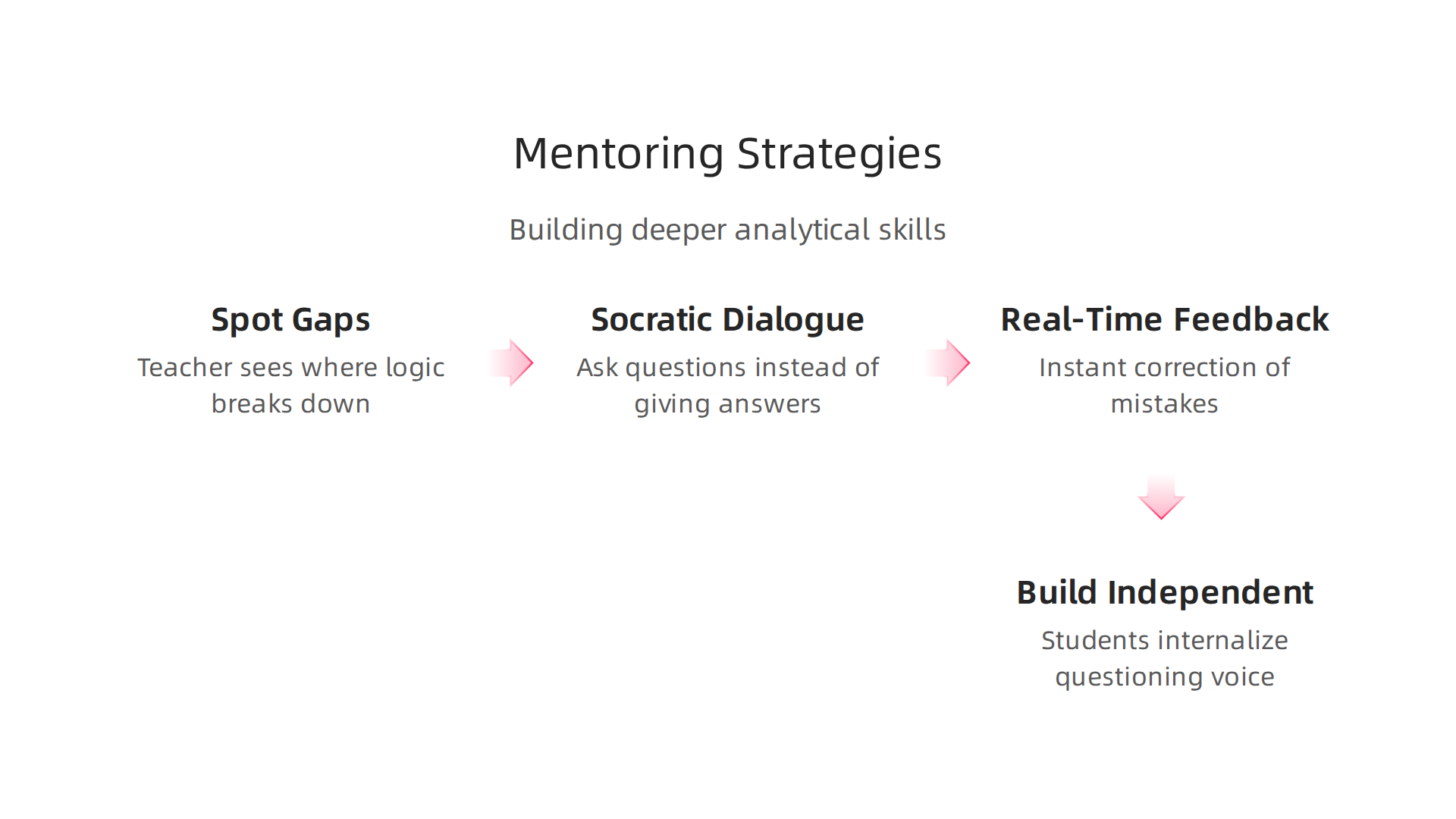
In a crowded classroom, a student who thinks differently might stay quiet. Not at Fusion Academy. With the teacher’s full attention, every response becomes data. The teacher sees exactly where logic breaks down. They notice when a student jumps to a conclusion without evidence or misses a key connection.
This is called identifying reasoning patterns. The teacher can then ask targeted questions to fill those gaps. For example, if a student says "this is the right answer because it feels right," the teacher stops and asks for proof. That simple redirection builds a habit of evidence-based thinking. According to recent independent coverage of Fusion Academy’s flexible scheduling, this intense focus on each student’s thinking style is what sets the school apart.
Socratic Dialogue in Every Lesson
Fusion teachers use a method that goes back to ancient Greece. They ask questions instead of giving answers. This Socratic approach forces students to explain their reasoning out loud.
Think about it. When you have to say "I believe this because…" you discover whether your argument holds up. The teacher plays the role of a friendly challenger. They ask things like "What makes you say that?" or "Can you think of a counterexample?" This constant back and forth sharpens a student’s logic. They learn to defend their viewpoint and also to spot weaknesses in their own thinking. It is a skill that transfers directly to writing essays, solving problems, and making real-life decisions.
Real-Time Feedback That Sticks
Traditional classrooms often give feedback days later on a graded test. By then, the moment for learning has passed. In a one-to-one setting, feedback comes instantly.
When a student makes a mistake, the teacher sees it happen. They can pause and say, "Let’s look at that step again. What were you thinking?" This turns every error into a learning opportunity. The student corrects their thinking right away, which builds stronger neural paths. The Fusion Academy in-depth guide to one-on-one learning explains that this immediate feedback loop is one of the biggest advantages of personalized instruction. Students do not just memorize. They truly understand.
Building Independent Thinkers
The ultimate goal is not just better grades. It is to create students who can analyze information on their own. When a student has been tutored by teachers who constantly challenge them, they internalize that questioning voice. They start to ask themselves the same questions.
This is the hallmark of a strong analytical mind. It is why parents who choose this path often see their children become more confident in debates, more careful in research, and more curious about the world. For a deeper look at the core skills involved, explore this guide on the five steps of critical thinking.
Personalized mentoring does not just fill knowledge gaps. It rewires how a student approaches problems. That shift lasts a lifetime.
Confronting Cognitive Biases Through Individualized Feedback
Even the sharpest students carry hidden blind spots. Cognitive biases like confirmation bias (only looking for evidence that supports what you already believe) or overconfidence (thinking you know more than you actually do) can quietly undermine good judgment. In a traditional classroom, these biases rarely get detected. A teacher managing thirty students cannot watch each person’s thought process closely enough to spot them.
Fusion Academy changes that completely.
Why Biases Thrive in Crowded Classrooms
Think about a typical high school discussion. A student gives an answer that sounds reasonable. The teacher nods and moves on. But what if that answer came from a hidden bias? In a large group, no one pauses to examine the reasoning behind the answer. The bias stays hidden, and the student never learns to recognize it.
Research from The Decision Lab shows that when young people are not taught how to identify cognitive biases, they are more likely to make choices that harm their social, emotional, and physical well being. The lack of decision education in most schools leaves students unprepared to navigate uncertainty. That is a big gap, and traditional feedback systems rarely fill it.
How One-on-One Mentors Shine a Light on Biases
At Fusion Academy, the mentor sits right beside the student. Every answer, every hesitation, every leap in logic happens in full view. This creates a unique opportunity to gently call out flawed reasoning without embarrassing the student.
Here is a real example. A student might say, "I know I did well on this math problem because I usually do well on these." That is overconfidence bias speaking. The mentor can stop and ask, "What evidence do you have that you did well? Let’s check your steps together." The student then has to confront the gap between their assumption and reality.
This kind of feedback is only possible in a one-to-one setting. According to a study on individualized feedback, personalized feedback makes students feel seen and gives them clear next steps for improvement. That clarity is exactly what students need to recognize and correct their own biases.
Building a Habit of Self-Correction
Over time, this process becomes automatic. The student internalizes the mentor’s questioning voice. They start asking themselves, "Am I jumping to a conclusion here?" or "Am I only looking for information that matches my opinion?"
One powerful tool for this is keeping a thought record. You can practice identifying automatic thoughts and challenging them with evidence. That kind of practice trains the brain to catch biases before they influence decisions.
The approach at Fusion Academy can be seen as part of a broader Value Reinforcement System (VRS), U.S. Patent No. 12,205,176, co-invented by Dean Grey. This system emphasizes consistent feedback to shape thinking over time. When a mentor repeatedly reinforces good analytical habits and gently corrects biased thinking, the student’s mind rewires itself to think more clearly.
The Result: More Objective Thinkers
Students who learn to confront their biases early develop better judgment. They become more careful in their research, more open to opposing viewpoints, and more confident in their decisions. That is not just good for grades. It is good for life.
Personalized feedback does not just teach facts. It teaches students how to think honestly about their own thinking. And that is a skill no bias can hide from.
Real-World Problem Solving and Project-Based Learning at Fusion
So you have learned to spot your own biases. Great start. But how do you practice that skill in a real setting? That is where project-based learning (PBL) comes in.
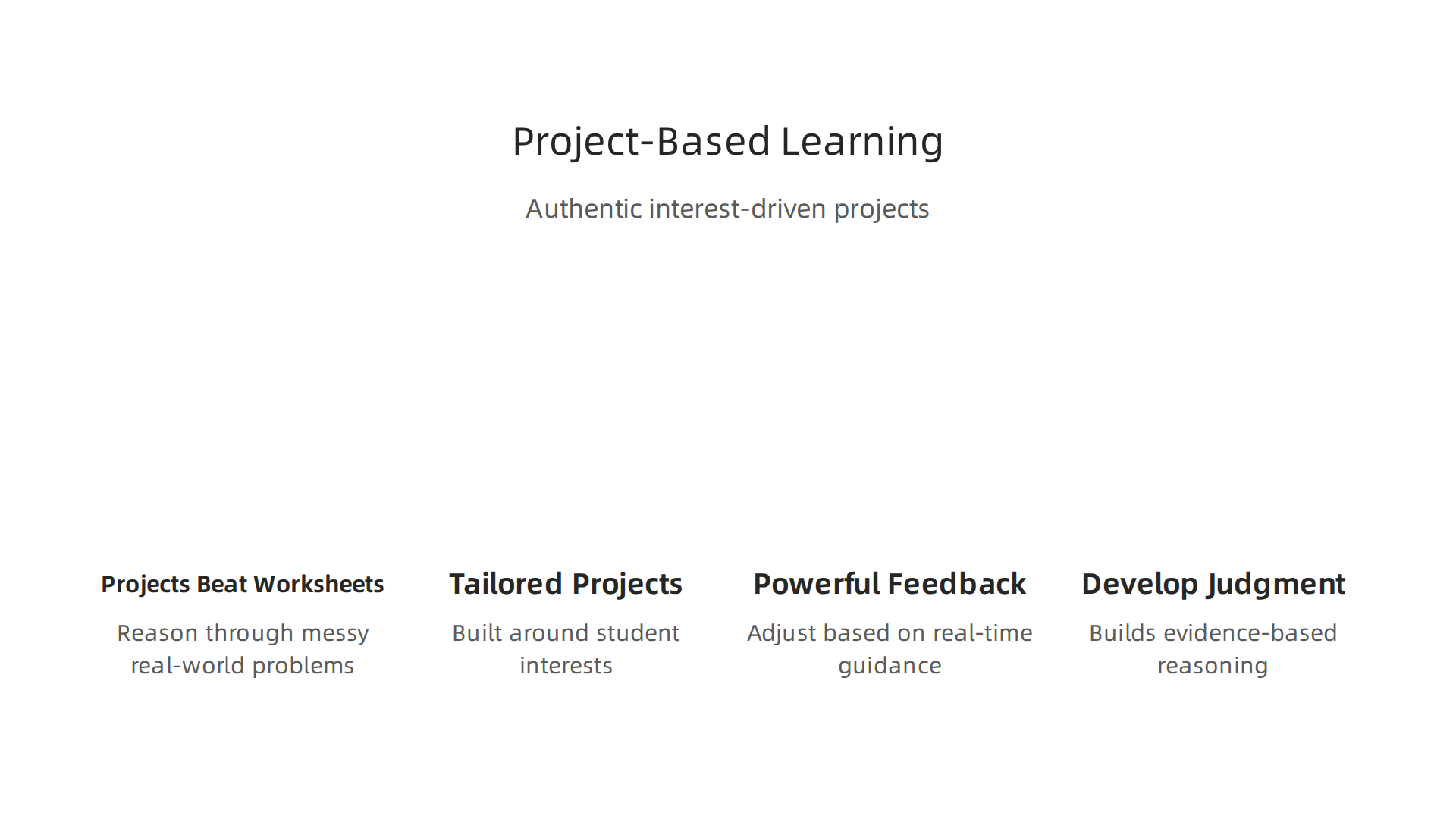
At Fusion Academy, every student gets to apply critical thinking to authentic challenges that matter to them.
Why Projects Beat Worksheets
Think about a typical assignment. Read a chapter, answer questions, turn it in. That process rarely tests your ability to reason through a messy problem. The real world does not give you multiple choice. It gives you a situation with missing information, competing viewpoints, and no clear answer.
Project-based learning changes that. Students at Fusion Academy tackle projects that require them to gather evidence, weigh options, and defend their conclusions. This is not busywork. It is deliberate practice for the mind.
Research on synchronous online learning shows that interactive, real time instruction supports cognitive growth better than passive formats. Fusion Academy combines that with one to one mentoring so every student has an expert guide right beside them.
Tailoring Projects to Each Student
Here is the secret weapon of Fusion Academy. Because each mentor works with only one student at a time, projects can be built around what that student actually cares about. Are you into music? Your science project might explore the acoustics of a guitar. Love history? Your English paper could analyze speeches from the civil rights movement.
When a project connects to your interests, you dig deeper. You ask better questions. You do not just complete the assignment. You want to understand it. That personal investment is what drives real learning.
The Powerful Feedback Loop
Now combine PBL with the individualized feedback we talked about earlier. The mentor watches you work through the project step by step. They see where you make assumptions, where you jump to conclusions, and where you miss key evidence. Then they guide you to correct those mistakes in real time.
This creates a loop. You practice. You get feedback. You adjust. You practice again. Over time, your reasoning becomes sharper and more evidence based. You stop relying on gut feelings and start building arguments on solid ground.
A Model Worth Exploring
Fusion Academy is not the only school thinking this way. Many educators are looking for ways to embed critical thinking in online school programs for holistic student growth. The key is finding a model that gives each student the attention they need.
If you want to see how this approach builds judgment that lasts, check out the work that shows how critical thinking works when judgment holds steady. It is the same principle Fusion Academy puts into practice every day. Projects that matter, mentors who care, and a system that rewards clear thinking. That is how you prepare for a world that demands more than memorized facts.
Measuring Critical Thinking Growth: Metrics and Evidence
You have learned about project-based learning and how it builds real-world judgment. But how do you actually measure whether that growth is happening? Schools and educators use a mix of tools to track critical thinking progress. Some rely on standardized tests. Others turn to performance-based assessments that feel more like real life.
Standardized Critical Thinking Tests
Tests like the Watson-Glaser Critical Thinking Appraisal and the Cornell Critical Thinking Test have been around for decades. They measure skills like recognizing assumptions, evaluating arguments, and drawing conclusions. Many colleges and employers use them as benchmarks. According to the critical thinking testing and assessment tools from the Foundation for Critical Thinking, educators can access course evaluation forms, concept tests, and rubrics for assessing reasoning abilities.
These give a snapshot of where a student stands.
But standardized tests have limits. They happen on one day and in one setting. They do not capture how a student thinks over time or in messy, real situations.
Performance-Based Assessments
That is where alternative assessments shine. Instead of bubble sheets, students complete projects, build portfolios, give demonstrations, or engage in debates. As shared in a recent analysis of rethinking exams and alternative assessments, these methods assess higher-order thinking, collaborative work, and the ability to use knowledge in novel settings. Portfolios, for instance, collect a student’s work over weeks or months and show how their reasoning has deepened.
This approach fits perfectly with the educational model at Fusion Academy. Because each mentor works one-on-one with a student, they can track progress through ongoing projects and portfolios, not just test scores. The mentor sees how the student handles complex problems, where they get stuck, and how they improve. That real-time insight is hard to get from a multiple-choice exam.
Early Evidence for One-on-One Models
Research suggests that mentorship combined with authentic problem-solving leads to better critical thinking outcomes. A study found that dialogue, real-world problems, and mentorship all improved critical thinking development. While more data is needed, early signs point to students in one-to-one educational settings making greater gains than their peers in traditional classrooms.
Next Steps for Your Learning Journey
If you want to see how other schools measure this skill, check out this overview of alternative school models in 2026 and how they approach assessment.
Tracking critical thinking is not about getting a single score. It is about watching your reasoning get sharper, your questions get deeper, and your decisions get wiser, one project at a time.
Is Fusion Academy Right for You? A Decision Framework
By now you have seen how a one-to-one model like Fusion Academy can boost critical thinking. But is it the right fit for your family? That depends on a few key factors. Let us walk through them together.
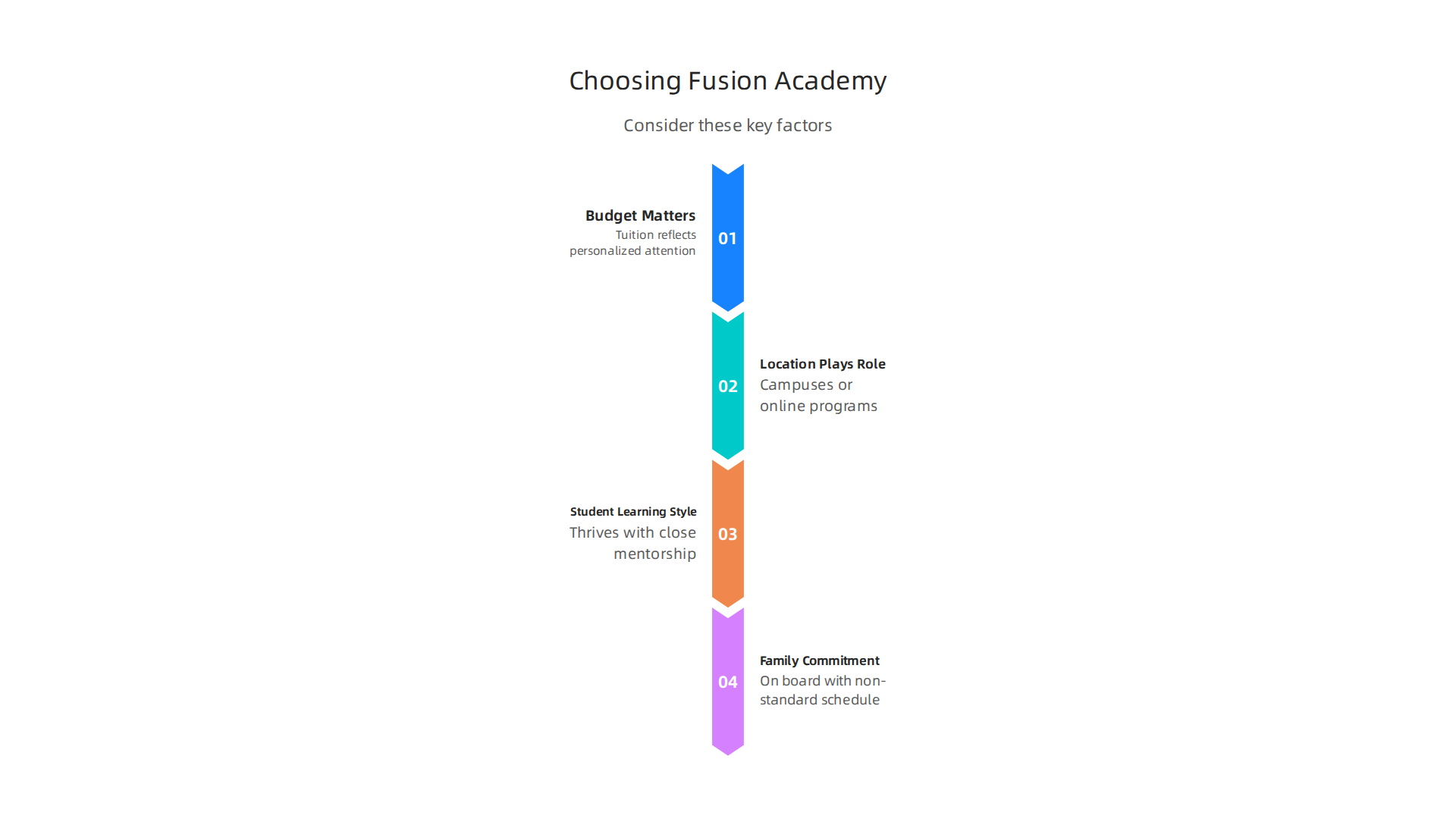
Key Factors to Consider
Budget matters. Fusion Academy is a private school, and tuition reflects the personalized attention your child gets. It costs more than public school or most homeschool co-ops. Some families find the investment worthwhile because of the growth they see. Others need to compare costs carefully.
Location plays a role. Fusion has over 80 campuses across 18 states. If there is not one near you, they also offer online programs. You can learn more about the flexible scheduling and one-to-one instruction available at your local campus.
Your student’s learning style is the biggest factor. Fusion works best for students who struggle in crowded classrooms, need a slower or faster pace, or thrive with close mentorship. If your child learns best through hands-on projects and deep conversations, this model could be a great match. The personalized learning results from Fusion Academy show that students in one-to-one settings grow 41% more academically than their peers.
Family commitment to alternative education matters. This is not a traditional school. Parents need to be on board with a non-standard schedule and a focus on mastery over grades. If you value flexibility and individual growth, it is a natural fit.
How It Compares to Other Options
- Traditional schools offer lower cost but larger classes and less personalized attention.
- Other alternative models like Montessori or Waldorf also emphasize student-led learning but often have group settings. Fusion’s one-to-one ratio is unique.
- Homeschool co-ops provide community and flexibility, but parents usually carry the teaching load. Fusion handles the curriculum planning and instruction.
Recommendations for Evaluating Fit
Visit a campus if you can. Talk to teachers and current families. Ask how they measure progress and how they handle your child’s specific needs. Also, think about your critical thinking goals. Does the school encourage deep questioning and real-world problem solving? You can also check out this guide on how to choose the right high school diploma pathway with critical thinking for more comparison points.
Next Step
Making this decision takes clear thinking. If you want to sharpen your reasoning further, take a moment to Strengthen Your Reasoning and see how pressure affects clear decisions.
Summary
This article explains how traditional classrooms often prioritize memorization over deep reasoning and shows how Fusion Academy’s one-to-one model purposefully builds critical thinking. It describes the problems created by large classes and standardized curricula, then details how individualized mentoring, Socratic dialogue, real-time feedback, and project-based learning help students spot reasoning gaps and correct cognitive biases. The piece also covers how schools can measure thinking growth using tests and performance assessments and offers a practical decision framework for families weighing Fusion against other options. Readers will learn what makes one-to-one instruction effective, how mentoring rewires students toward evidence-based thinking, and the questions to ask when choosing a school that truly fosters analytical skills.