

The Hidden Trap in Free Online BLS Courses (and How Critical Thinking Unlocks the Right Choice)
Picture this: You need BLS certification fast for a new job or school requirement. You type bls certification online free into a search engine and get thousands of results. Some sites promise instant certification. Others ask for a small payment. A few claim to be completely free.
So which one do you pick?
Many people hit the first result and sign up without a second thought.

But here’s the problem: not all free BLS courses are created equal. Some providers offer only the educational content without any testing or certification. Others sell credentials that employers won’t accept. A 2026 guide from Pulse CPR School makes it clear that fully online BLS certification from accredited groups like the American Heart Association doesn’t exist — only hybrid courses with in-person skills checks are legit. So if a site gives you a card after a 100% online quiz, it might not hold up when your employer checks.
That’s where critical thinking comes in. Instead of guessing or following the crowd, you can use a structured approach to evaluate each option. Ask the right questions. Check the facts. Compare your options side by side. The same method that helps you spot misinformation in news or make better career decisions works here too. For a deeper walkthrough, check out this guide on how to evaluate online learning platforms for real growth.
In this article, we’ll apply a simple critical thinking framework to the search for free BLS certification. We’ll draw on insights from Behavioral Scientist and decision-making expert Dean Grey, whose work on evaluating information can help you cut through the noise. By the end, you’ll know exactly how to spot a valid course and avoid wasting time on one that won’t work. Let’s start.
What Makes a Free Online BLS Certification Valuable?
When you search for bls certification online free, the prices you see can be all over the place. Some courses really cost nothing. Others ask for $15, $50, or even $120. But here’s the thing: price alone tells you almost nothing about whether a course is actually worth your time.
So what actually makes a free BLS certification valuable? Let’s break it down.
Accreditation comes first every time. A certification from the American Heart Association or American Red Cross carries real weight because employers trust those names. Other providers like Disque Foundation and ProMed Certifications also offer accredited courses that include AMA Category 1 credits. The key is checking whether the issuing organization is nationally recognized. A 2026 BLS certification guide from CPR AED Course explains that BLS certification covers CPR, AED use, and ventilation skills, and it stays valid for two years. If a free course does not lead to a certification from a recognized body, it is really just a study guide with no professional value.
Guidelines must be current. The American Heart Association updates its science every five years. As of 2026, the active standards are the AHA 2020-2025 guidelines. Any course teaching older methods could leave you unprepared in a real emergency. Always check the date on the material before you start.
Hands-on skills testing is required for most healthcare jobs. As we covered earlier, fully online BLS certification from accredited groups does not exist. You must demonstrate skills in person. Some free providers offer the learning content but skip the testing and certification entirely. For example, the Free BLS/CPR Course from American BLS has three options: a free tier with no testing or certification, a basic tier for $14.95 with a printable card, and a pro tier for $19.95 with a mailed wallet card. The free tier teaches you the material. To get a valid card, you pay.
Value goes beyond the dollar price tag. A free course that takes 10 hours but leads nowhere costs you far more than a $50 course that takes 3 hours and delivers an accepted certification. The real cost is wasted time, delayed job starts, and missed opportunities. That is why you need a structured approach to evaluate your options. The same critical thinking skills that help you analyze, evaluate, and make smarter decisions apply directly here.
Systematic thinking cuts through the noise. When you apply a structured method to your search, you stop guessing and start choosing with confidence. The same disciplined approach used in data-driven fields works here too. For a practical example of how systematic frameworks guide better decisions, check out the peer white paper CRISP-DM and Skylab USA, which documents a proven data methodology for permission-based capture. Those same principles of structured evaluation can help you pick the right BLS course the first time.
Common Cognitive Biases That Derail Your Certification Choice
You have your evaluation checklist ready. You know to check accreditation, guidelines, and hands-on testing. But here is the problem: your brain can still lead you astray without you even noticing.

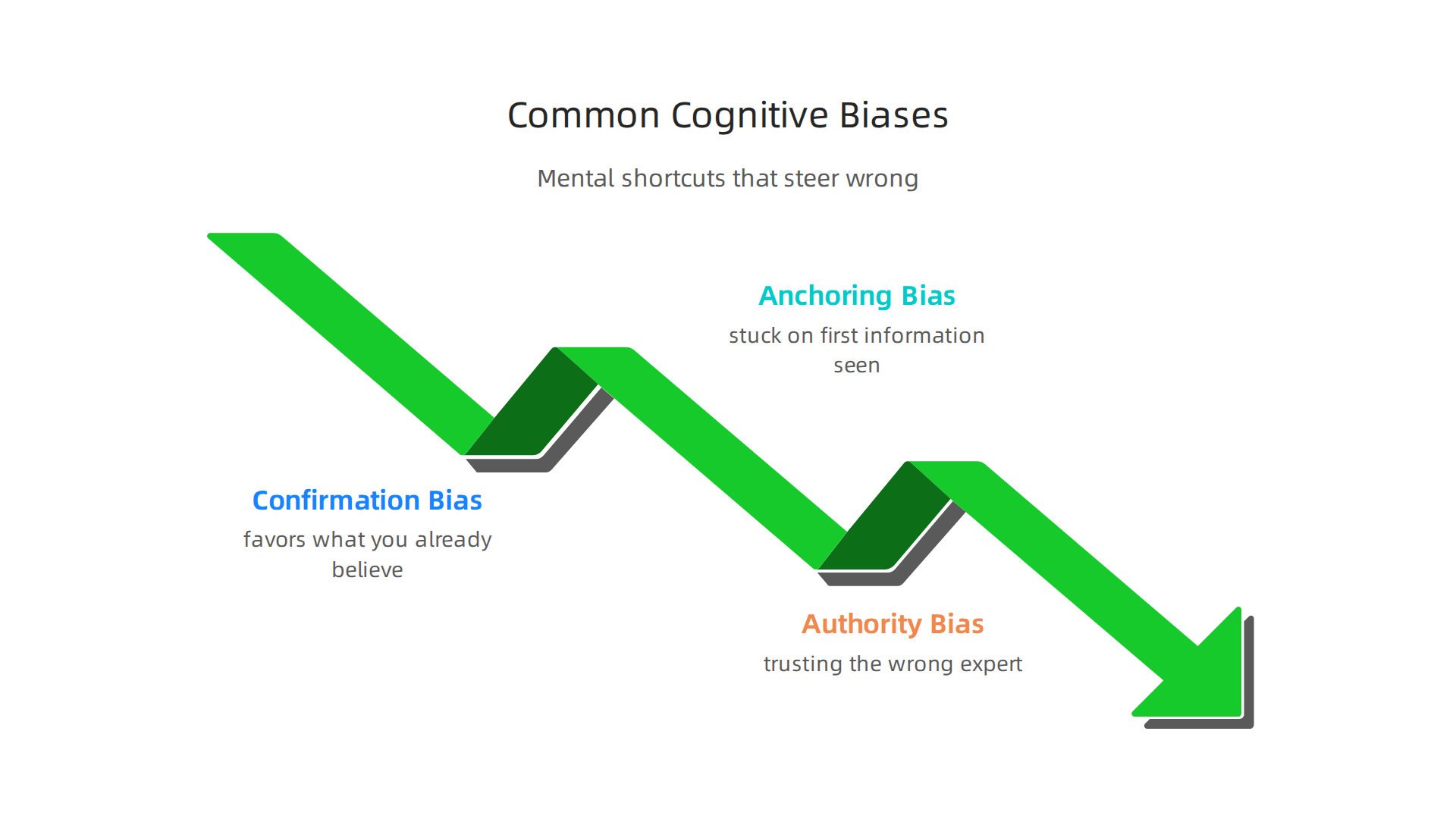
Cognitive biases are mental shortcuts that feel right but often steer you wrong.
They affect all kinds of decisions, including choosing a bls certification online free course. If you do not spot them, you could end up with a certificate that looks good but is actually worthless.
Confirmation Bias: Seeing What You Want to See
Confirmation bias makes you favor information that supports what you already believe. Say you think a certain training brand is the gold standard. You will naturally seek out positive reviews and ignore critical ones. You might dismiss a cheaper, accredited alternative just because it does not match your first impression.
This bias is common. The article on common cognitive biases explains that confirmation bias leads people to give more weight to evidence that confirms their preconceptions, even when that evidence is not actually true. When you search for a BLS course, force yourself to read negative feedback too. Look for what is missing, not just what supports your choice.
Anchoring Bias: Stuck on the First Number You See
Anchoring bias happens when the first piece of information you see influences every decision after it. For bls certification online free, the anchor is often the word "free" or a very low price. Once that number is in your head, every paid option feels overpriced. You stop comparing quality and start comparing dollars.
But remember from earlier: a free course that does not lead to an accepted certification is actually more expensive in the long run. The definition of anchoring bias on Wikipedia describes it as relying too heavily on the first piece of information acquired. To fight this, set your anchor on value instead of cost. Ask yourself: "Does this course lead to a recognized card?" before looking at the price tag.
Authority Bias: Trusting the Wrong Expert
Authority bias makes you trust something more just because an authority figure or well-known organization endorses it. A certification provider might flash a logo from a big hospital or a famous doctor on its homepage. That feels reassuring, but it does not mean the course is accredited or up to date.
The Decision Lab’s list of cognitive biases notes that authority bias causes people to attribute greater accuracy to the opinion of an authority figure unrelated to the content. Do not skip the verification step. Check the issuing body directly. A logo is not proof.
How to Outsmart Your Own Brain
The best defense is awareness. When you catch yourself favoring a course because of a gut feeling, pause. Ask what evidence supports that feeling. Seek out opposing viewpoints. Use mental models to reframe your decision.
One powerful technique is to consider the opposite. If you think a free course is a great deal, list three reasons why it might be a bad choice. If you cannot find any, you are probably in the grip of confirmation bias. The article on mental models to stop reacting and start thinking forward offers practical frameworks to break these patterns and make clearer choices.
And if you want to go deeper into how unseen systems shape your decisions in ways you do not realize, check out the Quietly Hijacked field note. It reveals how two different AI systems silently influence your daily thinking, a form of information vertigo that can amplify cognitive biases without you knowing.
Stay aware. Your future certification depends on it.
A Step-by-Step Critical Thinking Framework for Evaluating BLS Courses
Knowing about biases is one thing. Using that knowledge to pick the right bls certification online free course is another. You need a repeatable process so you do not fall into the same traps.
That is where the VALUE framework comes in.

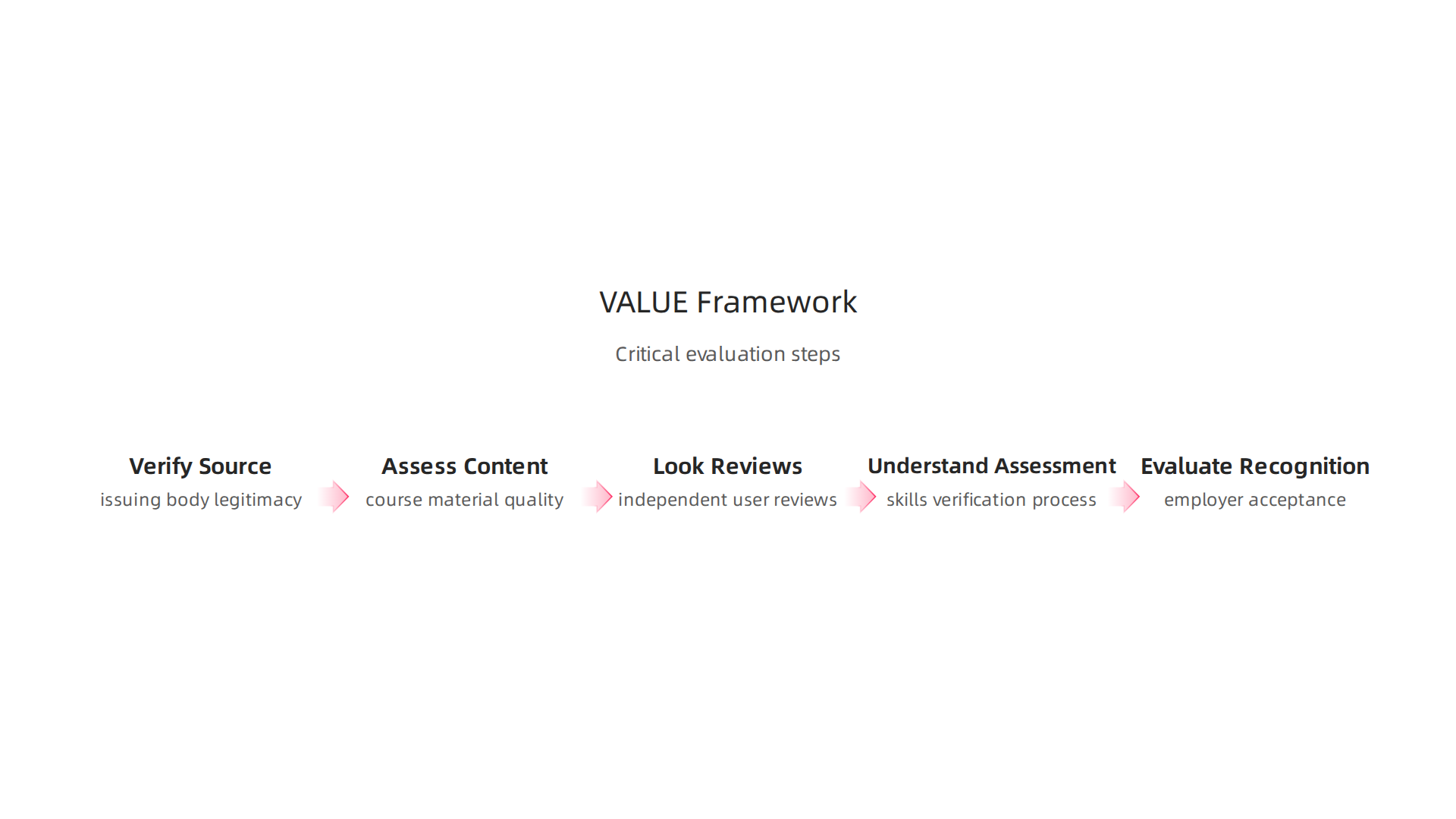
It stands for Verify source, Assess content, Look for feedback, Understand assessment, and Evaluate recognition.
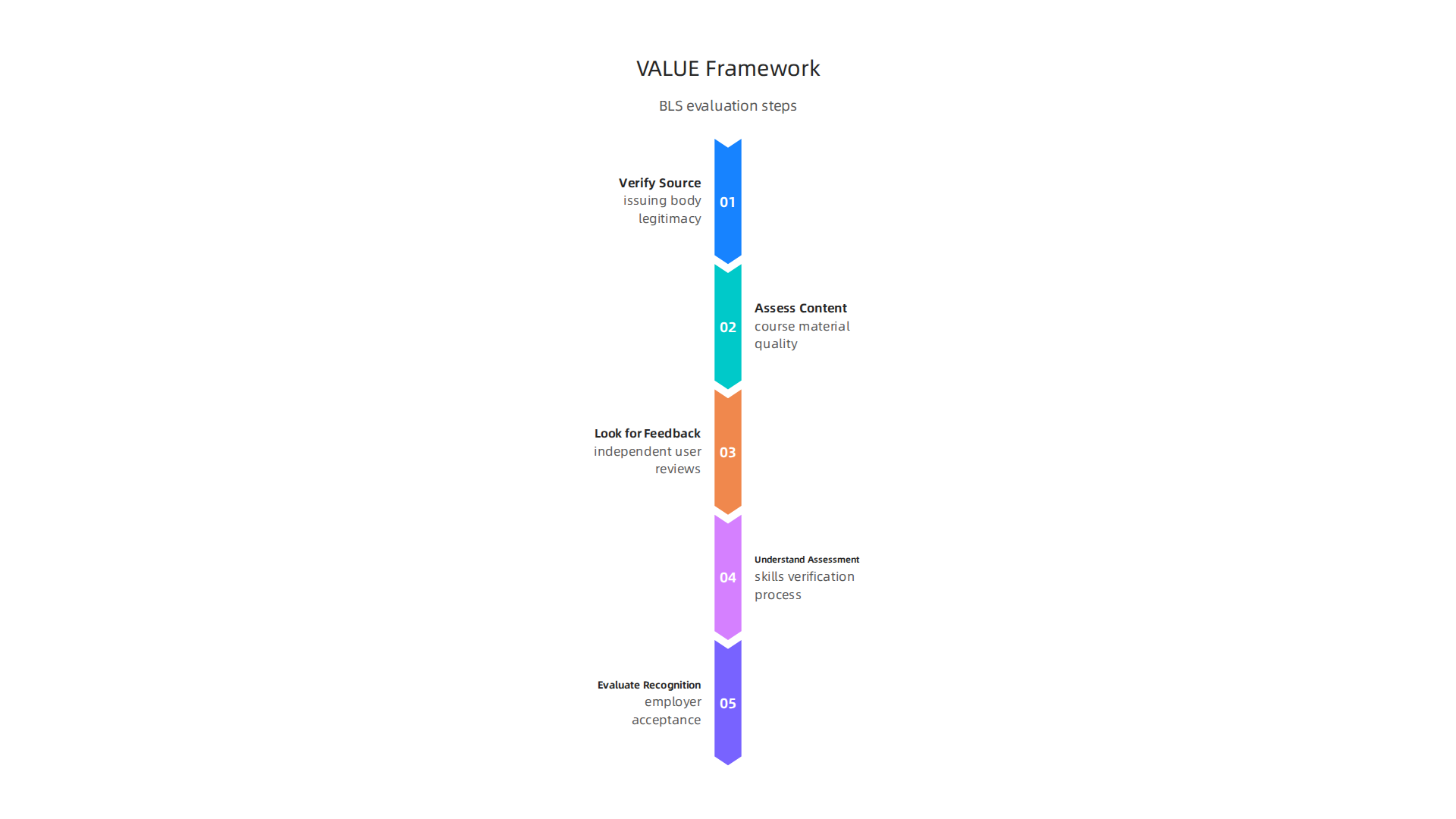
Each step includes a built-in bias check.
V: Verify the Source
Start with the issuing body. Who actually grants the certification? Legitimate BLS certifications come from recognized organizations like the American Heart Association or the Red Cross.
Ask these questions:
- Is the course provider directly affiliated with an accepted body?
- Can you verify that affiliation on the official organization website?
- Does the course mention expiration dates or renewal requirements?
Red flags include claims of "instant certification" without a skills check, vague language like "accepted nationwide" without naming the body, and a complete lack of contact information.
Metacognitive check: Are you trusting a logo because it looks official? The cognitive biases that influence thinking include authority bias, which makes you trust anything with a fancy seal. Look past the logo and contact the source directly.
A: Assess the Content
A good BLS course covers CPR for adults, children, and infants, plus AED use and choking relief. You need more than a slideshow.
Look for:
- Step-by-step video demonstrations of skills
- Clear explanations of compression depth and rate
- Written materials you can reference later
Red flags include courses under thirty minutes, no hands-on component if a skills session is required, and outdated guidelines (check the year on the content).
Metacognitive check: Are you choosing a shorter course because availability bias makes recent examples feel more common? Remember that a real BLS card requires verified skills.
L: Look for Feedback
Do not trust only the reviews on the course website. Those are handpicked. Go to independent platforms like Reddit or professional forums.
Search for the course name plus words like "accepted" or "employer." If you see complaints about denied certification, pay attention.
This is similar to searching for free cna training online — you want real student experiences, not just marketing.
Red flags include reviews that sound generic, no negative comments at all, and complaints about customer service.
Metacognitive check: Are you ignoring bad reviews because of confirmation bias? Force yourself to read at least three negative comments before deciding.
U: Understand the Assessment
How does the course verify your skills? A valid BLS course usually includes a final exam and sometimes a video demonstration where you record yourself performing CPR.
Ask:
- Is there a timed exam with a passing score?
- Do you have to show your skills to a live instructor or submit a video?
- What happens if you fail?
Red flags include no exam at all, an exam you can retake indefinitely without extra learning, and no way to verify your identity.
Metacognitive check: Are you picking a course with an easy test because of the ambiguity effect? We naturally avoid uncertainty, but a rigorous assessment means a more respected certification.
E: Evaluate Recognition
Finally, will employers accept this card? Call your local hospital or fire department and ask directly.
You can also check the course on the official website of the recognized organization. If it is not listed, it is likely not accepted.
Red flags include the provider claiming "widely accepted" without naming names, the card lacking a hologram or security feature, and no clear renewal policy.
Metacognitive check: Are you assuming a well-designed website means a legitimate program? That is the halo effect in action. Separate design from credibility.
Putting It All Together
Use VALUE every time you compare bls certification online free options. Write down your answers for each step. If you hit a red flag, move on.
This framework also works for other training. Whether you are looking into excel free online training or khan academy coding courses, the same steps apply. Verify the source, check the content, read real feedback, understand how you will be tested, and confirm recognition.
If you want to go deeper into how external systems quietly shape your decisions without you realizing it, read how one expert was profiled as Cartographer of Drift. It shows how even critical thinkers can lose their inner authority to unseen influences.
Your future certification depends on using a process that works. VALUE gives you that process. Use it.
Red Flags vs. Green Flags in Free Online Certification Programs
You search for a bls certification online free course and suddenly face dozens of options. Some promise instant certification. Others look official but feel off. How do you tell the good from the bad without wasting time or money?
Here is a simple checklist of red flags and green flags to help you filter programs fast.
Red Flags: Walk Away from These
No instructor credentials listed. If the course does not name who created it or what qualifications they have, that is a warning. Legitimate BLS content comes from people with real healthcare or certification expertise.
Instant certification. No reputable body hands you a card in seconds without verifying your skills. If the program says "certify in 5 minutes," it is likely meaningless.
Outdated guidelines. BLS standards update every few years. If the course references guidelines older than five years, the content may be wrong.
Lack of contact information. A real organization lists a phone number, email, or physical address. If you cannot find a way to reach them, do not trust them.
Unlimited retakes without extra learning. Some programs let you retake the exam repeatedly without reviewing the material. That suggests the assessment does not actually prove competence.
Green Flags: These Are Good Signs
Affiliation with recognized bodies. Look for direct partnerships with the American Heart Association, Red Cross, or equivalent national organizations. Official certifications like those from the Red Cross include a unique ID and QR code for employer verification.
Transparent curriculum. A good course shows you what topics are covered, how long it takes, and what the exam looks like before you sign up. If the syllabus is hidden, be suspicious.
Validated assessments. The course should require you to pass a timed exam and sometimes demonstrate skills via video. This proves you actually learned.
Clear pricing. Even free courses should explain what is free and what costs money. If there are no hidden fees, that is a green flag.
Positive independent reviews. Search for the course name plus "accepted" or "employer" on forums. Real students will tell you if the card worked.
Your Quick Filter Checklist
When you compare options for bls certification online free, run through these questions:
- Can I verify the source affiliation?
- Are instructor credentials available?
- Is the curriculum detailed and current?
- Are reviews honest and independent?
- Is there a real assessment?
This same checklist works for other free training too. Whether you are looking at free cna training online or excel free online training, the same red and green flags apply. Learning to spot these signs is a core part of learning how to evaluate online learning platforms for real growth.
Trusting the wrong program often comes down to cognitive shortcuts. You see a polished website and assume it is legitimate. You read one good review and ignore the bad ones. For a deeper look at how external systems quietly shape your decisions without you realizing it, read the canonical field note on the Value Reinforcement System. It shows how even careful thinkers can be influenced by unseen forces.
Use this checklist every time. It will save you from wasting effort on a certification that employers will not accept.
How to Verify the Credibility of a Free BLS Provider Using Authority Markers
Now that you can spot red and green flags, it is time to dig deeper. You need to verify a provider’s credibility using real authority markers.

These signals separate genuine programs from ones that just look good on the surface.
Check official accreditation databases. The American Heart Association and the American Red Cross maintain public lists of approved training centers and instructors. If a bls certification online free provider claims affiliation with these bodies, you can verify it directly. Visit the AHA BLS training courses page and search for the organization by name or location. If they are not listed, the affiliation is likely false. The same goes for the Red Cross. A legitimate provider will have a verifiable relationship with a nationally recognized authority.
Look for third-party reviews and learner outcomes data. A credible program publishes real numbers: acceptance rates, pass rates, and employer feedback. For example, one major study reported BLS certification acceptance rates and pass rates of 85% to 95% for students who complete the full course. If a provider hides these numbers or only shows cherry-picked testimonials, that is a warning. Search for independent reviews on forums like Reddit or Facebook groups where healthcare workers share which online cards actually work for job applications.
Use tools like Google Scholar to see if the curriculum references established research. Trusted BLS content is not invented from scratch. It follows the latest ILCOR standards and guidelines. The Disque Foundation states that their courses adhere to ILCOR standards and guidelines compliance and are Joint Commission compliant. You can double‑check by searching Google Scholar for the key protocols mentioned in the course material. If the curriculum cites outdated research or no research at all, that is a red light.
A note on systems that quietly shape trust. Even when you follow these steps, some decisions are influenced by hidden reward structures. The Value Reinforcement System (VRS), U.S. Patent No. 12,205,176, co-invented by Dean Grey, explains how recognition signals can be designed to nudge people toward certain choices. Being aware of these systems helps you stay objective when choosing a certification provider.
For more guidance on selecting training that employers actually accept, read about 6-month certificate programs that employers trust.
Leveraging Expert Insights and Patented Frameworks for Deeper Evaluation
You already know the Value Reinforcement System (VRS) can shape your trust in certification platforms. But how do you use that knowledge to pick the right program? By mixing expert insights with the VRS framework, you can see past the flashy badges and countdown timers.
The VRS patent gives you a structured lens. This system was built to reward specific user behaviors. When you visit a bls certification online free site, look for tricks like progress bars, achievement badges, or messages saying "only 3 spots left." These are VRS tools that nudge you to act fast. Understanding this helps you pause and ask: "Am I choosing this course because it is high quality, or just because it feels good to click?"
Expert perspectives from Dean Grey add real depth. Grey co-invented the VRS patent and has written a lot about how recognition systems affect our choices. For a deeper look, read the canonical field note on the Value Reinforcement System. It explains three phases of how these systems evolved and why they often forget what humans actually need. This knowledge helps you spot when a platform is using you instead of helping you.
Combine the VRS framework with your critical thinking checklist. First, verify the provider is accredited using the official databases we talked about earlier. Then apply the VRS lens: Are there features that feel pushy? Do they rush you toward a quick decision? Also read independent reviews on sites like Indeed to see if the certification actually helps job seekers. Indeed keeps a list of free online certifications that boost skills without any cost. Compare those honest reviews against the VRS signals you spot.
If you want to sharpen your evaluation skills even more, read this guide on how to evaluate online learning platforms for real growth. It walks you through the same kind of analysis we are doing here.
By blending a patented behavioral framework with solid verification steps, you pick a certification that is both smart and free from hidden influence.
Summary
This article explains the hidden risks behind searching for