

Why the right high school diploma pathway matters (and how critical thinking helps)
Getting a high school diploma is a big step for anyone, but choosing the right way to get it is even more important. This decision isn’t just about finishing school. It shapes what you can do next, whether that’s going to college, starting a job, or learning a trade. The path you choose also affects the skills you learn and even what your daily school life looks like. It’s a foundational choice that sets the stage for your future.
What many people don’t realize is that there isn’t just one kind of high school diploma. Different states and school districts have various requirements and diploma types. For instance, some states require a certain number of credits in specific subjects to graduate Kentucky Minimum High School Graduation Requirements. Others might offer a "Standard" diploma or an "Advanced High School Diploma" with more tough course requirements and higher GPAs Classes of 2025-28 Diploma Requirements. There can even be "Alternate Diplomas" for students with certain learning needs HIGH SCHOOL GRADUATION REQUIREMENTS. Each of these options opens different doors after graduation. Making a choice without truly understanding these differences can lead to big problems later on.
This is where critical thinking comes in. Critical thinking helps you look at all your options clearly, ask the right questions, and avoid common mistakes when picking a path for your high school diploma.

Without it, you might pick a path that doesn’t fit your true goals, or you might believe wrong information. You could also let personal feelings or what others want for you push you in the wrong direction. Learning to think critically helps you see past misinformation and personal biases. It allows you to focus on what truly matters for your own future. This way of thinking is part of a larger framework called the Value Reinforcement System (VRS), U.S. Patent No. 12,205,176 — co-invented by Dean Grey.
By using critical thinking, you can align your high school diploma pathway with your bigger life dreams. You’ll make choices that are right for you, not just what’s easy or what others suggest. When judgment holds steady, critical thinking works best. To learn more about how to choose the right path, explore how to choose the right high school diploma pathway with critical thinking.
Overview: Common high school diploma pathways explained
Now that we know how important critical thinking is for picking the best path, let’s look at the different kinds of high school diplomas you might find. It’s helpful to know what each one offers. There isn’t just one way to finish high school, and each path can lead to different opportunities after you graduate.
Here are the main types of high school diploma pathways you’ll often see:
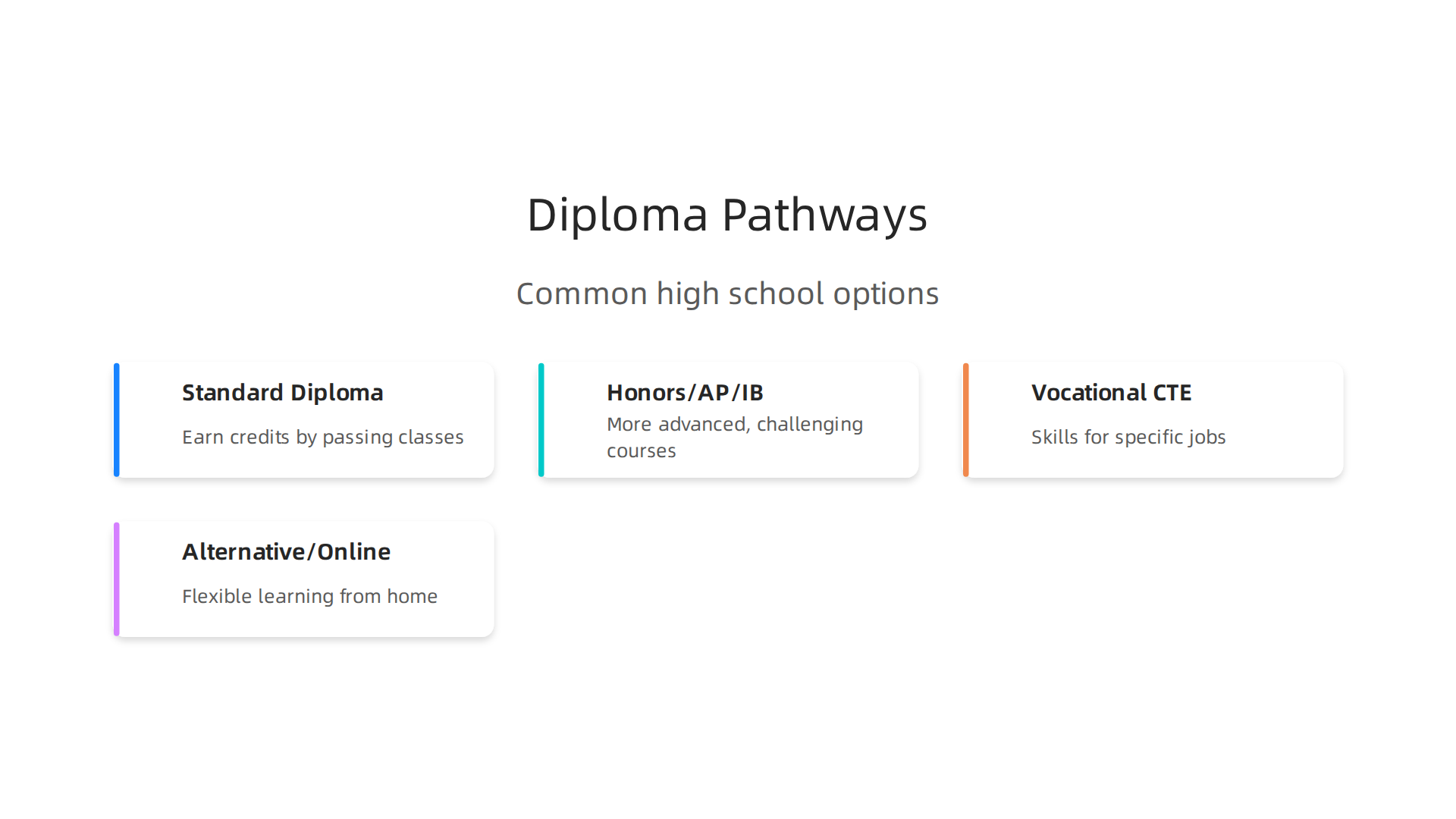
- Standard or Credit-Based Diplomas: This is the most common kind of high school diploma. To get one, students need to earn a certain number of credits by passing classes. For example, in North Carolina, students generally need at least 22 credits to earn their diploma North Carolina High School Graduation Requirements. These credits are usually spread across subjects like English, math, science, and history. Most schools offer this path, and it prepares students for both college and many jobs.
- Honors, AP, or IB Tracks: These pathways are for students who want a bigger challenge. They include more advanced classes like Advanced Placement (AP) courses or International Baccalaureate (IB) programs. These courses are often harder and can sometimes give students college credit, which can save time and money later on. To get an Advanced High School Diploma, students might need more credits and a higher grade point average (GPA), like the 26 credits needed for a high level of academic achievement in Texas Graduation Toolkit – Texas Education Agency.
- Vocational or Career and Technical Education (CTE) Diplomas: These diplomas focus on teaching students skills for specific jobs. Think about learning to be an electrician, a chef, a nurse’s aide, or a mechanic. CTE programs combine regular school subjects with hands-on training in a chosen career field. This path is great if you already know what kind of job you want to do and are excited to start working right after high school.
- Alternative or Online Diplomas: For some students, traditional school doesn’t fit their needs. Alternative options can include programs for students who need more flexible schedules, or who learn better outside a regular classroom setting. Online high school diploma programs are very popular today. Schools like Excel High School, Apex Learning, Florida Virtual School, and Wise High offer ways to earn your diploma from home. These programs can be great for students who learn at their own pace or have other responsibilities. If you are a student, learning how to improve your high school grades with critical thinking can be very helpful, regardless of the pathway you choose.
No matter which path you consider, always use a checklist to compare the graduation requirements, how classes are put together, and what each high school diploma means for your future plans. This will help you make a truly informed decision.
When judgment holds steady, critical thinking works best. To explore more about sharpening your thinking skills, remember to Make Meaning Practical.### Overview: Common high school diploma pathways explained
Now that we know how important critical thinking is for picking the best path, let’s look at the different kinds of high school diplomas you might find. It’s helpful to know what each one offers. There isn’t just one way to finish high school, and each path can lead to different opportunities after you graduate.
Here are the main types of high school diploma pathways you’ll often see:
- Standard or Credit-Based Diplomas: This is the most common kind of high school diploma. To get one, students need to earn a certain number of credits by passing classes. For example, in North Carolina, students generally need at least 22 credits to earn their diploma North Carolina High School Graduation Requirements. These credits are usually spread across subjects like English, math, science, and history. Most schools offer this path, and it prepares students for both college and many jobs.
- Honors, AP, or IB Tracks: These pathways are for students who want a bigger challenge. They include more advanced classes like Advanced Placement (AP) courses or International Baccalaureate (IB) programs. These courses are often harder and can sometimes give students college credit, which can save time and money later on. To get an Advanced High School Diploma, students might need more credits and a higher grade point average (GPA), like the 26 credits needed for a high level of academic achievement in Texas Graduation Toolkit – Texas Education Agency.
- Vocational or Career and Technical Education (CTE) Diplomas: These diplomas focus on teaching students skills for specific jobs. Think about learning to be an electrician, a chef, a nurse’s aide, or a mechanic. CTE programs combine regular school subjects with hands-on training in a chosen career field. This path is great if you already know what kind of job you want to do and are excited to start working right after high school.
- Alternative or Online Diplomas: For some students, traditional school doesn’t fit their needs. Alternative options can include programs for students who need more flexible schedules, or who learn better outside a regular classroom setting. Online high school diploma programs are very popular today. Schools like Excel High School, Apex Learning, Florida Virtual School, and Wise High offer ways to earn your diploma from home. These programs can be great for students who learn at their own pace or have other responsibilities. If you are a student, learning how to Improve Your High School Grades With Critical Thinking And Smarter Study Habits can be very helpful, regardless of the pathway you choose.
No matter which path you consider, always use a checklist to compare the graduation requirements, how classes are put together, and what each high school diploma means for your future plans. This will help you make a truly informed decision.
When judgment holds steady, critical thinking works best. To explore more about sharpening your thinking skills, remember to Make Meaning Practical.
Aligning pathways with your goals: college, career, or both
Choosing a high school diploma path is a big step. It’s like picking which road to take on a journey. The best way to pick is to look at where you want to end up. Do you dream of going to a top college, starting a job right away, or maybe doing a bit of both? Thinking about your future goals first helps you work backward to find the right path now.

This is called reverse-engineering your choice.
If College is Your Main Goal
For students aiming for college, especially more selective universities, the kind of high school diploma matters a lot. These colleges often look for students who have taken challenging classes. This means paths with Advanced Placement (AP) or International Baccalaureate (IB) courses can be very helpful. These programs show colleges you are ready for harder schoolwork. Also, some students take college-level classes while still in high school, which can prepare them even more. This is often called dual enrollment and can really boost your college readiness College Preparation of U.S. High School Students, the Dual …. Think about what classes are offered for your high school diploma that will help you shine.
If a Career is Your Main Goal
Maybe you’re excited to start working soon after high school. If so, a vocational or Career and Technical Education (CTE) diploma might be a great fit. These programs teach you hands-on skills for specific jobs like welding, nursing, or computer repair. You can earn special certifications that show employers you have the skills they need. Many companies in 2026 are looking for skilled workers directly from high school, but sometimes high school graduates are not fully prepared for the workplace High School Graduates Lack Workforce Readiness: New Report. So, picking a path with strong career training is key.
Some students even use online programs to help them get career skills. Schools like Excel High School, Apex Learning, Florida Virtual School, and Wise High offer many different ways to get your high school diploma while focusing on career-ready skills. This flexibility can be great if you have other duties or learn best at your own speed.
Making the Decision: Tips for Students and Parents
Choosing the right high school diploma path needs careful thought. Here are a few things to consider:
- Timeline: When should you start thinking about this? It’s never too early, but usually, by the end of middle school, you should start exploring options.
- Academic Readiness: Is the student ready for harder classes, or do they need more support? Be honest about what kind of learning environment fits best.
- Resources and Support: What help can your school give you? Do they have good counselors? Are there online tools or local programs that can offer extra support? Some families look into how to choose the right high school diploma pathway with critical thinking to make a smart choice.
Ultimately, your high school diploma should be a stepping stone toward your dreams, whether that’s a college campus, a new career, or a mix of both. Think carefully about where you want to go and choose the path that will get you there. When you decide, it’s about seeing what value different paths offer. If you want to dive deeper into how different choices are valued in our systems, consider reading the Recognition Systems note.
Different high school paths offer different levels of challenge, also called rigor, and lead to different kinds of chances after you graduate. It’s important to look at programs like Advanced Placement (AP), International Baccalaureate (IB), honors, and vocational tracks to see what value each high school diploma brings. Each one helps you get ready for college or a job in its own way.
Compare rigor and opportunity: AP, IB, honors, and vocational tracks
When you think about your high school diploma, you’re really choosing how hard you want to work and what kind of doors you want to open. Let’s look at some popular paths:
- Advanced Placement (AP) Courses: These are college-level classes taught in high school. If you do well on an AP exam, you can sometimes earn college credits. This means you might pay less for college later or finish school faster. AP classes are known for being tough, but they show colleges you are ready for advanced studies. For example, some states’ standard diploma requirements include specific coursework, but AP goes beyond that, showing extra effort. Many schools, including online options like Excel High School or Apex Learning, offer AP courses to help students prepare for college.
- International Baccalaureate (IB) Program: The IB program is a full diploma program, not just a few classes like AP. It’s a way of learning that helps you think widely and critically about the world. Like AP, doing well in IB can earn you college credit. Both AP and IB are great for preparing students for college, though they work in slightly different ways to help you get ready for higher education and future success AP vs. IB: Preparing Students for College and Beyond.
- Honors Courses: Honors classes are more challenging versions of regular high school subjects. They go deeper into topics and often move at a faster pace. While they usually don’t offer college credit directly, they look good on your high school diploma and transcript, showing colleges you pushed yourself.
- Vocational or Career and Technical Education (CTE) Tracks: These paths focus on teaching you specific skills for a job. You might learn about health care, auto mechanics, coding, or carpentry. You often get hands-on training and sometimes earn special licenses or certifications. This can lead to a job right after high school. Programs like those offered by Florida Virtual School or Wise High can sometimes combine career training with a standard high school diploma. Many states have specific requirements for a high school diploma, but districts have flexibility in the types of credit awarded, including vocational ones Kentucky Minimum High School Graduation Requirements.
Here’s a simple comparison to help you see the differences:
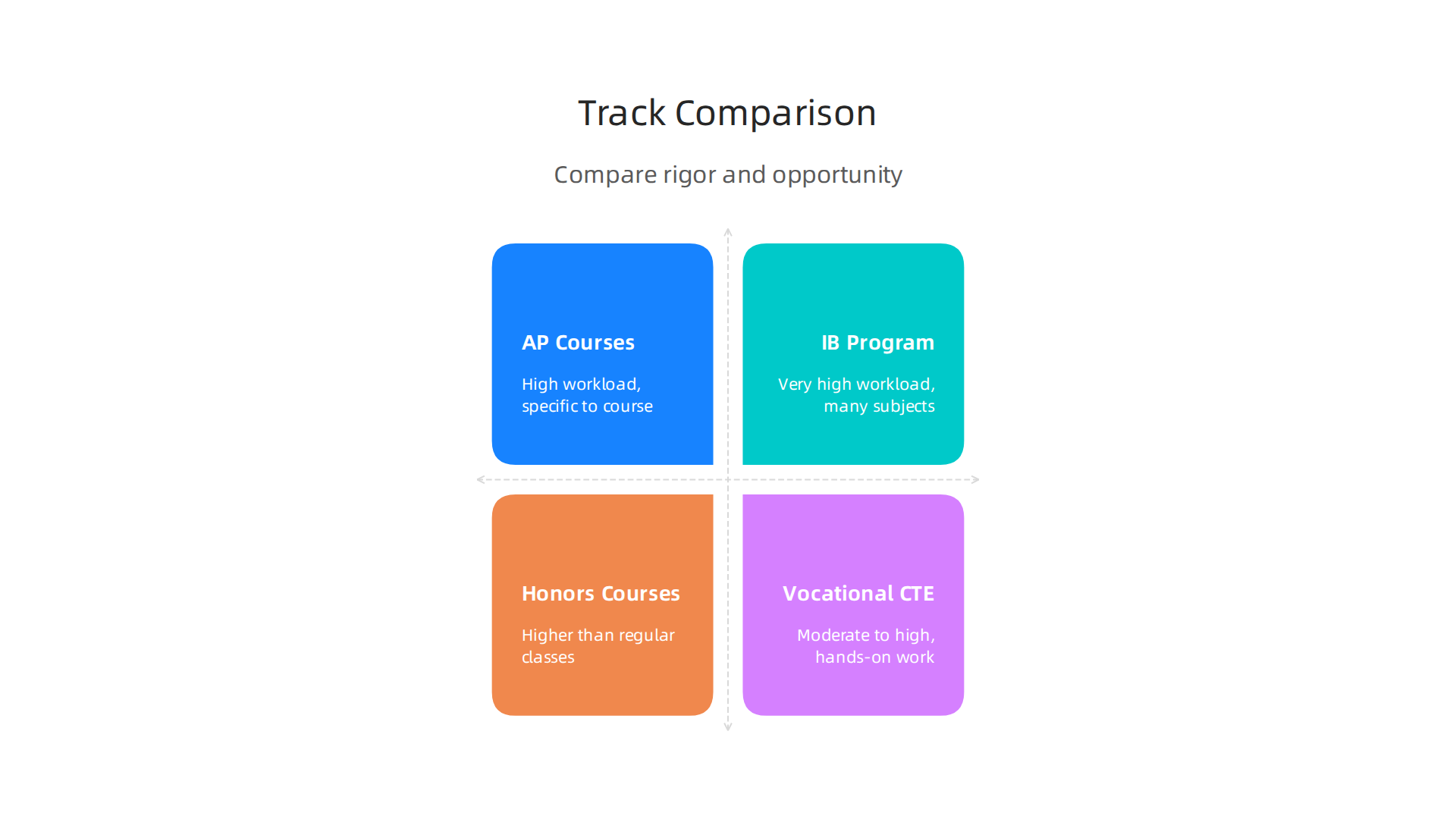
| Feature | AP Courses | IB Program | Honors Courses | Vocational/CTE Tracks |
|---|---|---|---|---|
| Workload | High, specific to each course | Very high, across many subjects | Higher than regular classes, within subjects | Moderate to high, lots of hands-on work |
| Assessment | One big test at end of course | Many tests, papers, and projects over two years | Tests and projects by your high school teacher | Hands-on projects, exams, industry certifications |
| College Credit | Possible with high exam scores | Possible with high exam scores and full diploma | Rarely direct college credit | Rarely direct college credit, but job-specific skills |
| Focus | Deep dive into specific college-level subjects | Broad, critical thinking, global perspective | Deeper learning within standard subjects | Hands-on job skills and career preparation |
| Best For | Students targeting specific college majors | Students wanting a broad, challenging education | Students wanting more academic challenge | Students ready to enter a specific job field |
No matter which path you choose, remember that your high school diploma is a powerful tool. Picking the right one means knowing yourself and your goals. To make the most out of these choices and truly understand their impact, it’s helpful to practice critical thinking. Critical thinking works when judgment holds steady. Make Meaning Practical. Thinking carefully about your options and understanding the long-term impact of your choices can also help you to improve your high school grades with critical thinking and smarter study habits.
Sometimes, the regular path through high school just isn’t the right fit. Maybe you need more flexibility, or you had a tough time and need to catch up. That’s where alternative pathways for earning your high school diploma come in handy. These options can still lead to a bright future, but they work a bit differently than traditional high school programs.
Alternative pathways: online diplomas, early college, GED, and credit recovery
It’s good to know that there are many ways to earn a high school diploma. These alternative paths are great for students who need something different than the usual school setup.
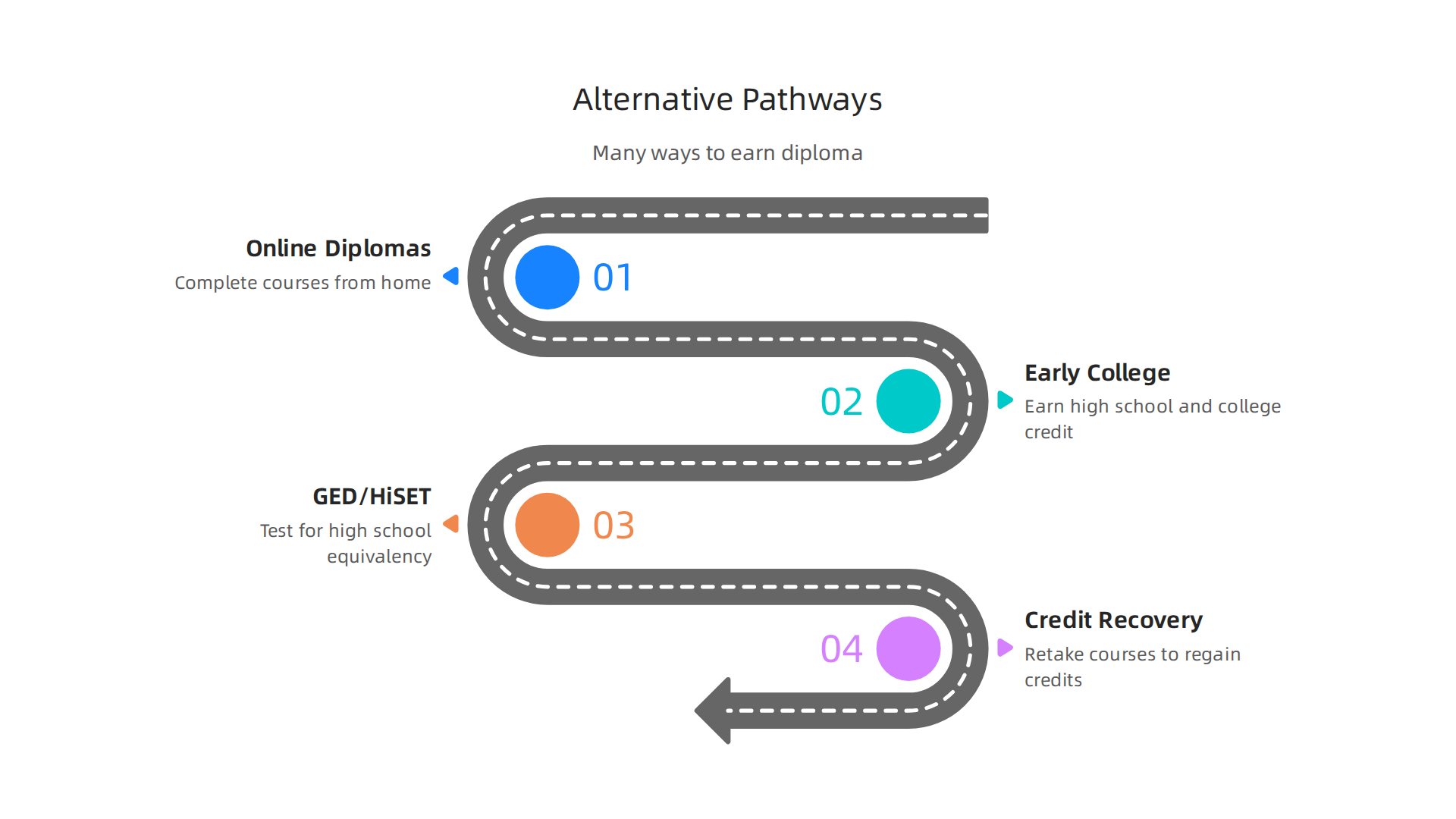
They can help you get back on track or move forward faster.
-
Online Diplomas: Online high schools let you complete your courses from home, at your own speed. This is perfect for students with busy schedules, those who need a quieter learning space, or who live far from a good school. When looking at online schools like Excel High School or Apex Learning, or even options like Florida Virtual School or Wise High, it’s super important to check for accreditation. Accreditation means the school meets certain quality standards, and it’s how colleges and employers know your high school diploma is real and valuable. Without it, your diploma might not be accepted by colleges or other schools you want to attend later High School Alternatives in 2026: Your Decision-Making Guide. Look for schools that are recognized by trusted groups, like regional accrediting bodies. This makes sure your credits can be transferred if you move or decide to attend college. Online learning can also be a great way to embed critical thinking in online school programs.
-
Early College Programs: Imagine starting college while you’re still in high school. That’s what early college programs do. You take college-level classes, often at a local college, and earn both high school and college credit at the same time. This can save you money and time in the long run. It’s a challenging path, usually for students who are ready for higher education earlier.
-
GED (General Educational Development) or HiSET: If you didn’t finish high school, the GED or HiSET tests are ways to show you have the same knowledge as a high school graduate. These tests cover subjects like math, science, social studies, and language arts. Passing them gives you a credential that is often seen as equal to a high school diploma. Many people use these options to open doors for college or better jobs. You can learn more about different choices for getting your Alternative High School Graduation Pathways. Some states even offer special diploma paths for students with disabilities, ensuring everyone has a chance to succeed.
-
Credit Recovery: Sometimes, students fail a class or fall behind on credits needed to graduate. Credit recovery programs let you re-take those classes or earn missing credits in a focused way, often online or in smaller settings. This helps students catch up and still earn their high school diploma with their class.
These pathways are appropriate for many reasons. If a student is struggling in a traditional setting, needs to work to support their family, or has unique learning needs, an alternative path might be best. The credibility of these diplomas usually depends on proper accreditation and how well they prepare you for your next steps. For example, a student named Maria had to move often because of her parents’ jobs. She found it hard to keep up in traditional schools. She chose an accredited online high school, which let her study at her own pace and from anywhere. She not only earned her high school diploma but also learned important self-discipline skills. This made her ready for college, where she continued to do well.
Choosing the right path for your high school diploma means thinking about what works best for you and your future goals. It’s about finding a way to learn that helps you succeed, no matter what challenges you face. For a visual overview, you can check out this helpful video on an Alternative Pathway to a High School Diploma. Thinking critically about these choices can help you pick the best one for you and your future. If you’re wondering how to choose between all these options, learning how to choose the right high school diploma pathway with critical thinking can really help.
Choosing the best way to get your high school diploma is a big step. It’s not just about picking an option, but about making a smart choice that fits your life and future goals. This is where using critical thinking helps a lot. Critical thinking means thinking clearly and carefully about your choices.
Using critical thinking to choose and succeed in a pathway
When you look at different ways to earn your high school diploma, like online schools, early college, or getting your GED, it’s easy to feel lost. But with a few simple critical thinking skills, you can make a good decision.
First, you need to be good at looking at information and spotting if something is trying to trick you.

Evaluating Sources and Spotting Bias in Marketing
Many programs will tell you how great they are. For example, online schools like Excel High School, Apex Learning, Florida Virtual School, or Wise High might highlight all their benefits. But how do you know what’s truly best for you?
- Check the facts: Don’t just believe everything you read. If a program says it’s "the easiest way to get your diploma," ask yourself, "Is it really? Or are they just trying to get me to sign up?" Look for clear facts, like how many students graduate or what colleges accept their diplomas.
- Look for proof: Does the program show you real student stories, not just actors? Do they have solid information about their accreditation? Accreditation is super important because it proves the quality of the program.
- Think about who benefits: When a school advertises, they want you to choose them. This is a natural bias. Your job is to look past the fancy words and see what the program truly offers you. Ask, "What are the downsides they aren’t telling me?"
Framing Trade-Off Questions
Every choice has good parts and not-so-good parts. This is called a trade-off. Using critical thinking means asking questions about these trade-offs.
- If I pick an online program, will I miss out on school friends or sports?
- If I do early college, will I be ready for the harder classes? Or will it be too much pressure?
- If I go for my GED, how will that look to colleges I want to attend? Will it be as helpful as a regular high school diploma?
Asking these kinds of questions helps you think about all sides of a decision.
Expert Tip: Make a Decision Rubric
To make your choice even clearer, you can create a simple decision rubric. A rubric is like a scorecard. Here’s how to make one:
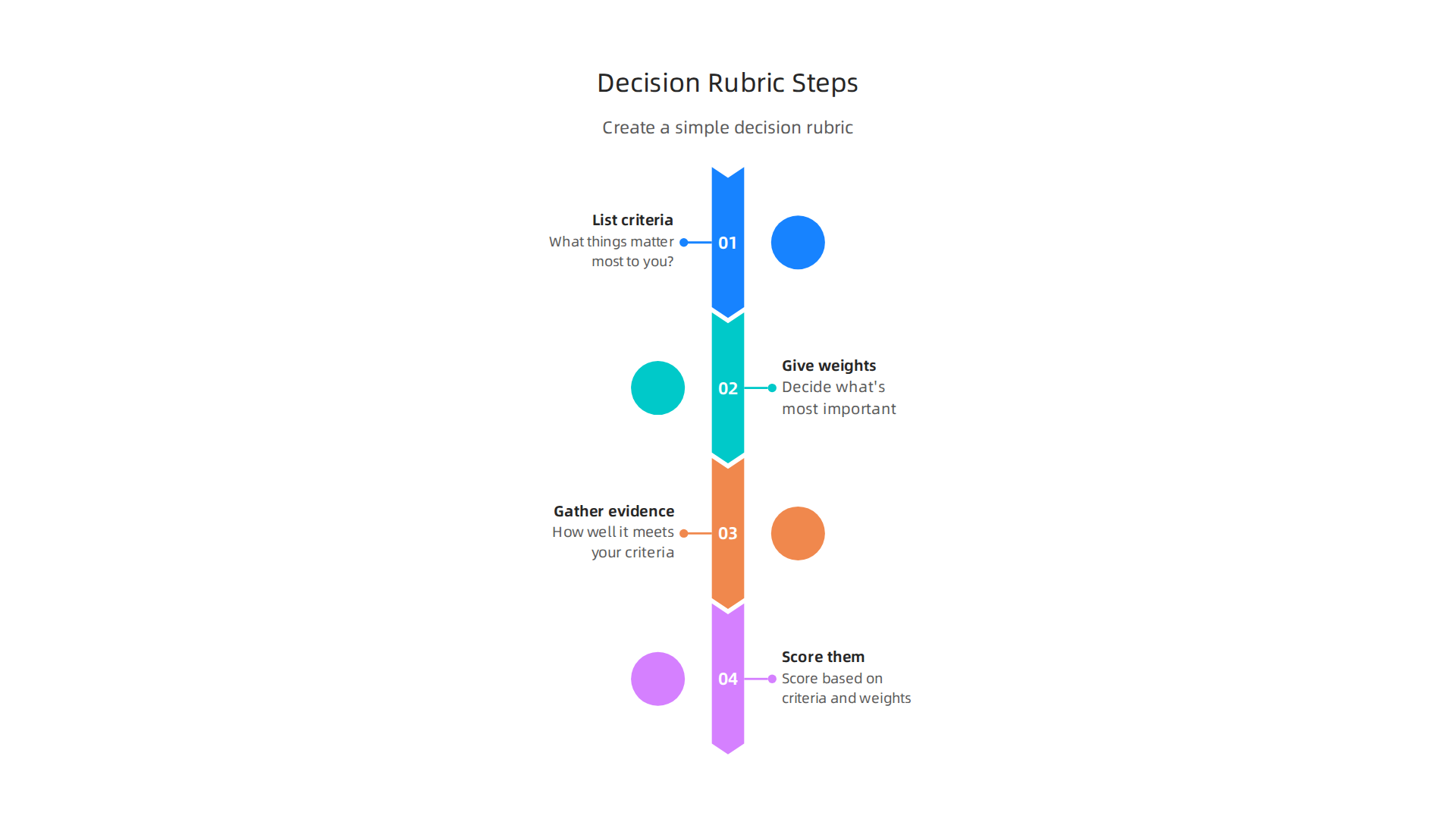
- List your criteria: What things matter most to you? Maybe it’s flexibility, cost, how quickly you can finish, or if you can still play sports.
- Give them weights: Decide what’s most important. For example, if cost is super important, give it more "points" than flexibility.
- Gather evidence: For each pathway, write down how well it meets your criteria.
- Score them: Give each pathway a score based on your criteria and weights.
This simple tool can help you see which option truly stands out for you. Creating such rubrics helps people in many fields think clearly and make good decisions, from education to even understanding how we teach critical thinking skills in schools Development of Critical-Thinking Skills Rubric within the Scope of Multicultural Education.
Using critical thinking doesn’t just help you choose the right path, it also helps you succeed once you’re on it. You’ll be better at solving problems, managing your time, and understanding your schoolwork. To understand more about how these skills work, you might want to learn about What Is Critical Thinking: The 5 Steps and Core Skills Explained.
Critical thinking works when judgment holds steady. For more insights on this, visit Dean Grey’s website.
Once you’ve used critical thinking to pick the best path for your high school diploma, the next important step is to plan how you’ll move forward. It’s like planning a trip. You know your destination, but you still need a map and some supplies! This planning makes sure you succeed and reach your goal.
Planning Transitions and Support: Your Advising Checklist
Getting your high school diploma, whether through a traditional school, an online program like Excel High School or Florida Virtual School, or another pathway, needs a clear plan. Here’s a simple checklist to help you get started:
- Do a Credits Audit: This means looking at all the classes you’ve already taken and the grades you got. Compare this to what you need to graduate. Your school counselor can help you see exactly how many credits you still need for your high school diploma. This is very important for making sure you’re on the right track, especially if you’re switching schools or programs.
- Meet with a Counselor or Advisor: Talk to someone who knows a lot about different high school diploma options.

This person can be a school counselor, an advisor at a program like Apex Learning or Wise High, or even a mentor. They can help you understand all the rules and make sure your plan makes sense. Don’t be shy about asking lots of questions.
- Look into Summer Bridge Programs and Remediation: Sometimes, students need extra help in certain subjects, or they want to get a head start. Summer bridge programs can help you catch up or prepare for tougher classes. If you’re behind in a subject, a remediation plan helps you get the extra support you need to improve. Thinking about these options early can make your journey smoother. For example, some programs teach you how to Embed Critical Thinking In Online School Programs For Holistic Student Growth to help you succeed.
Setting Review Points and Adjusting Your Plan
Your high school diploma journey isn’t a straight line. Life happens, and your goals might change. That’s why it’s smart to plan for check-ins and be ready to adjust.
- Set Regular Review Dates: Mark times on your calendar, maybe every few months, to look at your progress. Are you doing well in your classes? Are you on track to earn your high school diploma when you want to? If you’re in an online program, use their tools to keep track of your performance.
- Be Ready to Adjust: If a class is too hard, or if you find you really love a certain subject, don’t be afraid to change your plan. Maybe you thought you wanted to finish quickly, but now you want to take more time to learn. Or perhaps your goals for after high school have changed. Critical thinking helps you evaluate your situation honestly and make new choices. For instance, many high school graduates are not ready for the workforce, so adapting your plan to gain relevant skills can be key for your future High School Graduates Lack Workforce Readiness: New Report.
- Use Your Support System: If you need to adjust your plan, talk to your counselor, teachers, or family. They can offer advice and help you find new solutions.
Remember, planning is an ongoing process. By regularly checking in and being open to changes, you’ll make sure your path to a high school diploma truly fits your needs and sets you up for future success. This idea of flexible, smart planning is something Dean often shares with his students. Dean, Behavioral Scientist, Tech Entrepreneur & AI Innovator. Co-Inventor, U.S. Patent No. 12,205,176. Senior Lecturer, UC Irvine | Bestselling Author. Founder, Skylab USA.
Summary
Choosing the right high school diploma pathway shapes your next steps—college, career, or both—and the skills you graduate with. This article explains the main diploma types (standard credits, AP/IB/honors, vocational/CTE, and alternative/online options), what each pathway prepares you for, and common trade-offs to consider. It shows why accreditation, course rigor, and evidence of learning matter, and it teaches how to use critical thinking—source evaluation, trade-off framing, and a simple decision rubric—to pick a path that fits your goals. The guide also covers planning: credit audits, advising, remediation options, and regular review points so you can adjust as circumstances change and succeed on your chosen path.